Saw Swee Hock School of Public Health, National University of Singapore, 12 Science Drive 2 #10-01, Tahir Foundation Building, Singapore, 117549, Singapore.
National University Polyclinics, Singapore, 1 Jurong East Street 21, Singapore, 609606, Singapore.
BMC Public Health. 2020 Feb 27;20(1):273. doi: 10.1186/s12889-020-8375-8.
Approximately one-third of all adults worldwide are diagnosed with multiple chronic conditions (MCCs). The literature has identified several challenges facing providers and patients coping with managing MCCs in the community, yet few studies have considered their viewpoints in combination. A qualitative study involving healthcare providers and users was thus conducted to examine facilitators and barriers of managing patients with MCCs in the community in Singapore.
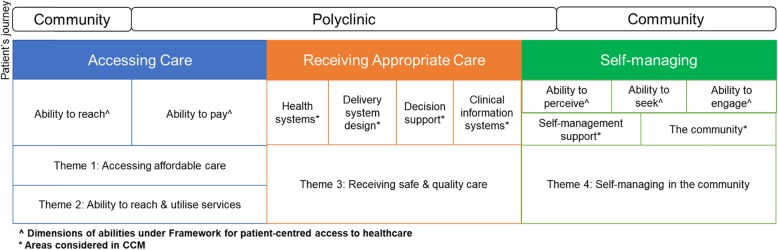
This study involves 26 semi-structured interviews with 10 physicians, 2 caregivers and 14 patients seeking treatment in the polyclinics that provide subsidised primary care services. Topic guides were developed with reference to the literature review, Chronic Care Model (CCM) and framework for patient-centred access to healthcare.
Despite the perceived affordability and availability of the support system, some patients still encountered financial difficulties in managing care. These include inadequacy of the nation-wide medical savings scheme to cover outpatient treatment and medications. Half of healthcare users did not know where to seek help. While patients could access comprehensive services in polyclinics, those who did not visit the clinics might not receive timely care. Furthermore, patients reported long consultation waiting time. Physicians were able to propose and drive quality improvement projects to improve care quality. However, there were challenges to delivering safe and quality care with limited consultation duration due to the need to manage high patient load and waiting time, inadequate communication with specialists to coordinate care, and resource constraints in managing complex patients. Although providers could equip patients with self-management and lifestyle-related guidelines, patients' actions are influenced by multiple factors, including work requirements, beliefs and environment.
There were barriers on care access, delivery and self-management. It is crucial to adopt a whole-of-society approach involving individuals, community, institutions and policymakers to improve and support MCC management. This study has also highlighted the importance of considering the different viewpoints of healthcare providers and users in policy formulation and community care planning.
全球约有三分之一的成年人被诊断患有多种慢性疾病(MCC)。文献已经确定了在社区中管理 MCC 的提供者和患者面临的一些挑战,但很少有研究综合考虑他们的观点。因此,进行了一项涉及医疗保健提供者和使用者的定性研究,以检查在新加坡社区中管理患有 MCC 的患者的促进因素和障碍。
本研究涉及 26 名接受过补贴初级保健服务的综合诊疗所治疗的 10 名医生、2 名护理人员和 14 名患者的半结构化访谈。主题指南是根据文献综述、慢性病护理模式(CCM)和以患者为中心获得医疗保健的框架制定的。
尽管患者认为支持系统负担得起且可获得,但一些患者在管理护理方面仍遇到经济困难。这些困难包括全国性医疗储蓄计划不足以支付门诊治疗和药物费用。一半的医疗保健使用者不知道在哪里寻求帮助。虽然患者可以在综合诊疗所获得全面服务,但那些不去诊所就诊的患者可能无法及时获得治疗。此外,患者报告了漫长的咨询等待时间。医生能够提出并推动质量改进项目以提高护理质量。然而,由于需要管理高患者负荷和等待时间、与专家沟通不足以协调护理以及资源有限来管理复杂患者,因此在提供安全和高质量的护理方面存在挑战。尽管提供者可以为患者提供自我管理和与生活方式相关的指南,但患者的行动受到多种因素的影响,包括工作要求、信念和环境。
在护理获得、提供和自我管理方面存在障碍。采用涉及个人、社区、机构和政策制定者的全社会方法来改善和支持 MCC 管理至关重要。本研究还强调了在制定政策和社区护理计划时考虑医疗保健提供者和患者不同观点的重要性。