Collaborative Innovation Center for the Diagnosis and Treatment of Infectious Diseases, State Key Laboratory for the Diagnosis and Treatment of Infectious Diseases, The First Affiliated Hospital, School of Medicine, Zhejiang University, Hangzhou, China.
National Clinical Research Center for Infectious Diseases, The First Affiliated Hospital, School of Medicine, Zhejiang University, Hangzhou, Zhejiang, People's Republic of China.
Stem Cell Res Ther. 2020 Feb 27;11(1):88. doi: 10.1186/s13287-020-01596-9.
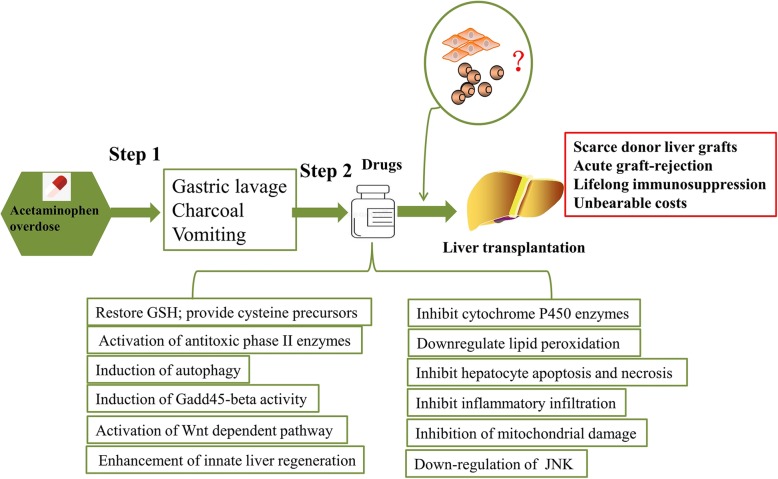
Acetaminophen (APAP)-induced injury is a common clinical phenomenon that not only occurs in a dose-dependent manner but also occurs in some idiosyncratic individuals in a dose-independent manner. APAP overdose generally results in acute liver injury via the initiation of oxidative stress, endoplasmic reticulum (ER) stress, autophagy, liver inflammation, and microcirculatory dysfunction. Liver transplantation is the only effective strategy for treating APAP-induced liver failure, but liver transplantation is inhibited by scarce availability of donor liver grafts, acute graft rejection, lifelong immunosuppression, and unbearable costs. Currently, N-acetylcysteine (NAC) effectively restores liver functions early after APAP intake, but it does not protect against APAP-induced injury at the late stage. An increasing number of animal studies have demonstrated that mesenchymal stem cells (MSCs) significantly attenuate acute liver injury through their migratory capacity, hepatogenic differentiation, immunoregulatory capacity, and paracrine effects in acute liver failure (ALF). In this review, we comprehensively discuss the mechanisms of APAP overdose-induced liver injury and current therapies for treating APAP-induced liver injury. We then comprehensively summarize recent studies about transplantation of MSC and MSC derivatives for treating APAP-induced liver injury. We firmly believe that MSCs and their derivatives will effectively promote liver regeneration and liver injury repair in APAP overdose-treated animals and patients. To this end, MSC-based therapies may serve as an effective strategy for patients who are waiting for liver transplantation during the early and late stages of APAP-induced ALF in the near future.
对乙酰氨基酚(APAP)诱导的损伤是一种常见的临床现象,不仅以剂量依赖性方式发生,而且在某些特发性个体中以剂量非依赖性方式发生。APAP 过量通常通过引发氧化应激、内质网(ER)应激、自噬、肝炎症和微循环功能障碍导致急性肝损伤。肝移植是治疗 APAP 诱导的肝衰竭的唯一有效策略,但由于供体肝移植物稀缺、急性移植物排斥、终身免疫抑制和难以承受的成本,肝移植受到抑制。目前,N-乙酰半胱氨酸(NAC)在 APAP 摄入后早期有效恢复肝功能,但不能在晚期预防 APAP 诱导的损伤。越来越多的动物研究表明,间充质干细胞(MSCs)通过其迁移能力、肝生成分化、免疫调节能力和急性肝衰竭(ALF)中的旁分泌作用,显著减轻急性肝损伤。在这篇综述中,我们全面讨论了 APAP 过量诱导的肝损伤的机制和目前治疗 APAP 诱导的肝损伤的方法。然后,我们全面总结了关于 MSC 移植治疗 APAP 诱导的肝损伤的最新研究。我们坚信,MSCs 及其衍生物将有效地促进 APAP 过量治疗的动物和患者的肝再生和肝损伤修复。为此,MSC 为基础的治疗方法可能成为 APAP 诱导的 ALF 早期和晚期等待肝移植患者的有效策略。