Department of Psychological Medicine, Institute of Psychiatry, Psychology & Neuroscience, King's College London, London, UK; Wellcome Trust Centre for Neuroimaging, University College London, London, UK; Max Planck UCL Centre for Computational Psychiatry and Ageing Research, London, UK; Department of Humanities and Social Sciences, California Institute of Technology, Pasadena, California.
Department of Psychological Medicine, Institute of Psychiatry, Psychology & Neuroscience, King's College London, London, UK; Department of Neuroimaging, Institute of Psychiatry, Psychology & Neuroscience, King's College London, London, UK.
Biol Psychiatry. 2020 May 15;87(10):908-915. doi: 10.1016/j.biopsych.2019.12.013. Epub 2020 Jan 8.
Generalized anxiety disorder is associated with hyperactivity in the amygdala-prefrontal networks, and normalization of this aberrant function is thought to be critical for successful treatment. Preclinical evidence implicates cholinergic neurotransmission in the function of these systems and suggests that cholinergic modulation may have anxiolytic effects. However, the effects of cholinergic modulators on the function of anxiety-related networks in humans have not been investigated.
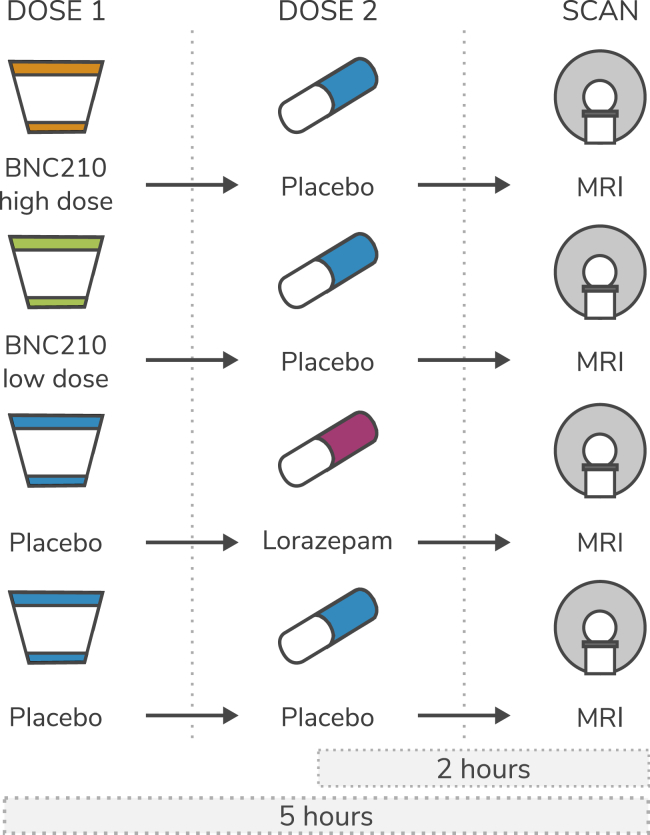
We administered a novel α7 nicotinic acetylcholine receptor-negative allosteric modulator, BNC210, to 24 individuals (3 male subjects) with generalized anxiety disorder and assessed its effects on neural responses to fearful face stimuli.
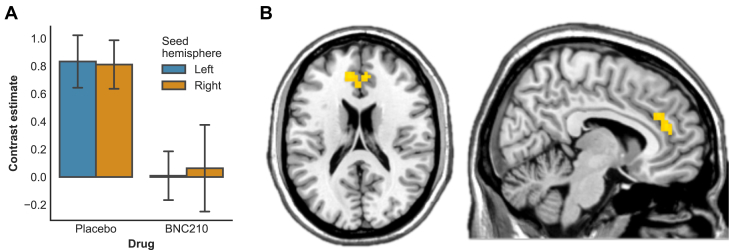
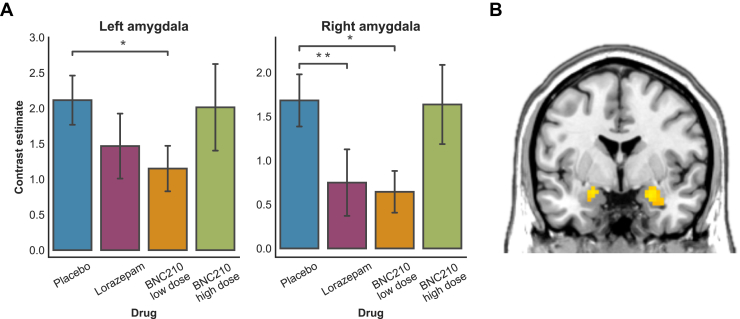
BNC210 reduced amygdala reactivity to fearful faces relative to placebo and similarly to lorazepam and also reduced connectivity between the amygdala and the anterior cingulate cortex, a network involved in regulating anxious responses to aversive stimuli.
These results demonstrate for the first time that the function of disorder-relevant neural circuits in generalized anxiety disorder can be beneficially altered through modulation of cholinergic neurotransmission and suggest potential for this system as a novel target for anxiolytic pharmacotherapy.
广泛性焦虑障碍与杏仁核-前额叶网络的过度活跃有关,而这种异常功能的正常化被认为是成功治疗的关键。临床前证据表明胆碱能神经传递在这些系统的功能中起作用,并表明胆碱能调节可能具有抗焦虑作用。然而,胆碱能调节剂对人类与焦虑相关网络功能的影响尚未得到研究。
我们给 24 名(3 名男性受试者)患有广泛性焦虑症的个体施用了一种新型的α7 烟碱型乙酰胆碱受体负变构调节剂 BNC210,并评估了它对恐惧面孔刺激的神经反应的影响。
BNC210 降低了杏仁核对恐惧面孔的反应性,相对于安慰剂和劳拉西泮也降低了杏仁核与前扣带回皮层之间的连接,前扣带回皮层是一个参与调节对厌恶刺激的焦虑反应的网络。
这些结果首次证明,通过调节胆碱能神经传递,可以有益地改变广泛性焦虑障碍中与疾病相关的神经回路的功能,并表明该系统有潜力成为新型抗焦虑药物治疗的靶点。