Centro de Investigación Biomédica en Red in Respiratory Diseases (CIBERES), Plataforma Biobanco Pulmonar CIBERES, Hospital Universitari Son Espases, Palma, Spain.
Grupo de Inflamación, reparación y cáncer en enfermedades respiratorias, Institut d'Investigació Sanitària de les Illes Balears (IdISBa), Hospital Universitari Son Espases, Palma, Spain.
Sci Rep. 2020 Feb 27;10(1):3579. doi: 10.1038/s41598-020-60618-x.
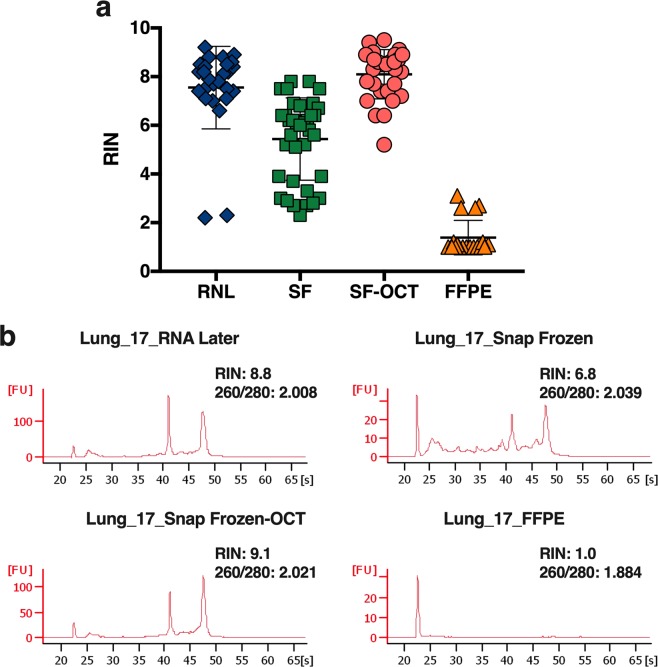
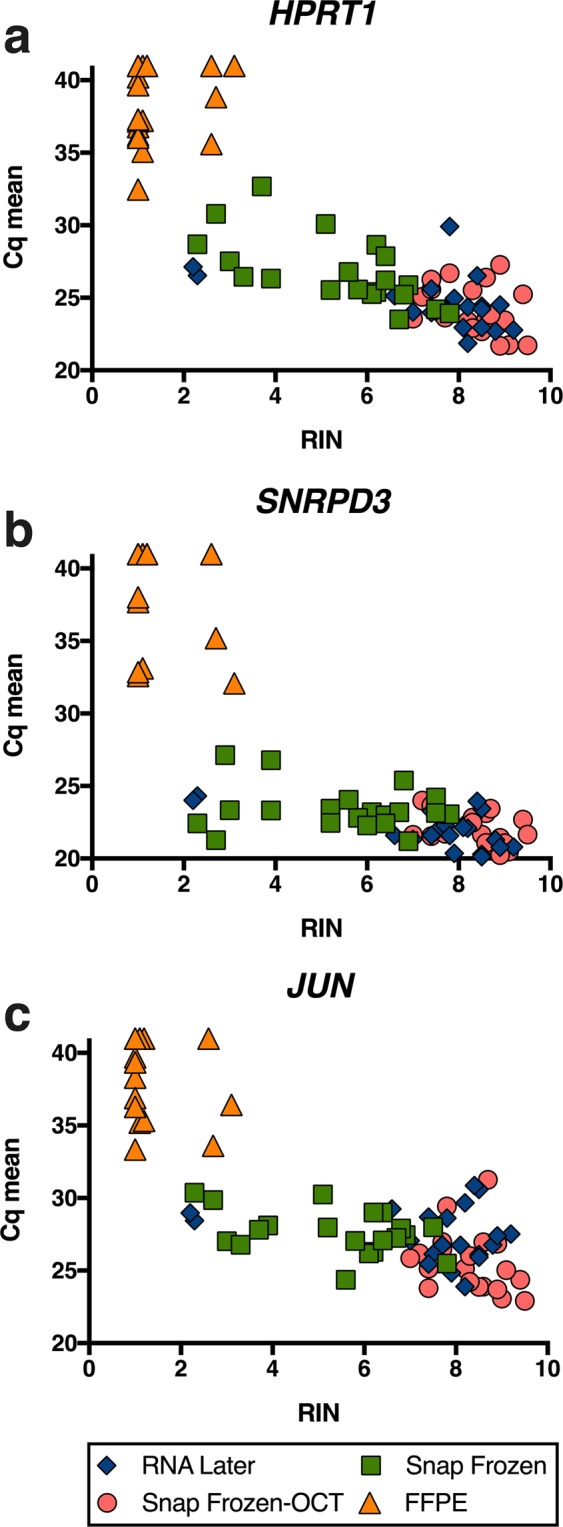
Aiming to increase the reproducibility of biomedical research results, biobanks obtain human tissues of the highest quality and carry out different storage methods adapted to the needs of analytical technique to be performed by the biomedical researchers. However, there is much controversy and little data concerning the real impact of different stabilization methods on tissue quality, integrity and functionality of derived biomolecules. The influence of four stabilization methods [RNAlater (RNL), snap freezing (SF), snap freezing using Optimal Cutting Tissue compound (SF-OCT) and formalin-fixed paraffin-embedded (FFPE)] on RNA quality and integrity was evaluated in paired samples of lung tissue. RNA integrity was evaluated through PCR-endpoint assays amplifying six fragments of different length of the HPRT1 gene and RNA Integrity Number (RIN). To evaluate the difference of tissue functionality among the stabilization methods tested, RT-qPCRs were performed focusing on the differential expression of the HPRT1, SNRPD3 and Jun genes. RNA from the samples preserved with the RNL or SF-OCT method showed better integrity compared to SF and FFPE, measured by PCR-endpoint and RT-qPCR assays. However, only statistically significant differences were observed between the RNA from FFPE and other stabilization methods when gene expression of HPRT1, SNRPD3 and Jun housekeeping genes were determined by RT-qPCR. For the three mentioned genes, Cq and RIN values were highly correlated. The present work describes the fragility of SF samples, being critical the moment just before RNA extraction, although further experiments of tissue RNA are needed. Standardization pre-analytic workflow can lead to improved reproducibility between biomedical research studies. The present study demonstrated clear evidences about the impact of the stabilization method on RNA derived from lung human tissue samples.
为了提高生物医学研究结果的可重复性,生物银行获取最高质量的人体组织,并采用不同的储存方法,以适应生物医学研究人员将要进行的分析技术的需求。然而,关于不同稳定化方法对组织质量、完整性和衍生生物分子功能的实际影响存在很多争议和很少的数据。本研究评估了四种稳定化方法[RNAlater(RNL)、快速冷冻(SF)、使用最佳切割组织化合物的快速冷冻(SF-OCT)和福尔马林固定石蜡包埋(FFPE)]对肺组织配对样本中 RNA 质量和完整性的影响。通过扩增 HPRT1 基因不同长度的 6 个片段的 PCR 终点分析和 RNA 完整性数(RIN)评估 RNA 完整性。为了评估所测试的稳定化方法之间组织功能的差异,进行了 RT-qPCR,重点关注 HPRT1、SNRPD3 和 Jun 基因的差异表达。与 SF 和 FFPE 相比,用 RNL 或 SF-OCT 方法保存的样本中的 RNA,通过 PCR 终点和 RT-qPCR 分析显示出更好的完整性。然而,只有当通过 RT-qPCR 确定 HPRT1、SNRPD3 和 Jun 管家基因的基因表达时,才观察到 FFPE 与其他稳定化方法之间的 RNA 存在统计学上的显著差异。对于这三个提到的基因,Cq 和 RIN 值高度相关。本工作描述了 SF 样本的脆弱性,在 RNA 提取之前的那一刻是关键的,尽管还需要进一步的组织 RNA 实验。标准化的预分析工作流程可以提高生物医学研究之间的可重复性。本研究清楚地证明了稳定化方法对人肺组织样本衍生 RNA 的影响。