Department of Medical Oncology and Haematology, Cantonal Hospital St. Gallen, Rorschacherstrasse 95, 9007, St. Gallen, Switzerland.
SAKK Coordinating Center, Bern, Switzerland.
BMC Cancer. 2020 Feb 28;20(1):166. doi: 10.1186/s12885-020-6623-z.
High rates of venous thromboembolic events (VTEs), mainly in advanced disease, are reported for patients with cancer of the upper gastrointestinal tract (stomach, pancreas) and for treatment with cisplatin.
Exploratory analysis of VTEs reported as adverse events and serious adverse events in a prospective, randomised, multicentre, multimodal phase III trial according to VTEs reported as adverse events and severe adverse events. Patients with resectable oesophageal cancer (T2N1-3, T3-4aNx) were randomized to 2 cycles of chemotherapy with docetaxel 75 mg/m, cisplatin 75 mg/m followed by chemo-radiotherapy (CRT) and subsequent surgery (control arm) or the same treatment with addition of cetuximab (investigational arm).
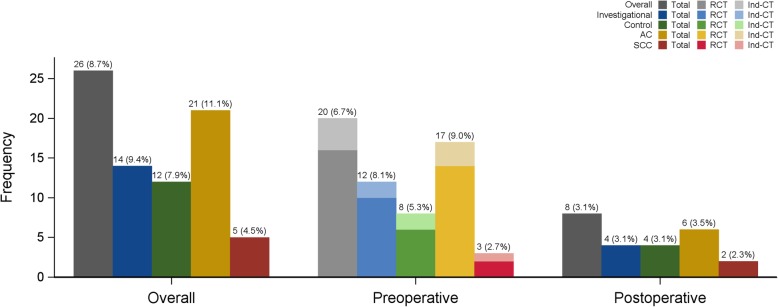
VTEs occurred in 26 of 300 patients included in the trial, resulting in an incidence rate (IR) of 8.7% [95% CI 5.7-12.4%]. A total of 29 VTEs were reported:13 (45%) VTEs were grade 2, 13 (45%) grade 3 and three (10%) fatal grade 5 events. 72% (21/29) of all VTEs occurred preoperatively (IR 6.7%): 14% (4/29) during chemotherapy and 59% (17/29) during CRT. In multivariable logistic regression only adenocarcinoma (IR 11.1%, 21/189 patients) compared to squamous cell cancer (IR 4.5%, 5/111 patients) was significantly associated with VTE-risk during treatment, OR 2.9 [95%CI 1.0-8.4], p = 0.046. Baseline Khorana risk score was 0 in 73% (19/26), 1-2 in 23% (6/26) and 3 in only 4% (1/26) of patients with VTEs.
A high incidence of VTEs during preoperative therapy of resectable oesophageal cancer is observed in this analysis, especially in patients with adenocarcinoma. The role of prophylactic anticoagulation during neoadjuvant therapy in resectable esophageal cancer should be further evaluated in prospective clinical trials. According to our data, which are in line with other analysis of VTE-risk in patients with oesophageal cancer patients treated with neoadjuvant cisplatin-based chemotherapy and CRT, prophylactic anticoagluation could be considered balanced against individual bleeding risks, especially in patients with adenocarcinoma. In addition to the established risk factors, oesophageal adenocarcinoma treated with neoadjuvant cisplatin-based therapy may be regarded as a high-risk situation for VTEs.
Registered at clinicaltrials.gov, NCT01107639, on 21 April 2010.
在上消化道(胃、胰腺)癌症患者中,以及在使用顺铂治疗时,报告了较高的静脉血栓栓塞事件(VTE)发生率,主要是晚期疾病。
根据 VTE 作为不良事件和严重不良事件的报告,对一项前瞻性、随机、多中心、多模式 III 期试验中报告的 VTE 进行探索性分析。可切除的食管癌症(T2N1-3、T3-4aNx)患者随机分为两组:两组均接受多西紫杉醇 75mg/m2 和顺铂 75mg/m2 化疗 2 个周期,然后进行化疗放疗(CRT)和随后的手术(对照组)或相同的治疗加西妥昔单抗(实验组)。
试验纳入的 300 例患者中有 26 例发生 VTE,发生率为 8.7%[95%CI 5.7-12.4%]。共报告了 29 例 VTE:13 例(45%)为 2 级,13 例(45%)为 3 级,3 例(10%)为致命的 5 级事件。所有 VTE 中,72%(21/29)发生在术前(IR6.7%):14%(4/29)在化疗期间,59%(17/29)在 CRT 期间。多变量逻辑回归仅发现腺癌(IR11.1%,189 例患者中有 21 例)与鳞状细胞癌(IR4.5%,111 例患者中有 5 例)相比,在治疗期间与 VTE 风险显著相关,OR2.9[95%CI1.0-8.4],p=0.046。VTE 患者的基线 Khorana 风险评分 0 占 73%(19/26),1-2 占 23%(6/26),仅 4%(1/26)为 3 分。
本分析发现,可切除食管癌症患者术前治疗期间 VTE 发生率较高,尤其是腺癌患者。在可切除的食管癌新辅助治疗中预防性抗凝的作用应在前瞻性临床试验中进一步评估。根据我们的数据,与其他新辅助顺铂化疗和 CRT 治疗食管癌症患者 VTE 风险分析一致,预防性抗凝治疗可以与个体出血风险平衡,特别是在腺癌患者中。除了已确定的危险因素外,接受新辅助顺铂治疗的食管腺癌可能被视为 VTE 的高危情况。
于 2010 年 4 月 21 日在 clinicaltrials.gov 注册,NCT01107639。