Faculty of Health Science and Medicine and.
Menzies Health Institute, Griffith University, Brisbane, Queensland, Australia.
Clin J Am Soc Nephrol. 2020 Mar 6;15(3):330-340. doi: 10.2215/CJN.12341019. Epub 2020 Feb 28.
The dietary self-management of CKD is challenging. Telehealth interventions may provide an effective delivery method to facilitate sustained dietary change.
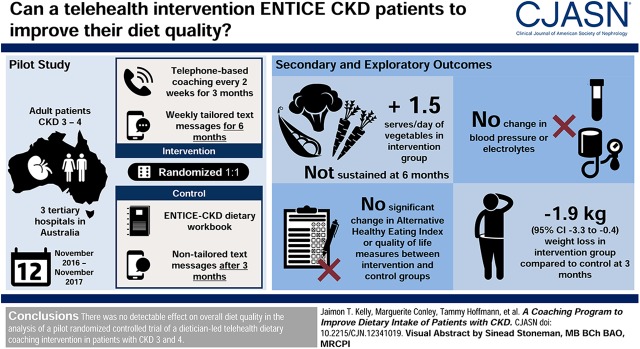
DESIGN, SETTING, PARTICIPANTS, & MEASUREMENTS: This pilot, randomized, controlled trial evaluated secondary and exploratory outcomes after a dietitian-led telehealth coaching intervention to improve diet quality in people with stage 3-4 CKD. The intervention group received phone calls every 2 weeks for 3 months (with concurrent, tailored text messages for 3 months), followed by 3 months of tailored text messages without telephone coaching, to encourage a diet consistent with CKD guidelines. The control group received usual care for 3 months, followed by nontailored, educational text messages for 3 months.
Eighty participants (64% male), aged 62±12 years, were randomized to the intervention or control group. Telehealth coaching was safe, with no adverse events or changes to serum biochemistry at any time point. At 3 months, the telehealth intervention, compared with the control, had no detectable effect on overall diet quality on the Alternative Health Eating Index (3.2 points, 95% confidence interval, -1.3 to 7.7), nor at 6 months (0.5 points, 95% confidence interval, -4.6 to 5.5). There was no change in clinic BP at any time point in any group. There were significant improvements in several exploratory diet and clinical outcomes, including core food group consumption, vegetable servings, fiber intake, and body weight.
Telehealth coaching was safe, but appeared to have no effect on the Alternative Healthy Eating Index or clinic BP. There were clinically significant changes in several exploratory diet and clinical outcomes, which require further investigation.
Evaluation of Individualized Telehealth Intensive Coaching to Promote Healthy Eating and Lifestyle in CKD (ENTICE-CKD), ACTRN12616001212448.
慢性肾脏病(CKD)患者的饮食自我管理具有挑战性。远程医疗干预可能是一种有效的提供方法,以促进持续的饮食改变。
设计、地点、参与者和测量:这项先导、随机、对照试验评估了营养师主导的远程健康教练干预对 3-4 期 CKD 患者改善饮食质量的次要和探索性结果。干预组每 2 周接受一次电话随访,持续 3 个月(同时接受 3 个月的个性化短信),以鼓励患者遵循 CKD 指南进行饮食。对照组在 3 个月内接受常规护理,然后接受非个性化的教育短信 3 个月。
80 名参与者(64%为男性),年龄 62±12 岁,被随机分配到干预组或对照组。远程健康教练是安全的,在任何时间点都没有不良反应或血清生化变化。在 3 个月时,与对照组相比,远程健康干预对整体饮食质量的替代健康饮食指数(3.2 分,95%置信区间,-1.3 至 7.7)没有可检测到的影响,6 个月时也没有影响(0.5 分,95%置信区间,-4.6 至 5.5)。任何组的诊所血压在任何时间点都没有变化。在一些探索性的饮食和临床结果方面有显著改善,包括核心食物组的消费、蔬菜份数、纤维摄入量和体重。
远程健康教练是安全的,但似乎对替代健康饮食指数或诊所血压没有影响。在一些探索性的饮食和临床结果方面有显著的变化,这需要进一步研究。
评估个体化远程健康强化教练以促进 CKD 患者的健康饮食和生活方式(ENTICE-CKD),ACTRN12616001212448。