
猪肝分解产物衍生的溶血磷脂促进体外小胶质细胞活化。
Porcine liver decomposition product-derived lysophospholipids promote microglial activation in vitro.
机构信息
Department of Pharmacology and Therapeutic Innovation, Nagasaki University Graduate School of Biomedical Sciences, 1-14 Bunkyo-machi, Nagasaki, 852-8521, Japan.
Institute for Biomedical Sciences, Shinshu University Interdisciplinary Cluster for Cutting Edge Research 3-1-1 Asahi, Matsumoto, Nagano, 390-8621, Japan.
出版信息
Sci Rep. 2020 Feb 28;10(1):3748. doi: 10.1038/s41598-020-60781-1.
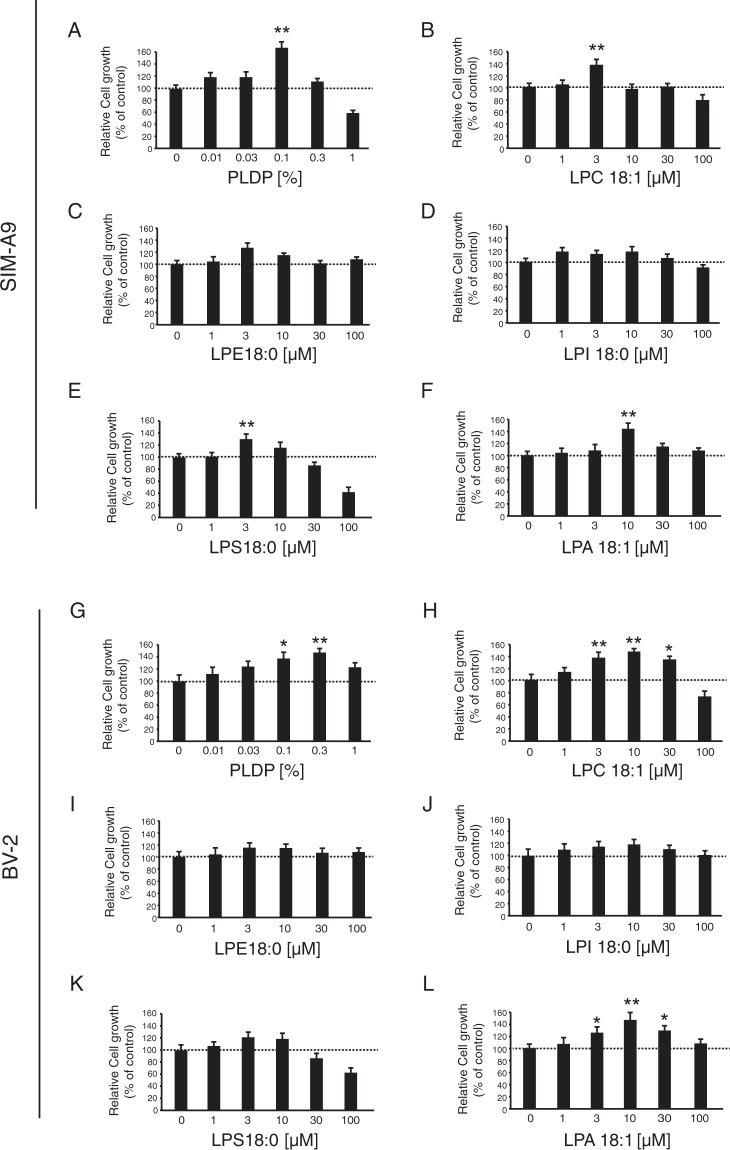
Cognitive impairments such as dementia are common in later life, and have been suggested to occur via a range of mechanisms, including oxidative stress, age-related changes to cellular metabolism, and a loss of phospholipids (PLs) from neuronal membranes. PLs are a class of amphipathic lipids that form plasma membrane lipid bilayers, and that occur at high concentrations in neuronal membranes. Our previous study suggested that a porcine liver decomposition product (PLDP) produced via protease treatment may improve cognitive function at older ages, by acting as a rich source of PLs and lysophospholipids (LPLs); however, its specific composition remains unclear. Thus, the present study used a novel liquid chromatography electrospray ionization tandem mass spectrometric (LC-MS/MS) protocol to identify the major PLs and LPLs in PLDP. Furthermore, it assessed the effect of identified LPLs on microglial activation in vitro, including cell shape, proliferation, and cell morphology. The results of the conducted analyses showed that PLDP and PLDP-derived LPLs concentration-dependently modulate microglial activation in vitro. In particular, lysophosphatidylcholine (LPC) concentration-dependently promotes cell morphology, likely via effects mediated by the enzyme autotaxin (ATX), since inhibiting ATX also promoted cell morphology, while conversely, increasing ATX production (via treatment with high levels of LPC) abolished this effect. These findings suggest that LPC is likely neuroprotective, and thus, support the importance of further research to assess its use as a therapeutic target to treat age-related cognitive impairments, including dementia.
认知障碍,如痴呆,在晚年很常见,据推测,其发生机制包括氧化应激、细胞代谢的年龄相关性变化以及神经元膜磷脂(PLs)的丧失。PLs 是一类两亲性脂质,构成质膜脂双层,并且在神经元膜中浓度很高。我们之前的研究表明,通过蛋白酶处理产生的猪肝脏分解产物(PLDP)可能通过充当 PL 和溶血磷脂(LPL)的丰富来源来改善老年时的认知功能;然而,其具体成分仍不清楚。因此,本研究使用新型液相色谱电喷雾串联质谱(LC-MS/MS)方案来鉴定 PLDP 中的主要 PL 和 LPL。此外,它评估了鉴定出的 LPL 对体外小胶质细胞激活的影响,包括细胞形状、增殖和细胞形态。进行的分析结果表明,PLDP 和 PLDP 衍生的 LPL 浓度依赖性地调节体外小胶质细胞激活。特别是,溶血磷脂酰胆碱(LPC)浓度依赖性地促进细胞形态,可能通过自分泌酶(ATX)介导的作用,因为抑制 ATX 也促进细胞形态,而相反,增加 ATX 产生(通过用高浓度的 LPC 处理)则消除了这种作用。这些发现表明 LPC 可能具有神经保护作用,因此,支持进一步研究其作为治疗与年龄相关的认知障碍(包括痴呆症)的治疗靶点的重要性。




 Zotero 插件