Department of Public Health and Policy, University of Liverpool, Liverpool, UK.
Department of Public Health and Policy, University of Liverpool, Liverpool, UK.
Lancet Public Health. 2020 Mar;5(3):e157-e164. doi: 10.1016/S2468-2667(20)30026-8.
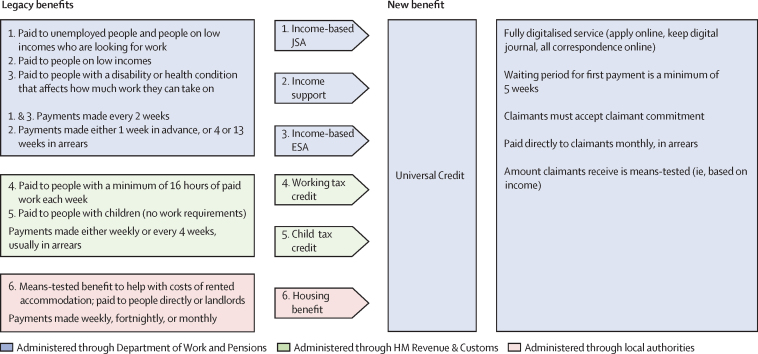
Universal Credit, a welfare benefit reform in the UK, began to replace six existing benefit schemes in April, 2013, starting with the income-based Job Seekers Allowance. We aimed to determine the effects on mental health of the introduction of Universal Credit.
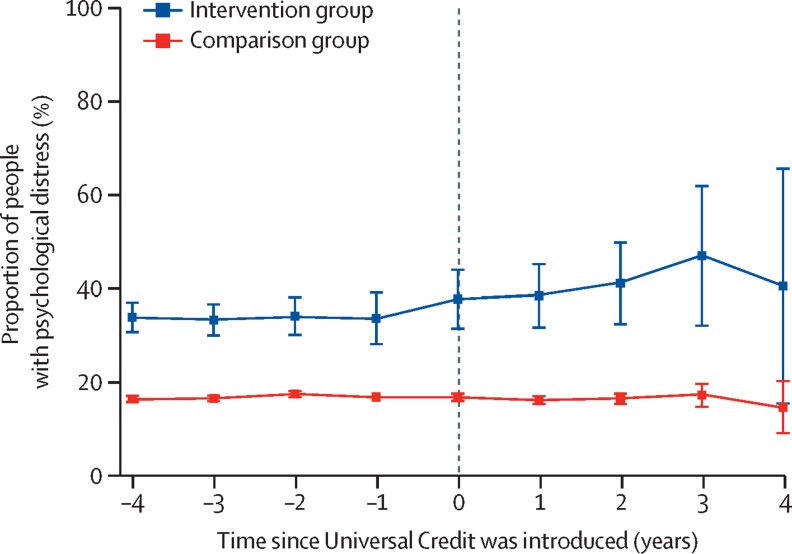
In this longitudinal controlled study, we linked 197 111 observations from 52 187 individuals of working age (16-64 years) in England, Wales, and Scotland who participated in the Understanding Society UK Longitudinal Household Panel Study between 2009 and 2018 with administrative data on the month when Universal Credit was introduced into the area in which each respondent lived. We included participants who had data on employment status, local authority area of residence, psychological distress, and confounding variables. We excluded individuals from Northern Ireland and people out of work with a disability. We used difference-in-differences analysis of this nationally representative, longitudinal, household survey and separated respondents into two groups: unemployed people who were eligible for Universal Credit (intervention group) and people who were not unemployed and therefore would not have generally been eligible for Universal Credit (comparison group). Using the phased roll-out of Universal Credit, we compared the change in psychological distress (self-reported via General Health Questionnaire-12) between the intervention group and the comparison group over time as the reform was introduced in the area in which each respondent lived. We defined clinically significant psychological distress as a score of greater than 3 on the General Health Questionnaire-12. We tested whether there were differential effects across subgroups (age, sex, and education).
The prevalence of psychological distress increased in the intervention group by 6·57 percentage points (95% CI 1·69-11·42) after the introduction of Universal Credit relative to the comparison group, after accounting for potential confounders. We estimate that between April 29, 2013, and Dec 31, 2018, an additional 63 674 (95% CI 10 042-117 307) unemployed people will have experienced levels of psychological distress that are clinically significant due to the introduction of Universal Credit; 21 760 of these individuals might reach the diagnostic threshold for depression.
Our findings suggest that the introduction of Universal Credit led to an increase in psychological distress, a measure of mental health difficulties, among those affected by the policy. Future changes to government welfare systems should be evaluated not only on a fiscal basis but on their potential to affect health and wellbeing.
Wellcome Trust, UK National Institute for Health Research, and Medical Research Council.
英国的福利改革“通用信贷”于 2013 年 4 月开始取代六种现有福利计划,首先是基于收入的求职者津贴。我们旨在确定通用信贷的引入对心理健康的影响。
在这项纵向对照研究中,我们将英格兰、威尔士和苏格兰 52187 名 16-64 岁工作年龄人群的 1971111 次观察结果与行政管理数据相联系,这些人参加了 2009 年至 2018 年期间的“英国社会动态调查”,了解每个受访者居住地区通用信贷的引入月份。我们纳入了就业状况、地方当局居住地区、心理困扰和混杂变量方面的数据的参与者。我们排除了北爱尔兰的个人和有残疾但失业的人。我们使用差异差异分析对这项全国代表性的纵向家庭调查进行分析,并将受访者分为两组:有资格获得通用信贷的失业者(干预组)和那些没有失业,因此通常没有资格获得通用信贷的人(对照组)。利用通用信贷的分阶段推出,我们比较了随着改革在受访者居住的地区推出,干预组和对照组在时间上心理困扰(通过一般健康问卷-12 自我报告)的变化。我们将一般健康问卷-12 的得分大于 3 定义为临床显著的心理困扰。我们检验了是否存在亚组(年龄、性别和教育程度)的差异效应。
在考虑了潜在混杂因素后,与对照组相比,在引入通用信贷后,干预组的心理困扰增加了 6.57 个百分点(95%CI,1.69-11.42)。我们估计,2013 年 4 月 29 日至 2018 年 12 月 31 日期间,由于引入通用信贷,将有额外的 63674 名(95%CI,10042-117307)失业者经历临床显著的心理困扰水平;其中 21760 人可能达到抑郁诊断标准。
我们的研究结果表明,通用信贷的引入导致受政策影响的人的心理健康困难程度增加,这是衡量心理健康的一种指标。未来政府福利制度的改革不仅应在财政基础上进行评估,还应评估其对健康和福利的潜在影响。
惠康信托基金会、英国国家卫生研究院和医学研究理事会。