Cancer Genome Research Center, Chang Gung Memorial Hospital at Linkou, Gueishan Dist., Taoyuan, 333, Taiwan.
Institute of Cellular and Organismic Biology, Academia Sinica, Taipei, 115, Taiwan.
J Biomed Sci. 2020 Mar 2;27(1):39. doi: 10.1186/s12929-020-00632-3.
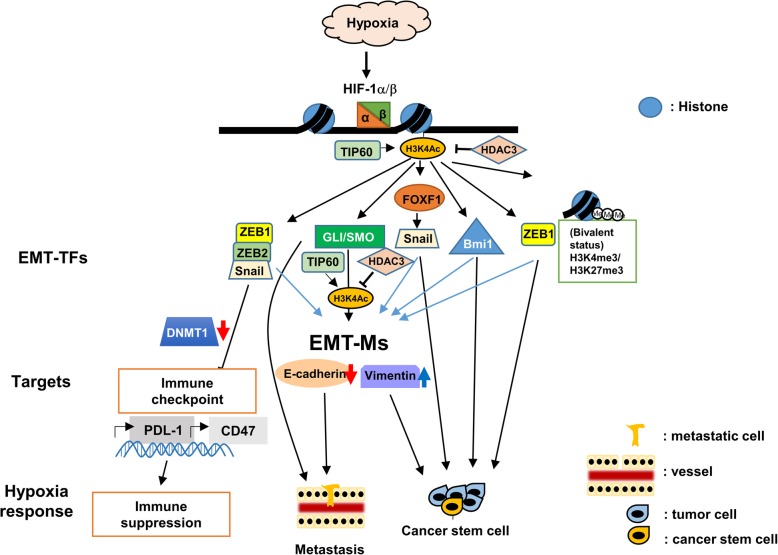
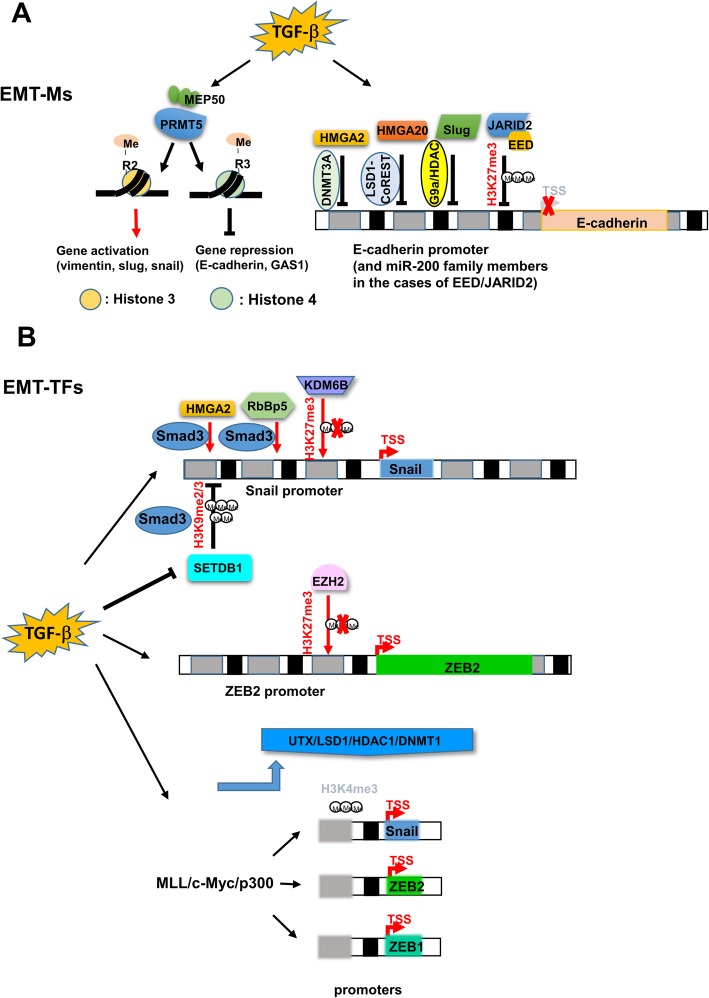
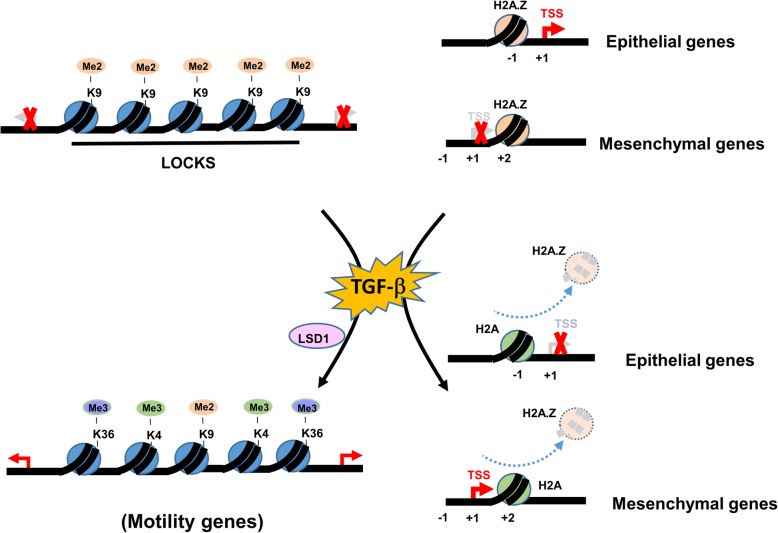
Epithelial-mesenchymal transition (EMT) is an important process triggered during cancer metastasis. Regulation of EMT is mostly initiated by outside signalling, including TGF-β, growth factors, Notch ligand, Wnt, and hypoxia. Many signalling pathways have been delineated to explain the molecular mechanisms of EMT. In this review, we will focus on the epigenetic regulation of two critical EMT signalling pathways: hypoxia and TGF-β. For hypoxia, hypoxia-induced EMT is mediated by the interplay between chromatin modifiers histone deacetylase 3 (HDAC3) and WDR5 coupled with the presence of histone 3 lysine 4 acetylation (H3K4Ac) mark that labels the promoter regions of various traditional EMT marker genes (e.g. CDH1, VIM). Recently identified new hypoxia-induced EMT markers belong to transcription factors (e.g. SMO, GLI1) that mediate EMT themselves. For TGF-β-induced ΕΜΤ, global chromatin changes, removal of a histone variant (H2A.Z), and new chromatin modifiers (e.g. UTX, Rad21, PRMT5, RbBP5, etc) are identified to be crucial for the regulation of both EMT transcription factors (EMT-TFs) and EMT markers (EMT-Ms). The epigenetic mechanisms utilized in these two pathways may serve as good model systems for other signalling pathways and also provide new potential therapeutic targets.
上皮间质转化(EMT)是癌症转移过程中触发的重要过程。EMT 的调节主要是由外部信号启动的,包括 TGF-β、生长因子、Notch 配体、Wnt 和缺氧。已经描述了许多信号通路来解释 EMT 的分子机制。在这篇综述中,我们将重点介绍两种关键 EMT 信号通路的表观遗传调控:缺氧和 TGF-β。对于缺氧,缺氧诱导的 EMT 是由染色质修饰酶组蛋白去乙酰化酶 3 (HDAC3) 和 WDR5 与组蛋白 3 赖氨酸 4 乙酰化 (H3K4Ac) 标记的相互作用介导的,该标记标记各种传统 EMT 标记基因(例如 CDH1、VIM)的启动子区域。最近发现的新的缺氧诱导的 EMT 标记物属于转录因子(例如 SMO、GLI1),它们本身介导 EMT。对于 TGF-β 诱导的 ΕΜΤ,全局染色质变化、组蛋白变体(H2A.Z)的去除以及新的染色质修饰物(例如 UTX、Rad21、PRMT5、RbBP5 等)被确定为 EMT 转录因子(EMT-TFs)和 EMT 标记物(EMT-Ms)调节的关键因素。这两种途径中使用的表观遗传机制可以作为其他信号通路的良好模型系统,也为新的潜在治疗靶点提供了依据。