Martínez-Cué Carmen, Rueda Noemí
Department of Physiology and Pharmacology, Faculty of Medicine, University of Cantabria, Santander, Spain.
Front Cell Neurosci. 2020 Feb 11;14:16. doi: 10.3389/fncel.2020.00016. eCollection 2020.
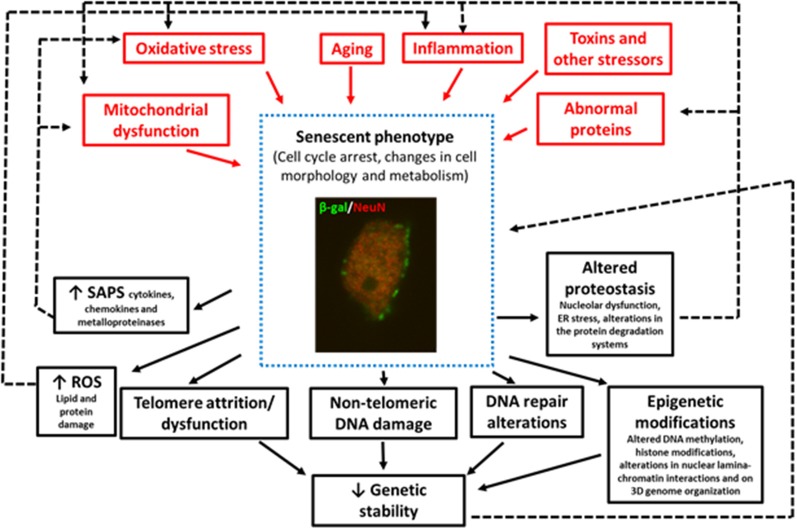
Cellular senescence is a homeostatic biological process characterized by a permanent state of cell cycle arrest that can contribute to the decline of the regenerative potential and function of tissues. The increased presence of senescent cells in different neurodegenerative diseases suggests the contribution of senescence in the pathophysiology of these disorders. Although several factors can induce senescence, DNA damage, oxidative stress, neuroinflammation, and altered proteostasis have been shown to play a role in its onset. Oxidative stress contributes to accelerated aging and cognitive dysfunction stages affecting neurogenesis, neuronal differentiation, connectivity, and survival. During later life stages, it is implicated in the progression of cognitive decline, synapse loss, and neuronal degeneration. Also, neuroinflammation exacerbates oxidative stress, synaptic dysfunction, and neuronal death through the harmful effects of pro-inflammatory cytokines on cell proliferation and maturation. Both oxidative stress and neuroinflammation can induce DNA damage and alterations in DNA repair that, in turn, can exacerbate them. Another important feature associated with senescence is altered proteostasis. Because of the disruption in the function and balance of the proteome, senescence can modify the proper synthesis, folding, quality control, and degradation rate of proteins producing, in some diseases, misfolded proteins or aggregation of abnormal proteins. There is an extensive body of literature that associates cellular senescence with several neurodegenerative disorders including Alzheimer's disease (AD), Down syndrome (DS), and Parkinson's disease (PD). This review summarizes the evidence of the shared neuropathological events in these neurodegenerative diseases and the implication of cellular senescence in their onset or aggravation. Understanding the role that cellular senescence plays in them could help to develop new therapeutic strategies.
细胞衰老一种稳态生物学过程,其特征是细胞周期永久停滞,这可能导致组织再生潜能和功能下降。衰老细胞在不同神经退行性疾病中数量增加,表明衰老在这些疾病的病理生理学中起作用。虽然有几个因素可以诱导衰老,但DNA损伤、氧化应激、神经炎症和蛋白稳态改变已被证明在其发生中起作用。氧化应激导致加速衰老和认知功能障碍阶段,影响神经发生、神经元分化、连接性和存活。在生命后期阶段,它与认知衰退、突触丧失和神经元变性的进展有关。此外,神经炎症通过促炎细胞因子对细胞增殖和成熟的有害影响,加剧氧化应激、突触功能障碍和神经元死亡。氧化应激和神经炎症都可诱导DNA损伤和DNA修复改变,进而加剧它们。与衰老相关的另一个重要特征是蛋白稳态改变。由于蛋白质组功能和平衡的破坏,衰老可改变蛋白质的正常合成、折叠、质量控制和降解速率,在某些疾病中产生错误折叠的蛋白质或异常蛋白质聚集。有大量文献将细胞衰老与包括阿尔茨海默病(AD)、唐氏综合征(DS)和帕金森病(PD)在内的几种神经退行性疾病联系起来。本综述总结了这些神经退行性疾病中共同神经病理事件的证据,以及细胞衰老在其发病或加重中的作用。了解细胞衰老在其中所起的作用有助于开发新的治疗策略。