Kardas Grzegorz, Daszyńska-Kardas Agnieszka, Marynowski Mateusz, Brząkalska Oliwia, Kuna Piotr, Panek Michał
Clinic of Internal Diseases, Asthma and Allergy, Medical University of Lodz, Łódź, Poland.
Front Pharmacol. 2020 Feb 14;11:47. doi: 10.3389/fphar.2020.00047. eCollection 2020.
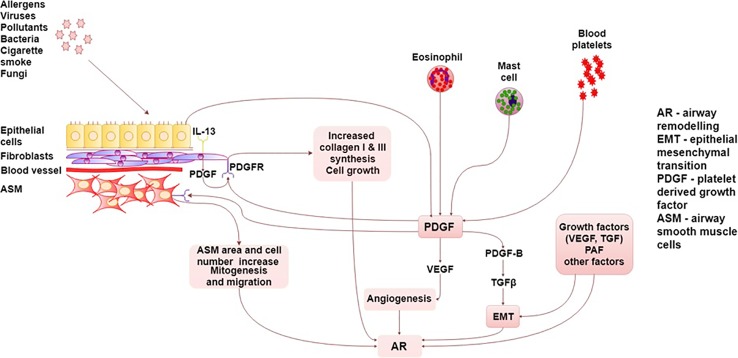
Asthma is a chronic and heterogenic disease of the respiratory system, one of the most common lung diseases worldwide. The underlying pathologies, which are chronic inflammatory process and airway remodeling (AR), are mediated by numerous cells and cytokines. Particularly interesting in this field is the platelet-derived growth factor (PDGF), one of the members of the human growth factor family. In this article, the authors analyze the available data on the role of PDGF in asthma in experimental models and in human research. PDGF is expressed in airway by various cells contributing to asthma pathogenesis-mast cells, eosinophils, and airway epithelial cells. Research confirms the thesis that this factor is also secreted by these cells in the course of asthma. The main effects of PDGF on bronchi are the proliferation of airway smooth muscle (ASM) cells, migration of ASM cells into the epithelium and enhanced collagen synthesis by lung fibroblasts. The importance of AR in asthma is well recognized and new therapies should also aim to manage it, possibly targeting PDGFRs. Further studies on new and already existing drugs, mediating the PDGF signaling and related to asthma are necessary. Several promising drugs from the tyrosine kinase inhibitors group, including nilotinib, imatinib masitinib, and sunitinib, are currently being clinically tested and other molecules are likely to emerge in this field.
哮喘是一种慢性异质性呼吸系统疾病,是全球最常见的肺部疾病之一。其潜在病理机制为慢性炎症过程和气道重塑(AR),由多种细胞和细胞因子介导。在这一领域,特别引人关注的是血小板衍生生长因子(PDGF),它是人类生长因子家族的成员之一。在本文中,作者分析了关于PDGF在哮喘实验模型和人体研究中作用的现有数据。PDGF由多种参与哮喘发病机制的细胞——肥大细胞、嗜酸性粒细胞和气道上皮细胞在气道中表达。研究证实,在哮喘过程中这些细胞也会分泌该因子。PDGF对支气管的主要作用是气道平滑肌(ASM)细胞增殖、ASM细胞迁移至上皮以及肺成纤维细胞胶原合成增强。AR在哮喘中的重要性已得到充分认识,新的治疗方法也应以控制AR为目标,可能针对血小板衍生生长因子受体(PDGFRs)。有必要对介导PDGF信号传导且与哮喘相关的新药和现有药物进行进一步研究。目前,包括尼洛替尼、伊马替尼、马斯itinib和舒尼替尼在内的几种来自酪氨酸激酶抑制剂组的有前景药物正在进行临床试验,该领域可能还会出现其他分子。