Aix-Marseille Univ, IRD, APHM, MEPHI, IHU Méditerranée Infection, MEPHI, Marseille, France.
Medical Office, Marseille, France.
Front Immunol. 2020 Feb 7;10:3149. doi: 10.3389/fimmu.2019.03149. eCollection 2019.
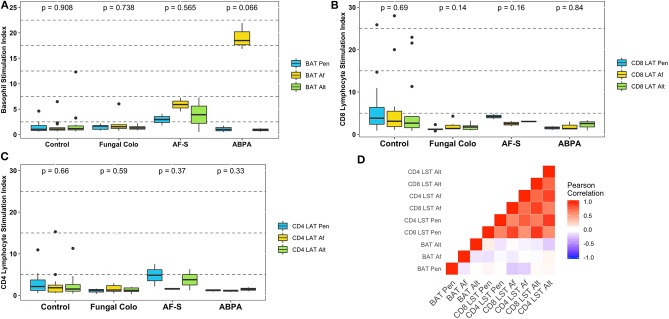
Allergic bronchopulmonary mycosis (ABPM) is an underestimated allergic disease due to fungi. Most reported cases are caused by (Af) and are referred to as allergic bronchopulmonary aspergillosis (ABPA). The main risk factor of ABPA is a history of lung disease, such as cystic fibrosis, asthma, or chronic obstructive pulmonary disease. The main diagnostic criteria for ABPA rely on the evaluation of humoral IgE and IgG responses to Af extracts, although these cannot discriminate Af sensitization and ABPA. Moreover, fungi other than Af have been incriminated. Flow cytometric evaluation of functional responses of basophils and lymphocytes in the context of allergic diseases is gaining momentum. We hypothesized that the detection of functional responses through basophil and lymphocyte activation tests might be useful for ABPM diagnosis. We present here the results of a pilot study comparing the performance of these cellular assays vs. usual diagnostic criteria in a cystic fibrosis (CF) cohort. basophil activation test (BAT) is a diagnostic tool highlighting an immediate hypersensitivity mechanism against an allergen, e.g., through CD63 upregulation as an indirect measure of degranulation. Lymphocyte stimulation test (LST) relies on the upregulation of activation markers, such as CD69, after incubation with allergen(s), to explain delayed hypersensitivity. These assays were performed with Af, , and extracts in 29 adult CF patients. BAT responses of ABPA patients were higher than those of sensitized or control CF patients. The highest LST result was for a woman who developed ABPA 3 months after the tests, despite the absence of specific IgG and IgE to Af at the time of the initial investigation. We conclude that basophil and lymphocyte activation tests could enhance the diagnosis of allergic mycosis, compared to usual humoral markers. Further studies with larger cohorts and addressing both mold extracts and mold relevant molecules are needed in order to confirm and extend the application of this personalized medicine approach.
变应性支气管肺真菌病 (ABPM) 是一种因真菌引起的被低估的过敏性疾病。大多数报道的病例是由 (Af)引起的,并被称为变应性支气管曲霉病 (ABPA)。ABPA 的主要危险因素是肺部疾病史,如囊性纤维化、哮喘或慢性阻塞性肺疾病。ABPA 的主要诊断标准依赖于对 Af 提取物的体液 IgE 和 IgG 反应的评估,尽管这些不能区分 Af 致敏和 ABPA。此外,除 Af 以外的真菌也被牵连在内。在过敏性疾病的背景下,通过对嗜碱性粒细胞和淋巴细胞的功能反应进行流式细胞术评估正在获得动力。我们假设通过嗜碱性粒细胞和淋巴细胞激活试验检测功能反应可能有助于 ABPM 的诊断。我们在此介绍了一项比较这些细胞检测与囊性纤维化 (CF) 队列中常用诊断标准的性能的初步研究结果。嗜碱性粒细胞激活试验 (BAT) 是一种诊断工具,突出了对过敏原的即刻过敏反应机制,例如通过 CD63 上调作为脱颗粒的间接测量。淋巴细胞刺激试验 (LST) 依赖于与过敏原孵育后激活标志物(如 CD69)的上调,以解释迟发性过敏反应。在 29 名成年 CF 患者中进行了 Af、、和 提取物的 BAT 和 LST。ABPA 患者的 BAT 反应高于致敏或对照 CF 患者。最高的 LST 结果是一位妇女的,她在测试后 3 个月发生 ABPA,尽管在初始调查时她没有针对 Af 的特异性 IgG 和 IgE。我们得出结论,与常用的体液标志物相比,嗜碱性粒细胞和淋巴细胞激活试验可以提高过敏性真菌病的诊断。需要进行更大规模队列的研究,并解决霉菌提取物和霉菌相关分子的问题,以确认和扩展这种个体化医学方法的应用。