
负载姜黄素和胡椒碱的脂质体作为联合治疗方法增强姜黄素对HCT116结直肠癌模型的抗癌活性。
Curcumin- and Piperine-Loaded Emulsomes as Combinational Treatment Approach Enhance the Anticancer Activity of Curcumin on HCT116 Colorectal Cancer Model.
作者信息
Bolat Zeynep Busra, Islek Zeynep, Demir Bilun Nas, Yilmaz Elif Nur, Sahin Fikrettin, Ucisik Mehmet Hikmet
机构信息
Department of Genetics and Bioengineering, Faculty of Engineering, Yeditepe University, Istanbul, Turkey.
Graduate School of Engineering and Natural Sciences, Istanbul Medipol University, Istanbul, Turkey.
出版信息
Front Bioeng Biotechnol. 2020 Feb 11;8:50. doi: 10.3389/fbioe.2020.00050. eCollection 2020.
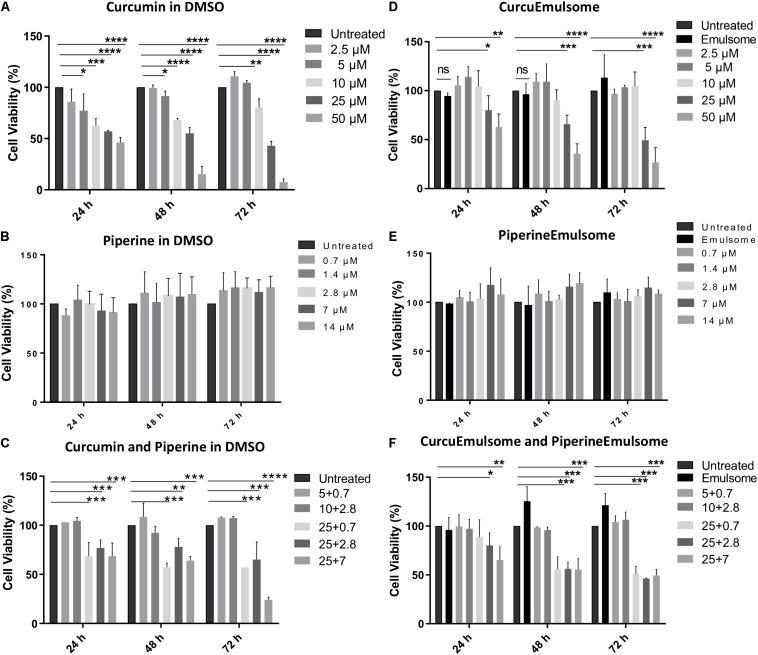
Combination chemotherapy, administrating two chemotherapeutic agents concurrently, comes into prominence, as the heterogeneity or the level of the disease necessitates a collaborative action. Curcumin, isolated from turmeric, and piperine, isolated from black long pepper, are two dietary polyphenols studied for their intrinsic anti-cancer properties against various cancer types including colorectal cancer (CRC). Furthermore, piperine improves the therapeutic effect of curcumin. Addressing this mutual behavior, this study combines curcumin and piperine within emulsome nanoformulations. Curcumin- (CurcuEmulsomes) and piperine-loaded emulsomes (PiperineEmulsomes) have established a uniform, stable, spherical dispersion with average diameters of 184.21 and 248.76 nm, respectively. The solid tripalmitin inner core achieved encapsulation capacities of up to 0.10 mg/ml curcumin and 0.09 mg/ml piperine content. While piperine treatment alone - in its both free and emulsome forms - showed no inhibition in the proliferation of HCT116 cells , its presence as the second drug agent enhanced curcumin's effect. Combination of 7 μM PiperineEmulsome and 25 μM CurcuEmulsome concentrations was found to be most effective with an inhibition of cell proliferation of about 50% viability. Cell cycle arrest at G2/M phase and induced apoptosis verified the improved anti-cancer characteristics of the therapy. While CurcuEmulsomes achieved a fourfold increase in Caspase 3 level, combination of treatment with PiperineEulsomes achieved a sixfold increase in the level of this apoptotic marker. Combinational treatment of HCT116 cells with CurcuEmulsomes and PiperineEmulsomes improved the anticancer activity of the compounds and highlighted the potential of the approach for further studies.
联合化疗,即同时使用两种化疗药物,由于疾病的异质性或程度需要协同作用而备受关注。姜黄素,从姜黄中分离出来,胡椒碱,从黑胡椒中分离出来,是两种膳食多酚,因其对包括结直肠癌(CRC)在内的各种癌症类型具有内在抗癌特性而受到研究。此外,胡椒碱可提高姜黄素的治疗效果。针对这种相互作用,本研究将姜黄素和胡椒碱结合在乳剂纳米制剂中。负载姜黄素的乳剂(姜黄素乳剂)和负载胡椒碱的乳剂(胡椒碱乳剂)分别形成了均匀、稳定的球形分散体,平均直径分别为184.21和248.76纳米。固体三棕榈酸甘油酯内核实现了高达0.10毫克/毫升姜黄素和0.09毫克/毫升胡椒碱含量的包封能力。虽然单独使用胡椒碱治疗——无论是游离形式还是乳剂形式——对HCT116细胞的增殖均无抑制作用,但其作为第二种药物的存在增强了姜黄素的效果。发现7μM胡椒碱乳剂和25μM姜黄素乳剂浓度的组合最有效,可抑制细胞增殖,使细胞活力约为50%。细胞周期停滞在G2/M期并诱导凋亡证实了该疗法改善的抗癌特性。虽然姜黄素乳剂使半胱天冬酶3水平增加了四倍,但胡椒碱乳剂治疗组合使这种凋亡标志物的水平增加了六倍。用姜黄素乳剂和胡椒碱乳剂联合处理HCT116细胞提高了化合物的抗癌活性,并突出了该方法在进一步研究中的潜力。




 Zotero 插件