Falbriard Mathieu, Meyer Frédéric, Mariani Benoît, Millet Grégoire P, Aminian Kamiar
Laboratory of Movement Analysis and Measurement, EPFL, Lausanne, Switzerland.
Institute of Sport Sciences, University of Lausanne, Lausanne, Switzerland.
Front Bioeng Biotechnol. 2020 Feb 13;8:65. doi: 10.3389/fbioe.2020.00065. eCollection 2020.
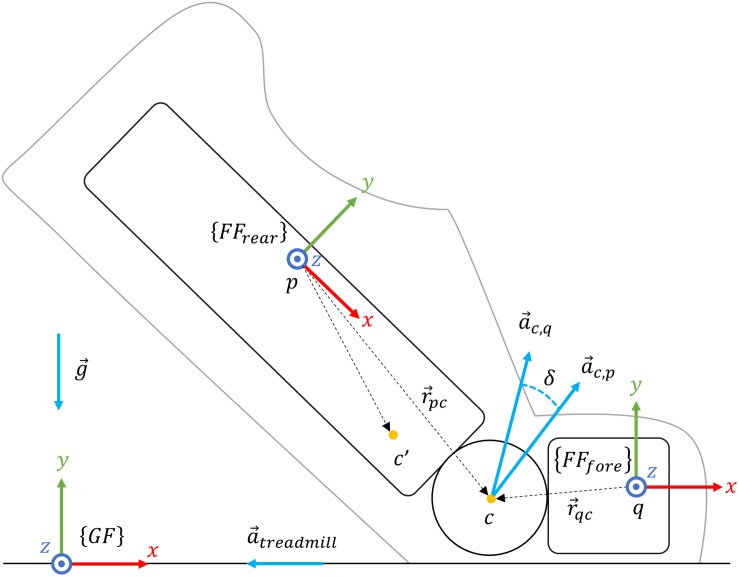
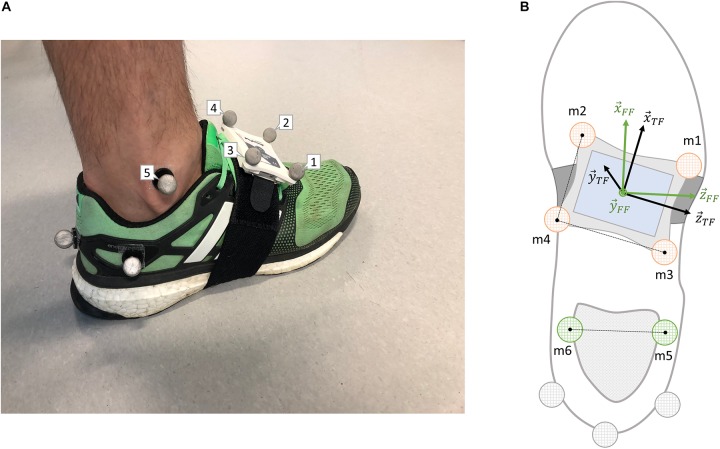
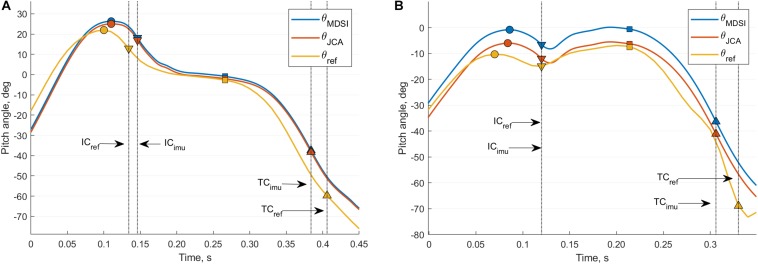
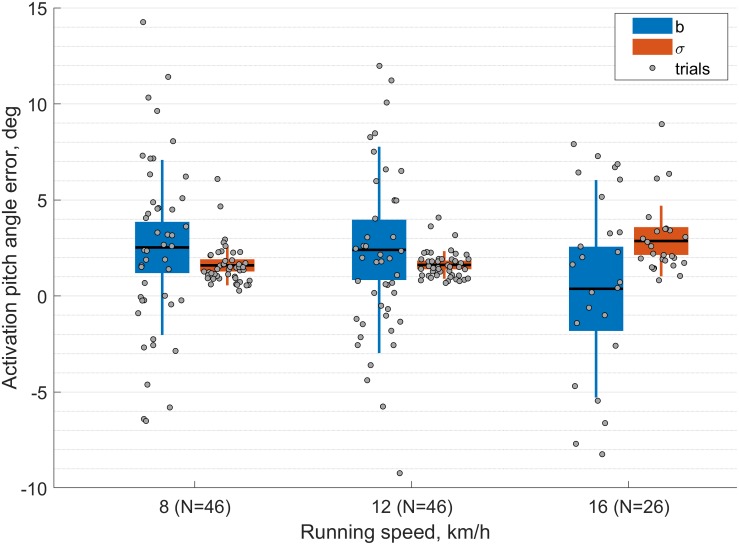
This study aimed to introduce and validate a new method to estimate and correct the orientation drift measured from foot-worn inertial sensors. A modified strap-down integration (MSDI) was proposed to decrease the orientation drift, which, in turn, was further compensated by estimation of the joint center acceleration (JCA) of a two-segment model of the foot. This method was designed to fit the different foot strike patterns observed in running and was validated against an optical motion-tracking system during level treadmill running at 8, 12, and 16 km/h. The sagittal and frontal plane angles obtained from the inertial sensors and the motion tracking system were compared at different moments of the ground contact phase. The results obtained from 26 runners showed that the foot orientation at mean stance was estimated with an accuracy (inter-trial median ± IQR) of 0.4 ± 3.8° and a precision (inter-trial precision median ± IQR) of 3.0 ± 1.8°. The orientation of the foot shortly before initial contact (IC) was estimated with an accuracy of 2.0 ± 5.9° and a precision of 1.6 ± 1.1°; which is more accurate than commonly used zero-velocity update methods derived from gait analysis and not explicitly designed for running. Finally, the study presented the effect initial and terminal contact (TC) detection errors have on the orientation parameters reported.
本研究旨在引入并验证一种新方法,用于估计和校正从足部佩戴的惯性传感器测量得到的方向漂移。提出了一种改进的捷联积分法(MSDI)来减少方向漂移,进而通过估计足部两段模型的关节中心加速度(JCA)进一步进行补偿。该方法旨在适应跑步中观察到的不同足部着地模式,并在水平跑步机上以8、12和16 km/h的速度跑步时,与光学运动跟踪系统进行了验证。在地面接触阶段的不同时刻,比较了从惯性传感器和运动跟踪系统获得的矢状面和额状面角度。从26名跑步者获得的结果表明,平均站立时足部方向的估计精度(试验间中位数±IQR)为0.4±3.8°,精度(试验间精度中位数±IQR)为3.0±1.8°。初始接触(IC)前不久足部的方向估计精度为2.0±5.9°,精度为1.6±1.1°;这比从步态分析得出的、未专门为跑步设计的常用零速度更新方法更准确。最后,该研究展示了初始和终末接触(TC)检测误差对所报告的方向参数的影响。