Sia Joseph, Szmyd Radoslaw, Hau Eric, Gee Harriet E
Department of Radiation Oncology, Peter MacCallum Cancer Centre, Melbourne, VIC, Australia.
Division of Cancer Research, Peter MacCallum Cancer Centre, Melbourne, VIC, Australia.
Front Cell Dev Biol. 2020 Feb 13;8:41. doi: 10.3389/fcell.2020.00041. eCollection 2020.
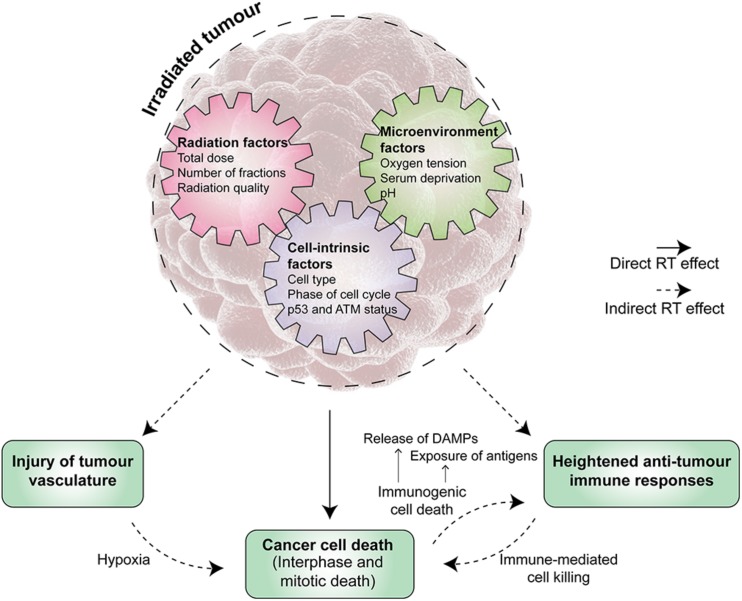
Radiation therapy (RT) is responsible for at least 40% of cancer cures, however treatment resistance remains a clinical problem. There have been recent advances in understanding the molecular mechanisms of radiation-induced cell death. The type of cell death after radiation depends on a number of factors including cell type, radiation dose and quality, oxygen tension, status, DNA repair capacity, cell cycle phase at time of radiation exposure, and the microenvironment. Mitotic catastrophe (a pathway preceding cell death that happens in mitosis or as a consequence of aberrant mitotic progression) is the primary context of radiation-induced cell death in solid cancers, although in a small subset of cancers such as haematopoietic malignancies, radiation results in immediate interphase apoptosis, occurring within hours after exposure. There is intense therapeutic interest in using stereotactic ablative body radiotherapy (SABR), a precise, high-dose form of RT given in a small number of fractions, to prime the immune system for cancer cell killing, but the optimal radiation dose and fractionation remain unclear. Additionally, promising novel radiosensitisers targeting the cell cycle and DNA repair pathways are being trialled. In the context of the increasing use of SABR and such novel agents in the clinic, we provide an updated primer on the major types of radiation-induced cell death, focussing on their molecular mechanisms, factors affecting their initiation, and their implications on immunogenicity.
放射治疗(RT)至少促成了40%的癌症治愈,但治疗抗性仍然是一个临床问题。最近在理解辐射诱导细胞死亡的分子机制方面取得了进展。辐射后细胞死亡的类型取决于多种因素,包括细胞类型、辐射剂量和质量、氧张力、状态、DNA修复能力、辐射暴露时的细胞周期阶段以及微环境。有丝分裂灾难(一种在有丝分裂期间或异常有丝分裂进程导致的细胞死亡前的途径)是实体癌中辐射诱导细胞死亡的主要情况,尽管在一小部分癌症如血液系统恶性肿瘤中,辐射会导致暴露后数小时内立即发生间期凋亡。使用立体定向消融体部放疗(SABR)这种精确、高剂量且分次数较少的放疗形式来激发免疫系统杀死癌细胞引起了强烈的治疗兴趣,但最佳辐射剂量和分割方式仍不明确。此外,针对细胞周期和DNA修复途径的有前景的新型放射增敏剂正在进行试验。鉴于SABR和此类新型药物在临床上的使用日益增加,我们提供了一份关于辐射诱导细胞死亡主要类型的最新入门指南,重点关注其分子机制、影响其启动的因素以及对免疫原性的影响。