Lunenfeld-Tanenbaum Research Institute, Sinai Health System, Toronto, Canada.
Lunenfeld-Tanenbaum Research Institute, Sinai Health System, Toronto, Canada; Department of Molecular Genetics, University of Toronto, Toronto, Canada.
Mol Cell Proteomics. 2020 May;19(5):757-773. doi: 10.1074/mcp.R120.001941. Epub 2020 Mar 3.
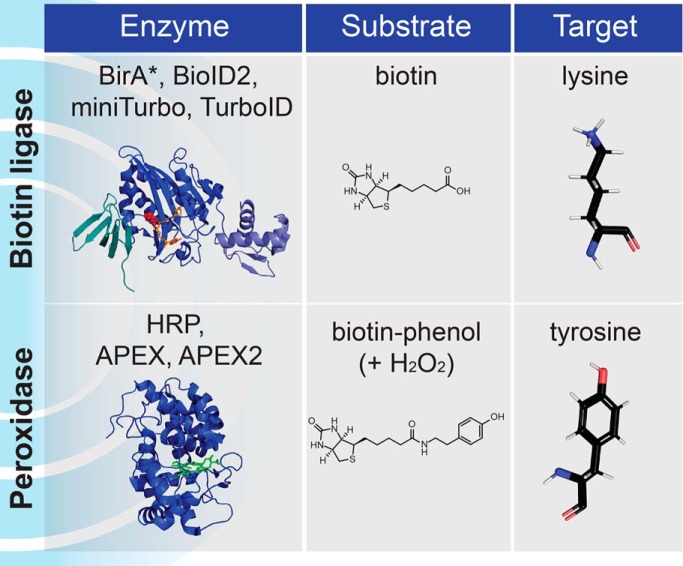
The study of protein subcellular distribution, their assembly into complexes and the set of proteins with which they interact with is essential to our understanding of fundamental biological processes. Complementary to traditional assays, proximity-dependent biotinylation (PDB) approaches coupled with mass spectrometry (such as BioID or APEX) have emerged as powerful techniques to study proximal protein interactions and the subcellular proteome in the context of living cells and organisms. Since their introduction in 2012, PDB approaches have been used in an increasing number of studies and the enzymes themselves have been subjected to intensive optimization. How these enzymes have been optimized and considerations for their use in proteomics experiments are important questions. Here, we review the structural diversity and mechanisms of the two main classes of PDB enzymes: the biotin protein ligases (BioID) and the peroxidases (APEX). We describe the engineering of these enzymes for PDB and review emerging applications, including the development of PDB for coincidence detection (split-PDB). Lastly, we briefly review enzyme selection and experimental design guidelines and reflect on the labeling chemistries and their implication for data interpretation.
研究蛋白质亚细胞定位、它们在复合物中的组装以及与它们相互作用的蛋白质组对于我们理解基本的生物学过程至关重要。与传统检测方法互补的是,邻近依赖性生物素化(PDB)方法与质谱法(如 BioID 或 APEX)相结合,已成为研究活细胞和生物体中近端蛋白质相互作用和亚细胞蛋白质组的强大技术。自 2012 年引入以来,PDB 方法已在越来越多的研究中得到应用,并且这些酶本身也经过了密集的优化。这些酶是如何被优化的,以及在蛋白质组学实验中使用这些酶时需要考虑哪些因素,这些都是重要的问题。在这里,我们回顾了两种主要类型的 PDB 酶的结构多样性和机制:生物素蛋白连接酶(BioID)和过氧化物酶(APEX)。我们描述了这些酶在 PDB 中的工程化,并回顾了新兴的应用,包括用于巧合检测(split-PDB)的 PDB 的开发。最后,我们简要回顾了酶的选择和实验设计指南,并反思了标记化学及其对数据解释的影响。