Silva Amanda R, Resende-Moreira Luciana C, Carvalho Carolina S, Lanes Eder C M, Ortiz-Vera Mabel P, Viana Pedro L, Jaffé Rodolfo
Universidade Federal Rural da Amazônia/Museu Paraense Emílio Goeldi, Programa de Pós-graduação em Ciências Biológicas - Botânica Tropical, Belém-PA, Brazil.
Museu Paraense Emílio Goeldi, Programa de Capacitação Institucional (PCI), Belém-PA, Brazil.
AoB Plants. 2020 Jan 31;12(1):plaa003. doi: 10.1093/aobpla/plaa003. eCollection 2020 Feb.
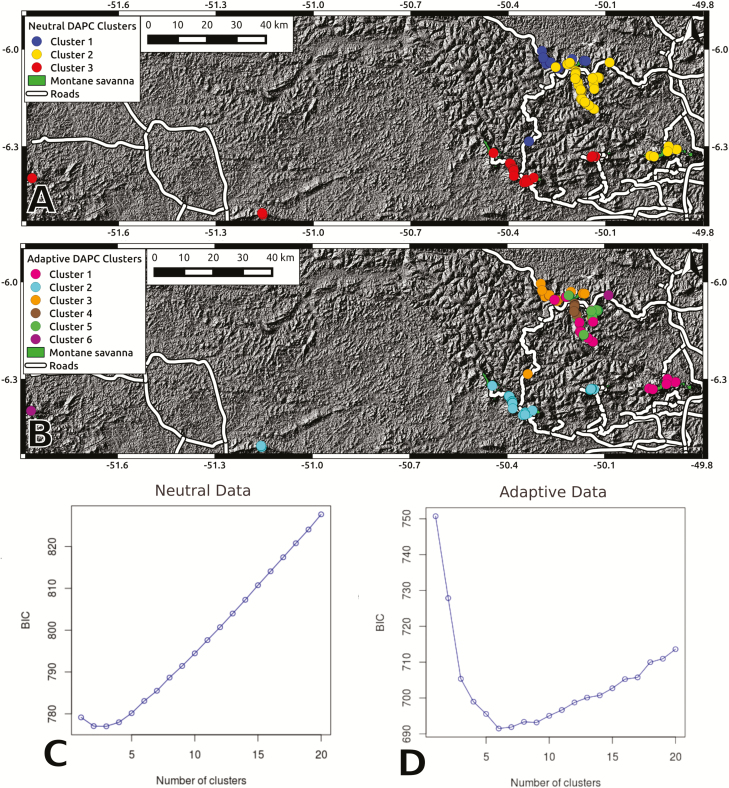
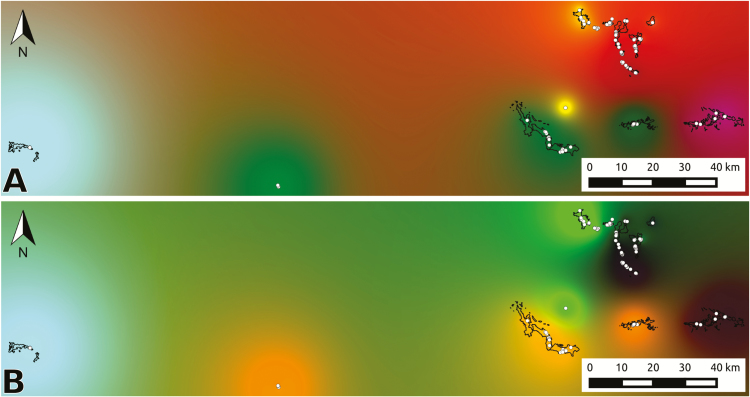
Conserving genetic diversity in rare and narrowly distributed endemic species is essential to maintain their evolutionary potential and minimize extinction risk under future environmental change. In this study we assess neutral and adaptive genetic structure and genetic diversity in (Melastomataceae), an endemic herb from Amazonian Savannas. Using RAD sequencing we identified a total of 9365 SNPs in 150 individuals collected across the species' entire distribution range. Relying on assumption-free genetic clustering methods and environmental association tests we then compared neutral with adaptive genetic structure. We found three neutral and six adaptive genetic clusters, which could be considered management units (MU) and adaptive units (AU), respectively. Pairwise genetic differentiation ( ) ranged between 0.024 and 0.048, and even though effective population sizes were below 100, no significant inbreeding was found in any inferred cluster. Nearly 10 % of all analysed sequences contained loci associated with temperature and precipitation, from which only 25 sequences contained annotated proteins, with some of them being very relevant for physiological processes in plants. Our findings provide a detailed insight into genetic diversity, neutral and adaptive genetic structure in a rare endemic herb, which can help guide conservation and management actions to avoid the loss of unique genetic variation.
保护珍稀且分布狭窄的特有物种的遗传多样性对于维持其进化潜力以及在未来环境变化下将灭绝风险降至最低至关重要。在本研究中,我们评估了一种来自亚马孙稀树草原的特有草本植物(野牡丹科)的中性和适应性遗传结构及遗传多样性。通过RAD测序,我们在该物种整个分布范围内采集的150个个体中总共鉴定出9365个单核苷酸多态性(SNP)。然后,我们依靠无假设的遗传聚类方法和环境关联测试,将中性遗传结构与适应性遗传结构进行了比较。我们发现了三个中性遗传簇和六个适应性遗传簇,它们可分别被视为管理单元(MU)和适应性单元(AU)。成对遗传分化( )在0.024至0.048之间,尽管有效种群大小低于100,但在任何推断出的簇中均未发现显著的近亲繁殖。在所有分析序列中,近10%包含与温度和降水相关的基因座,其中只有25个序列包含注释蛋白,其中一些蛋白与植物的生理过程密切相关。我们的研究结果详细揭示了一种珍稀特有草本植物的遗传多样性、中性和适应性遗传结构,这有助于指导保护和管理行动以避免独特遗传变异的丧失。