Jaffé Rodolfo, Veiga Jamille C, Pope Nathaniel S, Lanes Éder C M, Carvalho Carolina S, Alves Ronnie, Andrade Sónia C S, Arias Maria C, Bonatti Vanessa, Carvalho Airton T, de Castro Marina S, Contrera Felipe A L, Francoy Tiago M, Freitas Breno M, Giannini Tereza C, Hrncir Michael, Martins Celso F, Oliveira Guilherme, Saraiva Antonio M, Souza Bruno A, Imperatriz-Fonseca Vera L
Instituto Tecnológico Vale Belém Brazil.
Departamento de Ecologia Universidade de São Paulo São Paulo Brazil.
Evol Appl. 2019 Apr 10;12(6):1164-1177. doi: 10.1111/eva.12794. eCollection 2019 Jun.
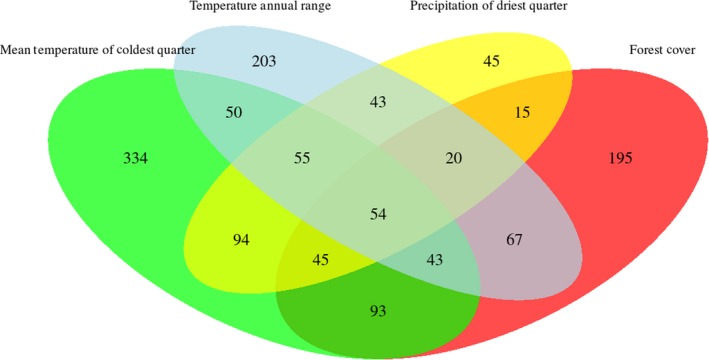
Habitat degradation and climate change are currently threatening wild pollinators, compromising their ability to provide pollination services to wild and cultivated plants. Landscape genomics offers powerful tools to assess the influence of landscape modifications on genetic diversity and functional connectivity, and to identify adaptations to local environmental conditions that could facilitate future bee survival. Here, we assessed range-wide patterns of genetic structure, genetic diversity, gene flow, and local adaptation in the stingless bee a tropical pollinator of key biological and economic importance inhabiting one of the driest and hottest regions of South America. Our results reveal four genetic clusters across the species' full distribution range. All populations were found to be under a mutation-drift equilibrium, and genetic diversity was not influenced by the amount of reminiscent natural habitats. However, genetic relatedness was spatially autocorrelated and isolation by landscape resistance explained range-wide relatedness patterns better than isolation by geographic distance, contradicting earlier findings for stingless bees. Specifically, gene flow was enhanced by increased thermal stability, higher forest cover, lower elevations, and less corrugated terrains. Finally, we detected genomic signatures of adaptation to temperature, precipitation, and forest cover, spatially distributed in latitudinal and altitudinal patterns. Taken together, our findings shed important light on the life history of and highlight the role of regions with large thermal fluctuations, deforested areas, and mountain ranges as dispersal barriers. Conservation actions such as restricting long-distance colony transportation, preserving local adaptations, and improving the connectivity between highlands and lowlands are likely to assure future pollination services.
栖息地退化和气候变化目前正威胁着野生传粉者,损害了它们为野生植物和栽培植物提供授粉服务的能力。景观基因组学提供了强大的工具,用于评估景观变化对遗传多样性和功能连通性的影响,并识别对当地环境条件的适应性,这有助于蜜蜂未来的生存。在这里,我们评估了无刺蜂的全分布范围内的遗传结构、遗传多样性、基因流和局部适应性模式。无刺蜂是一种热带传粉者,对生物和经济具有关键重要性,栖息在南美洲最干旱和最热的地区之一。我们的结果揭示了该物种全部分布范围内的四个遗传簇。所有种群都处于突变 - 漂变平衡状态,遗传多样性不受留存自然栖息地数量的影响。然而,遗传相关性存在空间自相关性,并且景观抗性隔离比地理距离隔离能更好地解释全分布范围内的相关性模式,这与之前关于无刺蜂的研究结果相矛盾。具体而言,热稳定性增加、森林覆盖率提高、海拔降低和地形起伏较小会增强基因流。最后,我们检测到了对温度、降水和森林覆盖的适应性基因组特征,这些特征呈纬度和海拔模式分布。综合来看,我们的研究结果为其生活史提供了重要见解,并突出了热波动大的地区、森林砍伐地区和山脉作为扩散障碍的作用。诸如限制远距离蜂群运输、保留局部适应性以及改善高地和低地之间的连通性等保护行动,可能会确保未来的授粉服务。