• 文献检索
  • 文档翻译
  • 深度研究
  • 学术资讯
  • Suppr Zotero 插件Zotero 插件
  • 邀请有礼
  • 套餐&价格
  • 历史记录
应用&插件
Suppr Zotero 插件Zotero 插件浏览器插件Mac 客户端Windows 客户端微信小程序
定价
高级版会员购买积分包购买API积分包
服务
文献检索文档翻译深度研究API 文档MCP 服务
关于我们
关于 Suppr公司介绍联系我们用户协议隐私条款
关注我们

Suppr 超能文献

核心技术专利:CN118964589B侵权必究
粤ICP备2023148730 号-1Suppr @ 2026

文献检索

告别复杂PubMed语法,用中文像聊天一样搜索,搜遍4000万医学文献。AI智能推荐,让科研检索更轻松。

立即免费搜索

文件翻译

保留排版,准确专业,支持PDF/Word/PPT等文件格式,支持 12+语言互译。

免费翻译文档

深度研究

AI帮你快速写综述,25分钟生成高质量综述,智能提取关键信息,辅助科研写作。

立即免费体验

含透明质酸盐培养基对人胚胎附着于子宫内膜上皮细胞的影响。

The effects of hyaluronate-containing medium on human embryo attachment to endometrial epithelial cells .

作者信息

Ruane Peter T, Buck Chelsea J, Babbington Phoebe A, Aboussahoud Wedad, Berneau Stéphane C, Westwood Melissa, Kimber Susan J, Aplin John D, Brison Daniel R

机构信息

Maternal and Fetal Health Research Centre, Division of Developmental Biology and Medicine, School of Medical Sciences, Faculty of Biology Medicine and Health, University of Manchester, Manchester Academic Health Sciences Centre, Manchester M13 9WL, UK.

Maternal and Fetal Health Research Centre, St. Mary's Hospital, Manchester University NHS Foundation Trust, Manchester Academic Health Sciences Centre, Manchester M13 9WL UK.

出版信息

Hum Reprod Open. 2020 Feb 28;2020(2):hoz033. doi: 10.1093/hropen/hoz033. eCollection 2020.

DOI:10.1093/hropen/hoz033
PMID:32128453
原文链接:https://pmc.ncbi.nlm.nih.gov/articles/PMC7047226/
Abstract

STUDY QUESTION

Does embryo transfer medium containing hyaluronate (HA) promote the attachment phase of human embryo implantation?

SUMMARY ANSWER

HA-containing medium does not promote human blastocyst attachment to endometrial epithelial cells .

WHAT IS KNOWN ALREADY

Embryo transfer media containing high concentrations of HA are being used to increase implantation and live birth rates in IVF treatment, although the mechanism of action is unknown.

STUDY DESIGN SIZE DURATION

Expression of HA-interacting genes in frozen-thawed oocytes/embryos was assessed by microarray analysis ( = 21). Fresh and frozen human blastocysts ( = 98) were co-cultured with human endometrial epithelial Ishikawa cell layers. Blastocyst attachment and the effects of a widely used HA-containing medium were measured.

PARTICIPANTS/MATERIALS SETTING METHODS: Human embryos surplus to treatment requirements were donated with informed consent from several ART centres. Blastocyst-stage embryos were transferred at day 6 to confluent Ishikawa cell layers; some blastocysts were artificially hatched. Blastocyst attachment was monitored from 1 to 48 h, and the effects of blastocyst pre-treatment for 10 min with HA-containing medium were determined.

MAIN RESULTS AND THE ROLE OF CHANCE

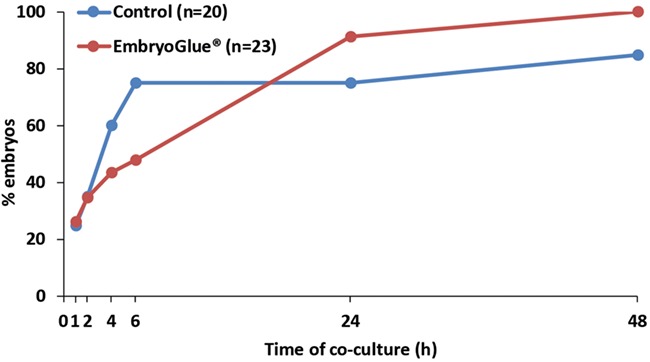
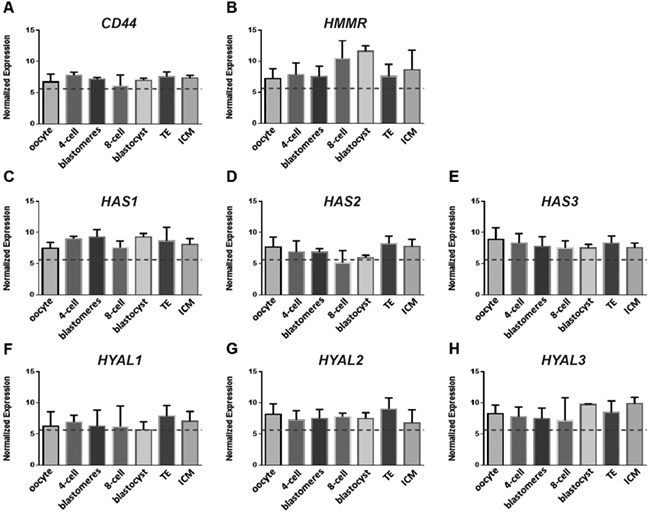
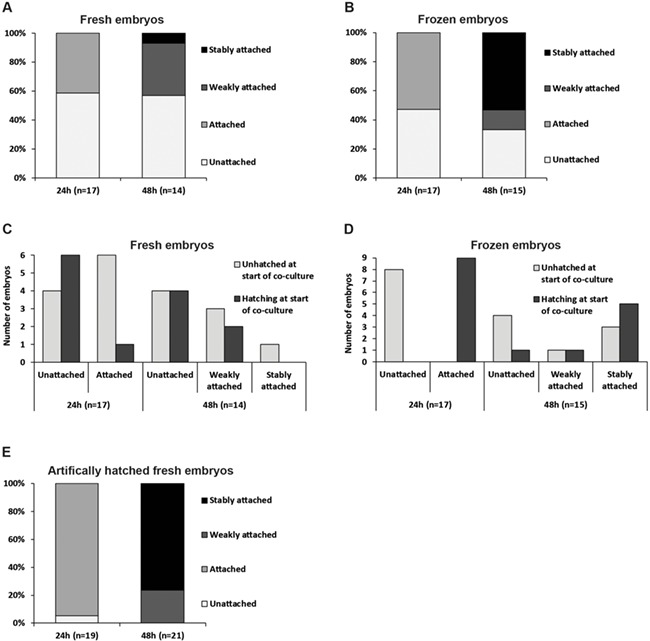
Human embryos expressed the HA receptor genes and , hyaluronan synthase genes , and hyaluronidase genes , at all stages of preimplantation development. Attachment of partially hatched blastocysts to Ishikawa cells at 24 and 48 h was related to trophectoderm grade ( = 0.0004 and 0.007, respectively,  = 34). Blastocysts of varying clinical grades that had been artificially hatched were all attached within 48 h ( = 21). Treatment of artificially hatched blastocysts with HA-containing medium did not significantly affect attachment at early (1-6 h) or late (24 and 48 h) time points, compared with control blastocysts ( = 43).

LIMITATIONS REASONS FOR CAUTION

Using an adenocarcinoma-derived cell line to model embryo-endometrium attachment may not fully recapitulate interactions. The high levels of blastocyst attachment seen with this model may limit the sensitivity with which the effects of HA can be observed.

WIDER IMPLICATIONS OF THE FINDINGS

Morphological trophectoderm grade can be correlated with blastocyst attachment . HA-containing medium may increase pregnancy rates by mechanisms other than promoting blastocyst attachment to endometrium.

STUDY FUNDING/COMPETING INTERESTS: This work was funded by a grant from the Wellbeing of Women, the NIHR Local Comprehensive Research Network and NIHR Manchester Clinical Research Facility, the Department of Health Scientist Practitioner Training Scheme, and the Ministry of Higher Education, The State of Libya. None of the authors has any conflict of interest to declare.

摘要

研究问题

含有透明质酸盐(HA)的胚胎移植培养基是否能促进人类胚胎着床的附着阶段?

简要回答

含HA的培养基不能促进人类囊胚附着于子宫内膜上皮细胞。

已知信息

尽管作用机制尚不清楚,但含高浓度HA的胚胎移植培养基正被用于提高体外受精治疗中的着床率和活产率。

研究设计、规模、持续时间:通过微阵列分析评估冻融卵母细胞/胚胎中HA相互作用基因的表达(n = 21)。将新鲜和冷冻的人类囊胚(n = 98)与人子宫内膜上皮Ishikawa细胞层共培养。测量囊胚附着情况以及一种广泛使用的含HA培养基的效果。

参与者/材料、设置、方法:经几个辅助生殖中心知情同意,捐赠了治疗所需多余的人类胚胎。在第6天将囊胚期胚胎移植到汇合的Ishikawa细胞层;一些囊胚进行人工孵化。在1至48小时监测囊胚附着情况,并确定用含HA培养基对囊胚预处理10分钟的效果。

主要结果及机遇的作用

人类胚胎在植入前发育的所有阶段均表达HA受体基因CD44和RHAMM、透明质酸合酶基因HAS1、HAS2和HAS3,以及透明质酸酶基因HYAL1、HYAL2和HYAL3。部分孵化的囊胚在24小时和48小时附着于Ishikawa细胞与滋养外胚层等级相关(分别为P = 0.0004和0.007,n = 34)。人工孵化的不同临床等级的囊胚在48小时内均实现附着(n = 21)。与对照囊胚相比,用含HA培养基处理人工孵化的囊胚在早期(1 - 6小时)或晚期(24小时和48小时)时间点对附着均无显著影响(n = 43)。

局限性、谨慎的原因:使用源自腺癌的细胞系模拟胚胎 - 子宫内膜附着可能无法完全重现体内相互作用。在此模型中观察到的高水平囊胚附着可能会限制观察HA作用效果的敏感性。

研究结果的更广泛影响

滋养外胚层形态学等级可与囊胚附着相关。含HA的培养基可能通过促进囊胚附着于子宫内膜以外的机制提高妊娠率。

研究资金/利益冲突:这项工作由妇女健康基金会、NIHR地方综合研究网络和NIHR曼彻斯特临床研究设施、卫生部科学家从业者培训计划以及利比亚高等教育部的一项资助提供资金。作者均无利益冲突需要声明。
https://cdn.ncbi.nlm.nih.gov/pmc/blobs/298c/7047226/f7764583d8de/hoz033f4.jpg
https://cdn.ncbi.nlm.nih.gov/pmc/blobs/298c/7047226/4bcbe678b034/hoz033f1.jpg
https://cdn.ncbi.nlm.nih.gov/pmc/blobs/298c/7047226/c8c8959944d0/hoz033f2.jpg
https://cdn.ncbi.nlm.nih.gov/pmc/blobs/298c/7047226/b520958cf6e0/hoz033f3.jpg
https://cdn.ncbi.nlm.nih.gov/pmc/blobs/298c/7047226/f7764583d8de/hoz033f4.jpg
https://cdn.ncbi.nlm.nih.gov/pmc/blobs/298c/7047226/4bcbe678b034/hoz033f1.jpg
https://cdn.ncbi.nlm.nih.gov/pmc/blobs/298c/7047226/c8c8959944d0/hoz033f2.jpg
https://cdn.ncbi.nlm.nih.gov/pmc/blobs/298c/7047226/b520958cf6e0/hoz033f3.jpg
https://cdn.ncbi.nlm.nih.gov/pmc/blobs/298c/7047226/f7764583d8de/hoz033f4.jpg

相似文献

1
The effects of hyaluronate-containing medium on human embryo attachment to endometrial epithelial cells .含透明质酸盐培养基对人胚胎附着于子宫内膜上皮细胞的影响。
Hum Reprod Open. 2020 Feb 28;2020(2):hoz033. doi: 10.1093/hropen/hoz033. eCollection 2020.
2
Trophectoderm differentiation to invasive syncytiotrophoblast is promoted by endometrial epithelial cells during human embryo implantation.滋养外胚层向侵袭性合体滋养层的分化是在人类胚胎植入过程中由子宫内膜上皮细胞促进的。
Hum Reprod. 2022 Apr 1;37(4):777-792. doi: 10.1093/humrep/deac008.
3
Apposition to endometrial epithelial cells activates mouse blastocysts for implantation.子宫内膜上皮细胞并列激活小鼠囊胚着床。
Mol Hum Reprod. 2017 Sep 1;23(9):617-627. doi: 10.1093/molehr/gax043.
4
The expression and activity of Toll-like receptors in the preimplantation human embryo suggest a new role for innate immunity.着床前人类胚胎中Toll样受体的表达及活性提示了天然免疫的新作用。
Hum Reprod. 2021 Sep 18;36(10):2661-2675. doi: 10.1093/humrep/deab188.
5
Expression of adhesion and extracellular matrix genes in human blastocysts upon attachment in a 2D co-culture system.黏附及细胞外基质基因在人囊胚于二维共培养系统黏附时的表达。
Mol Hum Reprod. 2018 Jul 1;24(7):375-387. doi: 10.1093/molehr/gay024.
6
Insulin-like growth factor 1 increases apical fibronectin in blastocysts to increase blastocyst attachment to endometrial epithelial cells in vitro.胰岛素样生长因子 1 增加囊胚顶端纤维连接蛋白,以增加囊胚在体外附着于子宫内膜上皮细胞。
Hum Reprod. 2015 Feb;30(2):284-98. doi: 10.1093/humrep/deu309. Epub 2014 Nov 28.
7
Improvement of implantation potential in mouse blastocysts derived from IVF by combined treatment with prolactin, epidermal growth factor and 4-hydroxyestradiol.通过催乳素、表皮生长因子和4-羟基雌二醇联合处理提高体外受精衍生的小鼠囊胚的着床潜力。
Mol Hum Reprod. 2017 Aug 1;23(8):557-570. doi: 10.1093/molehr/gax035.
8
Is there an optimal window of time for transferring single frozen-thawed euploid blastocysts? A cohort study of 1170 embryo transfers.移植单个冻融整倍体囊胚是否存在最佳时间窗?一项针对1170例胚胎移植的队列研究。
Hum Reprod. 2022 Nov 24;37(12):2797-2807. doi: 10.1093/humrep/deac227.
9
Hatching status before embryo transfer is not correlated with implantation rate in chromosomally screened blastocysts.胚胎移植前的孵化状态与经染色体筛查的囊胚的着床率无关。
Hum Reprod. 2016 Nov;31(11):2458-2470. doi: 10.1093/humrep/dew205. Epub 2016 Sep 12.
10
TEAD4 regulates trophectoderm differentiation upstream of CDX2 in a GATA3-independent manner in the human preimplantation embryo.TEAD4 通过一种 GATA3 非依赖的方式在上游调控人胚胎着床前阶段 CDX2 表达从而调控滋养层分化。
Hum Reprod. 2022 Jul 30;37(8):1760-1773. doi: 10.1093/humrep/deac138.

引用本文的文献

1
The modeling of human implantation and early placentation: achievements and perspectives.人类着床和早期胎盘形成的建模:成就与展望
Hum Reprod Update. 2025 Mar 1;31(2):133-163. doi: 10.1093/humupd/dmae033.
2
Effect of Hyaluronic Acid-Containing Transfer Media (EmbryoGlue®) on the Live Birth Rate in Frozen Thawed Embryo Transfer Cycles.含透明质酸的移植介质(EmbryoGlue®)对冻融胚胎移植周期活产率的影响。
Cureus. 2024 Jan 22;16(1):e52713. doi: 10.7759/cureus.52713. eCollection 2024 Jan.
3
A combined clinical and specific genes' model to predict live birth for in vitro fertilization and embryo transfer patients.

本文引用的文献

1
Estimation of embryo transfer media viscosity and consideration of its effect on media and uterine fluid interactions.胚胎移植介质黏度的评估及其对介质与子宫液相互作用的影响。
Reprod Biomed Online. 2019 Dec;39(6):931-939. doi: 10.1016/j.rbmo.2019.07.034. Epub 2019 Jul 29.
2
Building an evidence base for IVF 'add-ons'.建立体外受精“附加疗法”的证据基础。
Reprod Biomed Online. 2019 Jun;38(6):853-856. doi: 10.1016/j.rbmo.2019.04.005. Epub 2019 Apr 10.
3
Investigating the role of CD44 and hyaluronate in embryo-epithelial interaction using an in vitro model.
联合临床和特定基因模型预测体外受精和胚胎移植患者的活产率。
BMC Pregnancy Childbirth. 2023 Sep 30;23(1):702. doi: 10.1186/s12884-023-05988-6.
4
Efficacy of Hyaluronan-Enriched Transfer Medium for Low-Grade Frozen Embryo Transfer.富含透明质酸的移植培养基用于低级别冷冻胚胎移植的疗效
Cureus. 2023 May 19;15(5):e39210. doi: 10.7759/cureus.39210. eCollection 2023 May.
5
Hyaluronan-enriched transfer medium (HETM) can improve the implantation rate in morphologically poor euploid blastocyst transfer.富含透明质酸的转移培养基 (HETM) 可提高形态学上良好的整倍体囊胚移植的着床率。
Arch Gynecol Obstet. 2023 Aug;308(2):611-619. doi: 10.1007/s00404-023-07083-9. Epub 2023 May 31.
6
Generating human blastoids modeling blastocyst-stage embryos and implantation.生成模拟囊胚期胚胎和着床的人类类囊胚体。
Nat Protoc. 2023 May;18(5):1584-1620. doi: 10.1038/s41596-023-00802-1. Epub 2023 Feb 15.
7
Effect of Hyaluronic Acid-Enriched Media in Embryo Implantation.富含透明质酸的培养基对胚胎着床的影响。
Cureus. 2022 Jul 20;14(7):e27083. doi: 10.7759/cureus.27083. eCollection 2022 Jul.
8
Three-dimensional culture models of human endometrium for studying trophoblast-endometrium interaction during implantation.用于研究着床过程中滋养层-子宫内膜相互作用的人子宫内膜三维培养模型。
Reprod Biol Endocrinol. 2022 Aug 13;20(1):120. doi: 10.1186/s12958-022-00973-8.
9
Early human trophoblast development: from morphology to function.早期人类滋养层的发育:从形态到功能。
Cell Mol Life Sci. 2022 Jun 5;79(6):345. doi: 10.1007/s00018-022-04377-0.
10
Organoids to model the endometrium: implantation and beyond.类器官模型子宫内膜:植入及其他。
Reprod Fertil. 2021 Aug 5;2(3):R85-R101. doi: 10.1530/RAF-21-0023. eCollection 2021 Jul.
利用体外模型研究 CD44 和透明质酸在胚胎-上皮相互作用中的作用。
Mol Hum Reprod. 2019 May 1;25(5):265-273. doi: 10.1093/molehr/gaz011.
4
Systems based analysis of human embryos and gene networks involved in cell lineage allocation.基于系统的人类胚胎分析和涉及细胞谱系分配的基因网络。
BMC Genomics. 2019 Mar 5;20(1):171. doi: 10.1186/s12864-019-5558-8.
5
Hyaluronan: molecular size-dependent signaling and biological functions in inflammation and cancer.透明质酸:分子大小依赖性信号转导及在炎症和癌症中的生物学功能。
FEBS J. 2019 Aug;286(15):2883-2908. doi: 10.1111/febs.14777. Epub 2019 Feb 21.
6
Assisted reproductive technology: an overview of Cochrane Reviews.辅助生殖技术:Cochrane系统评价概述
Cochrane Database Syst Rev. 2018 Aug 17;8(8):CD010537. doi: 10.1002/14651858.CD010537.pub5.
7
Expression of adhesion and extracellular matrix genes in human blastocysts upon attachment in a 2D co-culture system.黏附及细胞外基质基因在人囊胚于二维共培养系统黏附时的表达。
Mol Hum Reprod. 2018 Jul 1;24(7):375-387. doi: 10.1093/molehr/gay024.
8
The Biological Role of Hyaluronan-Rich Oocyte-Cumulus Extracellular Matrix in Female Reproduction.富含透明质酸的卵丘卵母细胞细胞外基质在女性生殖中的生物学作用。
Int J Mol Sci. 2018 Jan 18;19(1):283. doi: 10.3390/ijms19010283.
9
Apposition to endometrial epithelial cells activates mouse blastocysts for implantation.子宫内膜上皮细胞并列激活小鼠囊胚着床。
Mol Hum Reprod. 2017 Sep 1;23(9):617-627. doi: 10.1093/molehr/gax043.
10
Long-term, hormone-responsive organoid cultures of human endometrium in a chemically defined medium.在化学成分明确的培养基中对人子宫内膜进行长期的、激素反应性类器官培养。
Nat Cell Biol. 2017 May;19(5):568-577. doi: 10.1038/ncb3516. Epub 2017 Apr 10.