Zota Ami R, Geller Ruth J, VanNoy Brianna N, Marfori Cherie Q, Tabbara Sana, Hu Lisa Y, Baccarelli Andrea A, Moawad Gaby N
Department of Environmental and Occupational Health, Milken Institute School of Public Health, The George Washington University, Washington, DC, USA.
Department of Obstetrics & Gynecology, The George Washington University, Washington, DC, USA.
Epigenet Insights. 2020 Feb 18;13:2516865720904057. doi: 10.1177/2516865720904057. eCollection 2020.
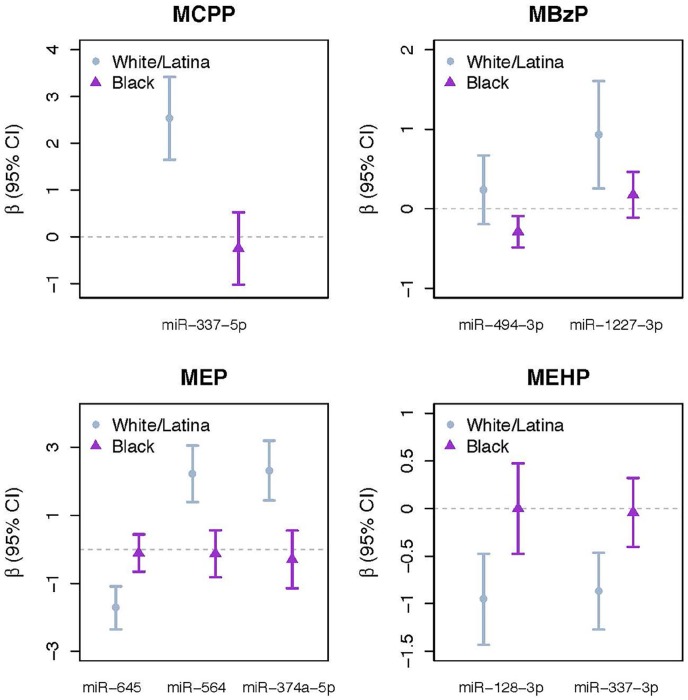
Phthalates are associated with multiple, adverse reproductive outcomes including increased risk of uterine leiomyoma (fibroids). Phthalates can interact with epigenetic modifications including microRNAs (miRNAs), which help regulate processes crucial to fibroid pathogenesis. However, no prior study has examined the influence of phthalates on miRNA expression in fibroid tumors. We conducted a preliminary, cross-sectional study to examine the associations between phthalate exposures and miRNA expression levels in fibroid tumors and to explore potential effect modification by race/ethnicity. We quantified expression levels of 754 miRNAs in fibroid tumor samples and analyzed spot urine samples for phthalate metabolites collected from 45 pre-menopausal women undergoing surgery for fibroid treatment at an academic hospital. Associations between miRNA levels in fibroids and phthalate biomarkers were evaluated using linear regression adjusting for age, race/ethnicity, and body mass index (BMI). Statistical tests were adjusted for multiple comparisons. We also performed in silico Ingenuity Pathway Analysis to identify the biological pathways that are regulated by phthalate-associated miRNAs. Mono-hydroxybutyl phthalate and mono(2-ethyl-5-hydroxyhexyl) phthalate were positively associated with miR-10a-5p (β = 0.76, 95% CI = [0.40, 1.11]) and miR-577 (β = 1.06, 95% CI = [0.53, 1.59]), respectively. A total of 8 phthalate-miRNA associations varied by race/ethnicity (q < 0.10). Pathway analysis revealed that mRNA gene targets of phthalate-associated miRNAs were significantly associated with multiple fibroid-related processes including angiogenesis, apoptosis, and proliferation of connective tissues. Collectively, these data suggest that exposures to some phthalates are associated with miRNA in fibroids, and that associations may vary by race/ethnicity. Validation of these findings may provide insight into mechanisms underlying associations between phthalates and fibroids and contribute to novel hypotheses regarding racial/ethnic disparities in fibroids.
邻苯二甲酸盐与多种不良生殖结局相关,包括子宫平滑肌瘤(纤维瘤)风险增加。邻苯二甲酸盐可与表观遗传修饰相互作用,包括微小RNA(miRNA),其有助于调节对纤维瘤发病机制至关重要的过程。然而,此前尚无研究探讨邻苯二甲酸盐对纤维瘤肿瘤中miRNA表达的影响。我们进行了一项初步的横断面研究,以检查邻苯二甲酸盐暴露与纤维瘤肿瘤中miRNA表达水平之间的关联,并探讨种族/族裔的潜在效应修正作用。我们对纤维瘤肿瘤样本中754种miRNA的表达水平进行了定量,并分析了从一家学术医院接受纤维瘤治疗手术的45名绝经前女性收集的斑点尿样中的邻苯二甲酸盐代谢物。使用线性回归评估纤维瘤中miRNA水平与邻苯二甲酸盐生物标志物之间的关联,并对年龄、种族/族裔和体重指数(BMI)进行调整。对统计检验进行了多重比较调整。我们还进行了计算机 Ingenuity 通路分析,以识别由邻苯二甲酸盐相关miRNA调节的生物通路。邻苯二甲酸单羟基丁酯和邻苯二甲酸单(2-乙基-5-羟基己基)酯分别与miR-10a-5p(β = 0.76,95%CI = [0.40,1.11])和miR-577(β = 1.06,95%CI = [0.53,1.59])呈正相关。共有8种邻苯二甲酸盐与miRNA的关联因种族/族裔而异(q < 0.10)。通路分析表明,邻苯二甲酸盐相关miRNA的mRNA基因靶点与多个纤维瘤相关过程显著相关,包括血管生成、细胞凋亡和结缔组织增殖。总体而言,这些数据表明,接触某些邻苯二甲酸盐与纤维瘤中的miRNA相关,且这种关联可能因种族/族裔而异。对这些发现的验证可能有助于深入了解邻苯二甲酸盐与纤维瘤之间关联的潜在机制,并有助于提出关于纤维瘤种族/族裔差异的新假设。