Loda Teresa, Erschens Rebecca, Junne Florian, Stengel Andreas, Zipfel Stephan, Herrmann-Werner Anne
Medical Department VI/Psychosomatic Medicine and Psychotherapy, University Hospital Tuebingen, Tuebingen, Germany.
Charité Center for Internal Medicine and Dermatology, Department for Psychosomatic Medicine, Charité-Universitätsmedizin Berlin, Berlin, Germany.
JMIR Med Inform. 2020 Mar 2;8(3):e16279. doi: 10.2196/16279.
Previous research shows that being a "digital native" or growing up in a digital environment does not necessarily lead to increased digital competencies, such as digital health literacy or evaluation of webpage quality.
This study showed how medical students searched for health information online, specifically the recommended testing for histamine intolerance, by comparing the use of various search engines (Google, Medisuch, and a website of the student's choice) to find out more about search strategies in future health professionals. As Medisuch presents a qualitatively better search engine, we assumed that medical students using this search engine might find valid information faster on more reliable webpages, and might recommend the correct diagnostic steps for histamine intolerance to their patients more often than students using a generic search engine like Google.
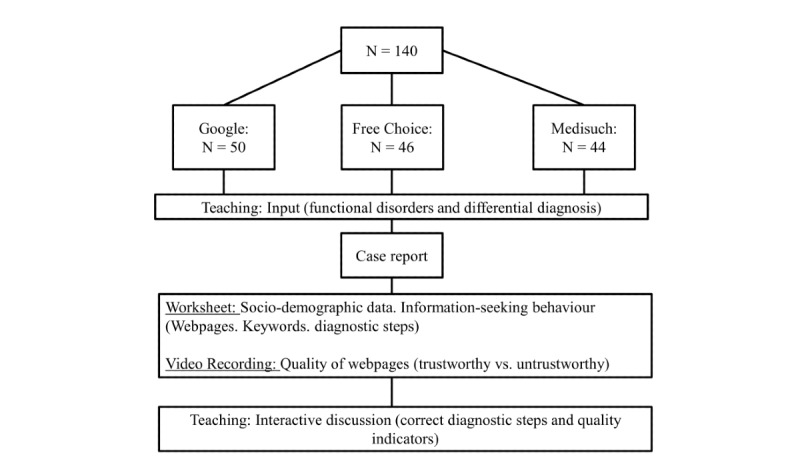
Medical students in their third year of study were asked to find the relevant diagnostic steps of histamine intolerance online. They were randomly assigned to use one search engine: Google, their personal choice, or Medisuch. Their process of seeking information online was video recorded.
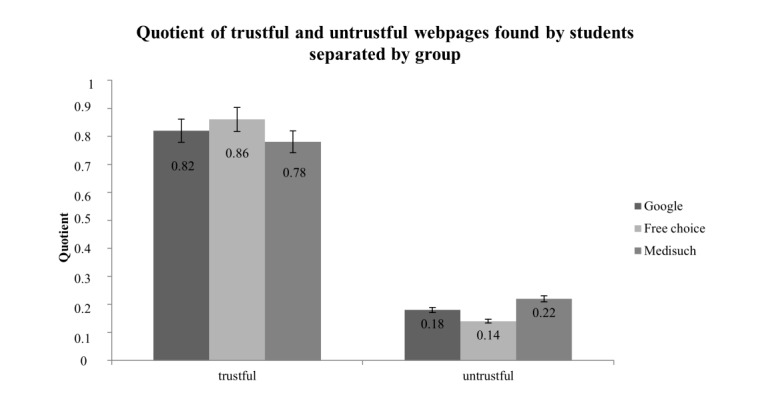
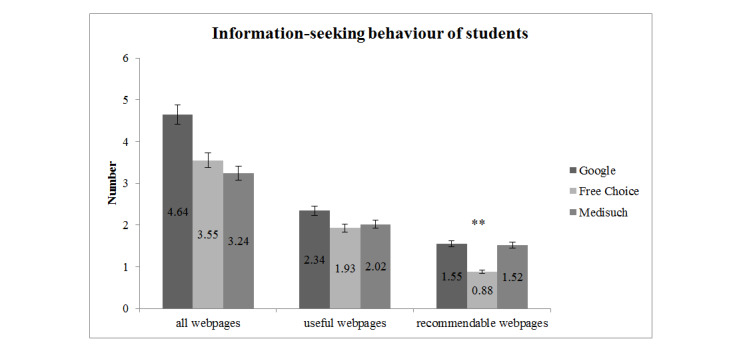
In total, 140 medical students participated in this study. The total number of webpages found did not differ among the groups (P=.52). Students using Medisuch (P=.02) correctly identified the elimination diet as a relevant diagnostic step more frequently. The provocation test was reported by almost half of the students independent of the search engine used. In general, medical students commonly identified trustworthy webpages in all three groups (Google: 36/44, 82%; free choice: 31/36; 86%; and Medisuch: 35/45, 78%).
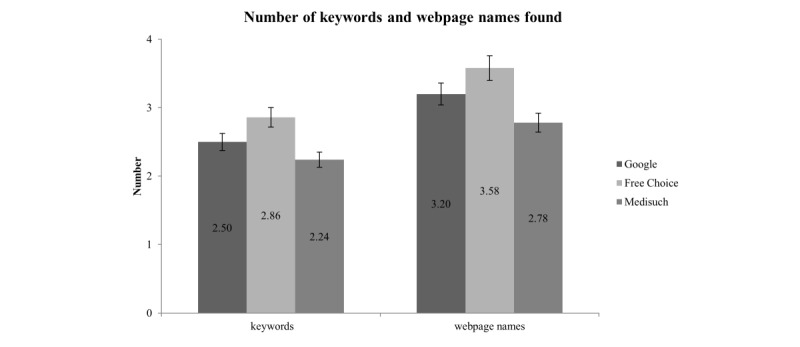
The results indicate that medical students were able to find trustworthy health-related information online independent of the search engine used. Medical students that are digital natives seem to have proper internet skills and a knowledge of how to use them. They entered specific medical terms (evidence-based diagnostic steps) or names of reliable webpages (DocCheck) in the search engines to gain correct information. However, it remains to be seen if this behavior can be called true "digital literacy".
先前的研究表明,作为“数字原住民”或在数字环境中成长并不一定会提高数字能力,如数字健康素养或网页质量评估能力。
本研究通过比较各种搜索引擎(谷歌、Medisuch和学生自选的网站)的使用情况,展示医学生如何在网上搜索健康信息,特别是关于组胺不耐受的推荐检测方法,以了解未来卫生专业人员的搜索策略。由于Medisuch是一个质量上更好的搜索引擎,我们假设使用该搜索引擎的医学生可能会在更可靠的网页上更快地找到有效信息,并且比使用谷歌等通用搜索引擎的学生更频繁地向患者推荐组胺不耐受的正确诊断步骤。
要求三年级医学生在网上查找组胺不耐受的相关诊断步骤。他们被随机分配使用一种搜索引擎:谷歌、他们自己选择的搜索引擎或Medisuch。他们的在线信息搜索过程被录像。
共有140名医学生参与了本研究。各组找到的网页总数没有差异(P = 0.52)。使用Medisuch的学生(P = 0.02)更频繁地正确将排除饮食识别为相关诊断步骤。几乎一半的学生报告了激发试验,与使用的搜索引擎无关。总体而言,三组医学生通常都能识别出值得信赖的网页(谷歌组:36/44,82%;自由选择组:31/36,86%;Medisuch组:35/45,78%)。
结果表明,医学生能够在网上找到与健康相关的可靠信息,而与使用的搜索引擎无关。作为数字原住民的医学生似乎具备适当的互联网技能以及如何使用这些技能的知识。他们在搜索引擎中输入特定的医学术语(循证诊断步骤)或可靠网页的名称(DocCheck)以获取正确信息。然而,这种行为是否能被称为真正的“数字素养”还有待观察。