Sak Gabriele, Diviani Nicola, Allam Ahmed, Schulz Peter J
Institute of Communication and Health (ICH), Università della Svizzera italiana (USI), Via G. Buffi 13, 6900, Lugano, Switzerland.
Amsterdam School of Communication Research / ASCoR, University of Amsterdam, Amsterdam, The Netherlands.
BMC Public Health. 2016 Jan 15;16:38. doi: 10.1186/s12889-016-2722-9.
The exponential increase in health-related online platforms has made the Internet one of the main sources of health information globally. The quality of health contents disseminated on the Internet has been a central focus for many researchers. To date, however, few comparative content analyses of pro- and anti-vaccination websites have been conducted, and none of them compared the quality of information. The main objective of this study was therefore to bring new evidence on this aspect by comparing the quality of pro- and anti-vaccination online sources.
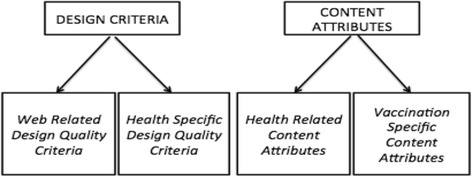
Based on past literature and health information quality evaluation initiatives, a 40-categories assessment tool (Online Vaccination Information Quality Codebook) was developed and used to code a sample of 1093 webpages retrieved via Google and two filtered versions of the same search engine. The categories investigated were grouped into four main quality dimensions: web-related design quality criteria (10 categories), health-specific design quality criteria (3 categories), health related content attributes (12 categories) and vaccination-specific content attributes (15 categories). Data analysis comprised frequency counts, cross tabulations, Pearson's chi-square, and other inferential indicators.
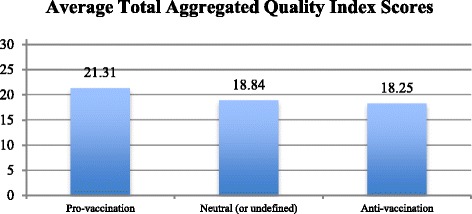
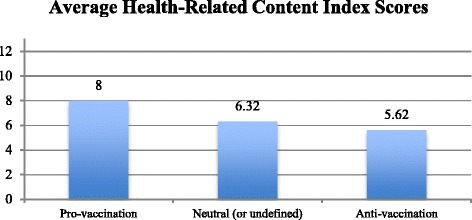
The final sample included 514 webpages in favor of vaccination, 471 against, and 108 neutral. Generally, webpages holding a favorable view toward vaccination presented more quality indicators compared to both neutral and anti-vaccination pages. However, some notable exceptions to this rule were observed. In particular, no differences were found between pro- and anti-vaccination webpages as regards vaccination-specific content attributes.
Our analyses showed that the overall quality of pro-vaccination webpages is superior to anti-vaccination online sources. The developed coding scheme was proven to be a helpful and reliable tool to judge the quality of vaccination-related webpages. Based on the results, we advance recommendations for online health information providers as well as directions for future research in this field.
与健康相关的在线平台呈指数级增长,使互联网成为全球健康信息的主要来源之一。互联网上传播的健康内容质量一直是许多研究人员关注的焦点。然而,迄今为止,很少有对支持和反对疫苗接种网站的比较性内容分析,而且没有一项分析比较过信息质量。因此,本研究的主要目的是通过比较支持和反对疫苗接种的在线资源的质量,为这方面提供新的证据。
基于以往的文献和健康信息质量评估倡议,开发了一个包含40个类别的评估工具(在线疫苗接种信息质量编码手册),并用于对通过谷歌及其两个过滤版本检索到的1093个网页样本进行编码。所调查的类别分为四个主要质量维度:与网络相关的设计质量标准(10个类别)、特定健康的设计质量标准(3个类别)、与健康相关的内容属性(12个类别)和与疫苗接种相关的内容属性(15个类别)。数据分析包括频率计数、交叉列表、皮尔逊卡方检验和其他推断指标。
最终样本包括514个支持疫苗接种的网页、471个反对疫苗接种的网页和108个中立的网页。总体而言,与中立和反对疫苗接种的网页相比,对疫苗接种持支持态度的网页呈现出更多的质量指标。然而,也观察到了该规则的一些显著例外。特别是,在与疫苗接种相关的内容属性方面,支持和反对疫苗接种的网页之间没有发现差异。
我们的分析表明,支持疫苗接种的网页的整体质量优于反对疫苗接种的在线资源。所开发的编码方案被证明是判断与疫苗接种相关网页质量的一个有用且可靠的工具。基于这些结果,我们为在线健康信息提供者提出了建议,并为该领域的未来研究指明了方向。