Centre for Ophthalmology Tübingen, University Eye Hospital, Tübingen, Germany.
Experimental Eye Research Institute, University Eye Hospital, Ruhr-University Bochum, Bochum, Germany.
J Cell Mol Med. 2020 Apr;24(7):4312-4323. doi: 10.1111/jcmm.15091. Epub 2020 Mar 4.
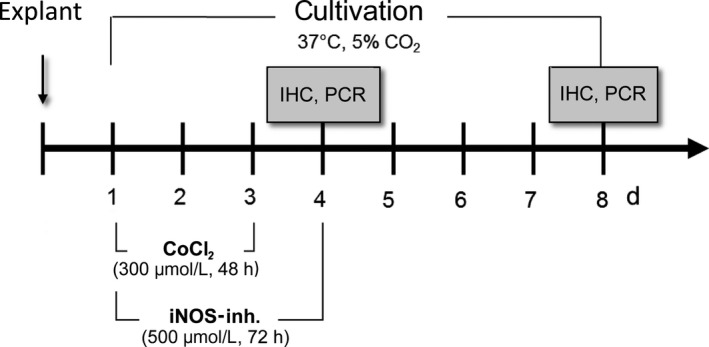
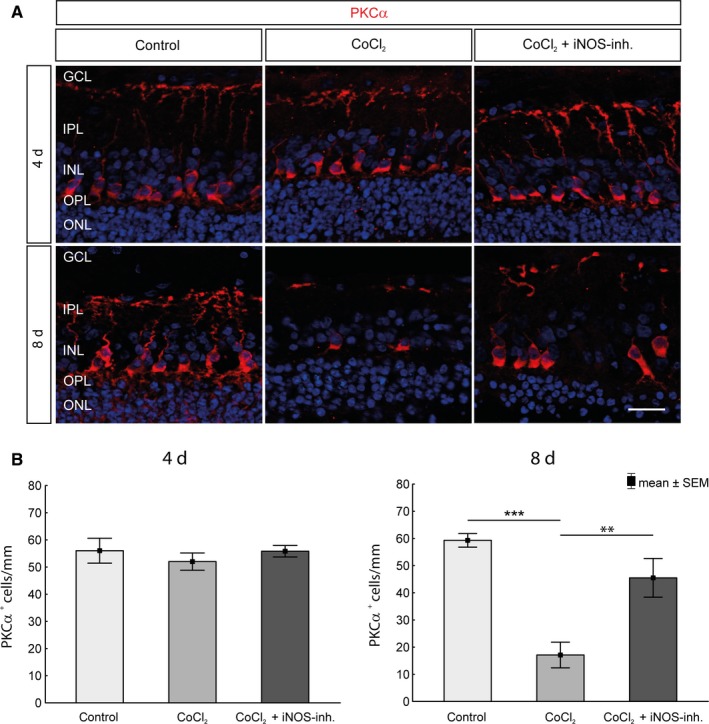
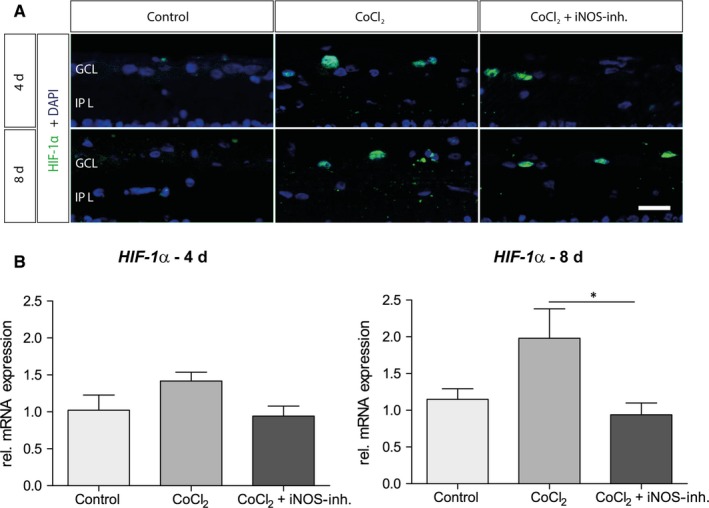
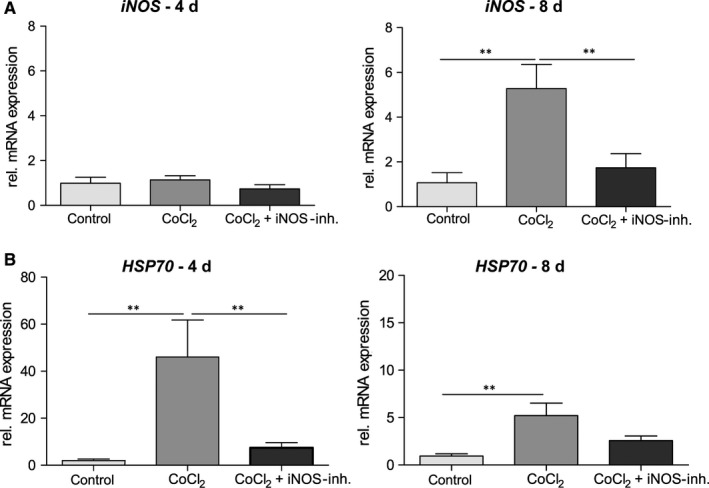
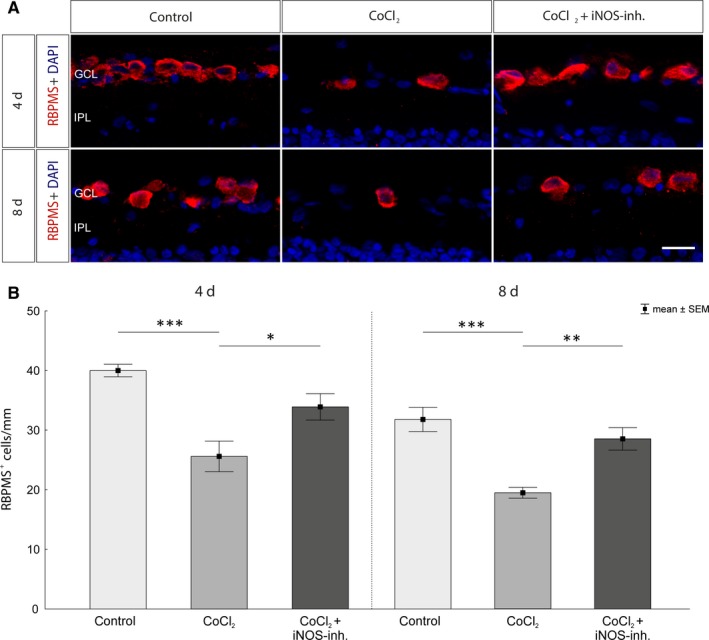
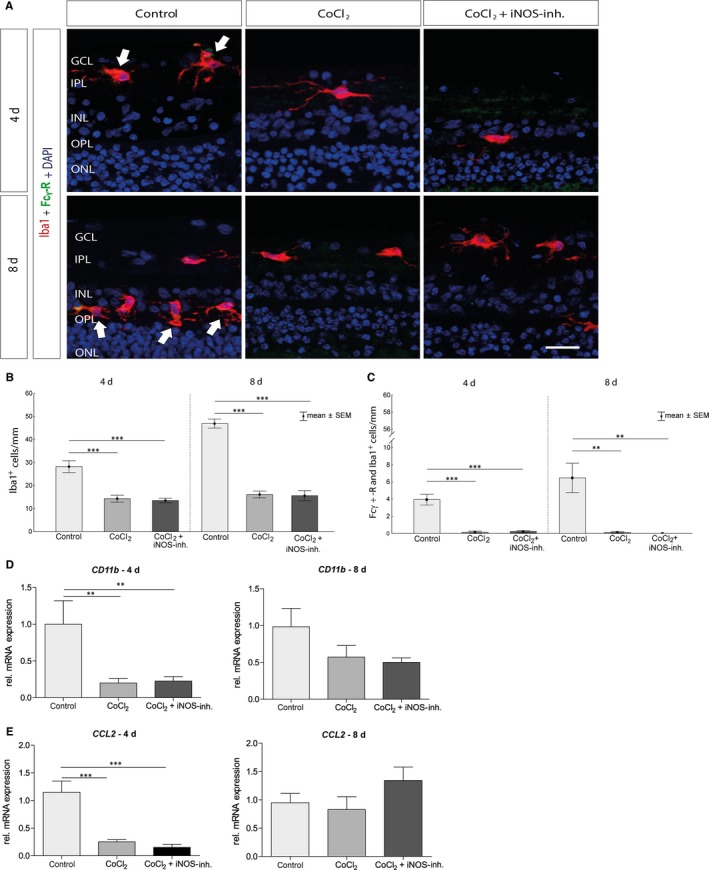
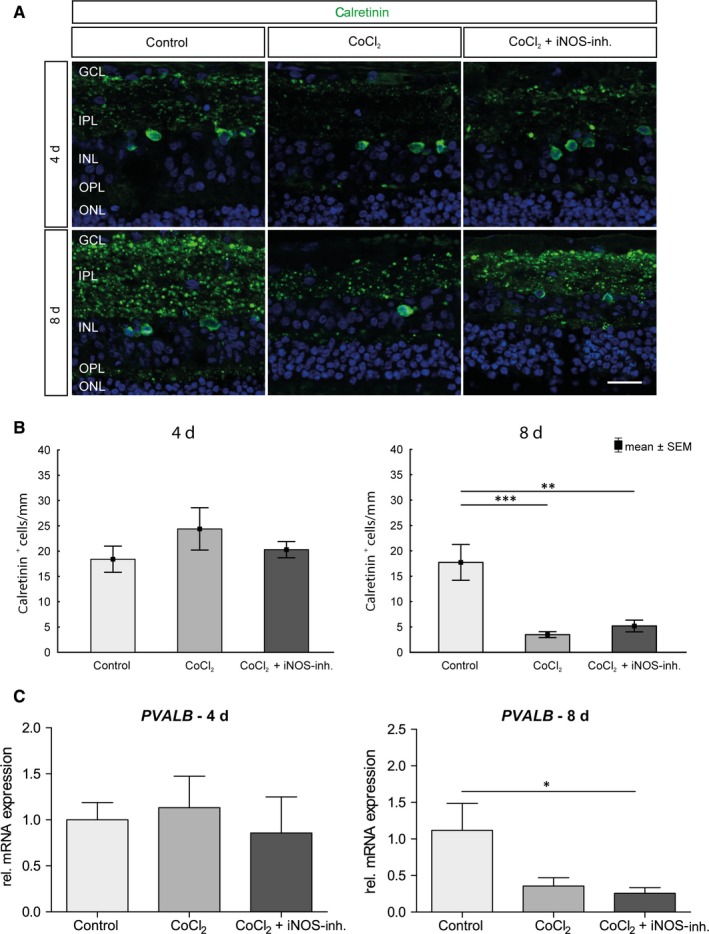
Nitrite oxide plays an important role in the pathogenesis of various retinal diseases, especially when hypoxic processes are involved. This degeneration can be simulated by incubating porcine retinal explants with CoCl . Here, the therapeutic potential of iNOS-inhibitor 1400W was evaluated. Degeneration through CoCl and treatment with the 1400W were applied simultaneously to porcine retinae explants. Three groups were compared: control, CoCl , and CoCl + iNOS-inhibitor (1400W). At days 4 and 8, retinal ganglion cells (RGCs), bipolar, and amacrine cells were analysed. Furthermore, the influence on the glia cells and different stress markers were evaluated. Treatment with CoCl resulted in a significant loss of RGCs already after 4 days, which was counteracted by the iNOS-inhibitor. Expression of HIF-1α and its downstream targets confirmed the effective treatment with 1400W. After 8 days, the CoCl group displayed a significant loss in amacrine cells and also a drastic reduction in bipolar cells was observed, which was prevented by 1400W. The decrease in microglia could not be prevented by the inhibitor. CoCl induces strong degeneration in porcine retinae by mimicking hypoxia, damaging certain retinal cell types. Treatment with the iNOS-inhibitor counteracted these effects to some extent, by preventing loss of retinal ganglion and bipolar cells. Hence, this inhibitor seems to be a very promising treatment for retinal diseases.
亚硝酸盐氧化物在各种视网膜疾病的发病机制中起着重要作用,尤其是在涉及缺氧过程时。通过用 CoCl 孵育猪视网膜外植体可以模拟这种退化。本文评估了 iNOS 抑制剂 1400W 的治疗潜力。将 CoCl 和 1400W 同时应用于猪视网膜外植体以诱导退化。比较了三组:对照组、CoCl 组和 CoCl + iNOS 抑制剂(1400W)组。在第 4 天和第 8 天,分析视网膜神经节细胞(RGCs)、双极细胞和无长突细胞。此外,还评估了对神经胶质细胞和不同应激标志物的影响。用 CoCl 处理导致 RGCs 在第 4 天就明显丢失,而 iNOS 抑制剂可拮抗这种丢失。HIF-1α及其下游靶标的表达证实了 1400W 的有效治疗。在第 8 天,CoCl 组的无长突细胞明显丢失,同时也观察到双极细胞急剧减少,而 1400W 可预防这种减少。抑制剂不能防止小胶质细胞的减少。通过模拟缺氧,CoCl 诱导猪视网膜强烈退化,破坏某些视网膜细胞类型。用 iNOS 抑制剂治疗在一定程度上对抗了这些作用,防止了视网膜神经节和双极细胞的丢失。因此,这种抑制剂似乎是治疗视网膜疾病的一种很有前途的方法。