Management Institute of Xinxiang Medical University, Xinxiang, China.
Department of General Medicine, Henan Provincial People's Hospital, School of Clinical Medicine, Henan University, Zhengzhou, China.
BMC Health Serv Res. 2020 Mar 4;20(1):167. doi: 10.1186/s12913-020-5026-9.
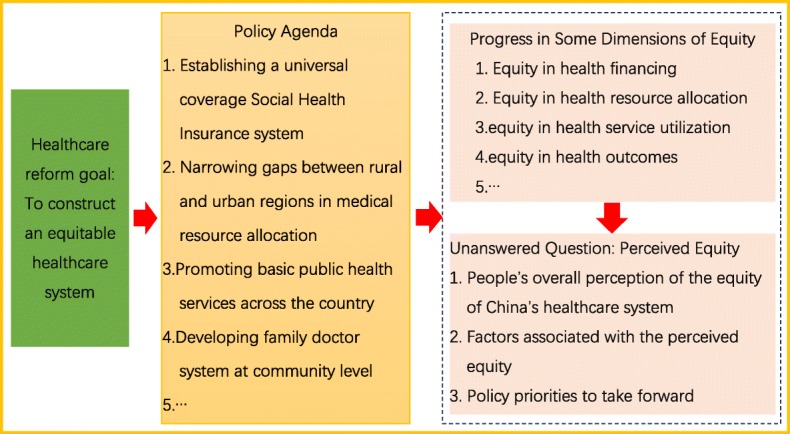
Building an equitable health care system involves both the promotion of social justice in health and people's subjective perception of the promotion. This study aimed to analyze the overall status and associated factors of the perceived equity of the Chinese health care system, and then to offer policy recommendations for health care reform.
Information on the perceived equity score (scale 0 to 10) of 10,243 valid cases in total were derived from the data set of Chinese Social Survey 2015. Univariate analysis methods were applied to present respondents' overall perceived equity of the Chinese health care system. Multivariate linear regression method was used to explore the associated factors of the perceived equity and examine their independent effect.
The respondents gave positive but relatively low marks (6.7 ± 2.6, 95% CI: = 6.646.74) of the equity of the Chinese health care system. Younger respondents reported a higher score of perceived equity than their elder counterparts (β = - 0.132, 95% CI: - 0.203 - 0.062, P < 0.001). Respondents with lower education level were significantly more likely to consider the Chinese health care system equitable (β = - 0.104, 95% CI: - 0.153~ - 0.056, P < 0.001). Respondents satisfied with the Social Health Insurance reimbursement ratio tended to score the system higher in the survey (β = 0.044, 95% CI: 0.0240.063, P < 0.001). Respondents residing in eastern China and rural areas were significantly more likely to consider the Chinese health care system equitable (β = - 0.268, 95% CI: - 0.338 - 0.199, P < 0.001). Meanwhile, rural respondents reported higher scores of the perceived equity than urban respondents did (β = 0.348, 95% CI: 0.2370.458, P < 0.001). Respondents from regions with adequate GPs scored the system higher in this survey (β = 0.087, 95% CI: 0.0080.165, P < 0.001). The present study found no influence of gender, economic status, Social Health Insurance coverage, or satisfaction with the latest treatment on perceived equity.
Eliminating the sense of inequity among a range of populations should be prioritized in health care reform. A national-level investigation system to rate residents' perceived equity was necessary for global health care reform.
构建公平的医疗保健体系既涉及健康领域的社会公正促进,也涉及人们对促进的主观感知。本研究旨在分析中国医疗保健系统感知公平的整体状况及相关因素,为医疗改革提供政策建议。
本研究基于 2015 年中国社会综合调查的有效数据(共 10243 例),得出感知公平得分(0-10 分)的总体情况。采用单因素分析方法呈现受访者对中国医疗保健系统整体感知公平的情况。采用多元线性回归方法探索感知公平的相关因素及其独立影响。
受访者对中国医疗保健系统的公平性给予了积极但相对较低的评价(6.7±2.6,95%置信区间:6.646.74)。年轻受访者比年长受访者报告了更高的感知公平得分(β=-0.132,95%置信区间:-0.203-0.062,P<0.001)。受教育程度较低的受访者更有可能认为中国的医疗保健系统是公平的(β=-0.104,95%置信区间:-0.153-0.066,P<0.001)。对社会医疗保险报销比例满意的受访者在调查中更倾向于给系统高分(β=0.044,95%置信区间:0.0240.063,P<0.001)。居住在东部和农村地区的受访者更有可能认为中国的医疗保健系统是公平的(β=-0.268,95%置信区间:-0.338-0.199,P<0.001)。同时,农村受访者的感知公平得分高于城市受访者(β=0.348,95%置信区间:0.2370.458,P<0.001)。本研究发现,受访者的性别、经济状况、社会医疗保险覆盖范围或对最新治疗的满意度对感知公平均没有影响。
在医疗改革中,应优先消除不同人群的不公平感。建立全国性的居民感知公平评价体系,对全球医疗改革具有重要意义。