Department of Health Sciences, Faculty of Science, Vrije Universiteit Amsterdam, Amsterdam Public Health research institute, Amsterdam, The Netherlands.
Nuffield Department of Orthopaedics, Rheumatology and Musculoskeletal Sciences, University of Oxford, Oxford, UK.
Int J Behav Nutr Phys Act. 2020 Mar 4;17(1):30. doi: 10.1186/s12966-020-00934-7.
Increasing physical activity reduces the risk of chronic illness including Type 2 diabetes, cardiovascular disease and certain types of cancer. Lifestyle interventions can increase physical activity but few successfully engage men. This study aims to investigate the 5 year cost-effectiveness of EuroFIT, a program to improve physical activity tailored specifically for male football (soccer) fans compared to a no intervention comparison group.
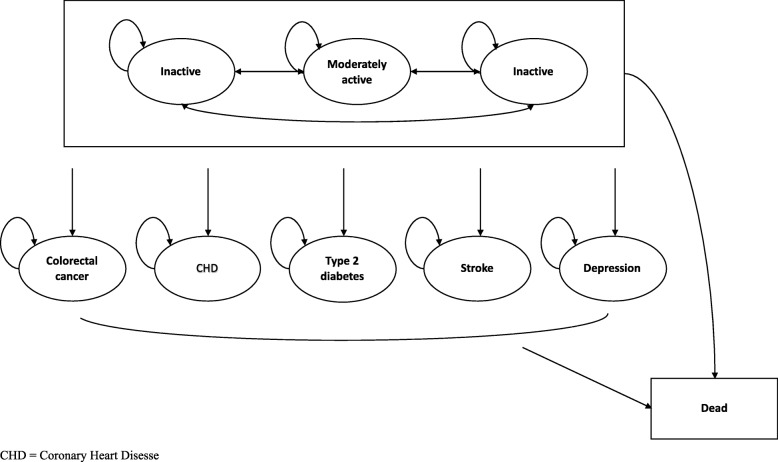
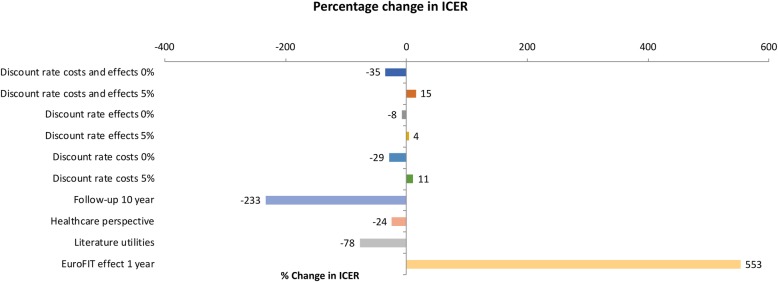
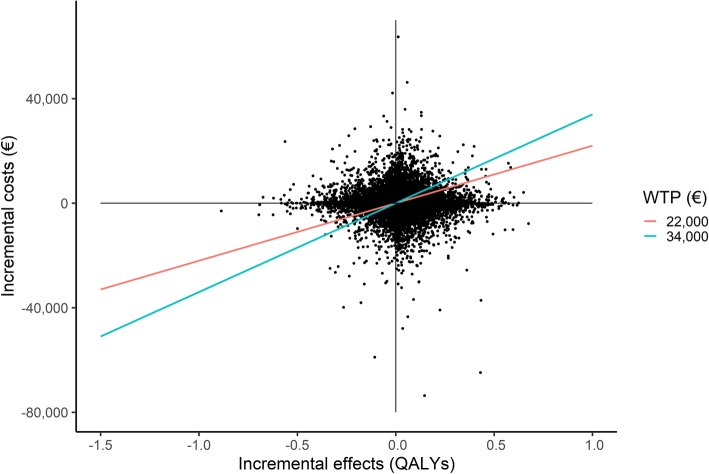
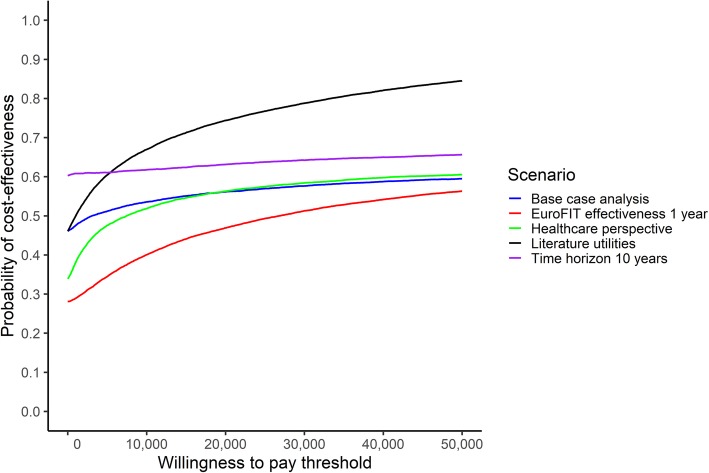
We developed a Markov cohort model in which the impact of improving physical activity on five chronic health conditions (colorectal cancer, Type 2 diabetes, coronary heart disease, stroke and depression) and mortality was modelled. We estimated costs from a societal perspective and expressed benefits as quality adjusted life years (QALYs). We obtained data from a 4-country (England, Netherlands, Portugal and Norway) pragmatic randomised controlled trial evaluating EuroFIT, epidemiological and cohort studies, and meta-analyses. We performed deterministic and probabilistic sensitivity analyses to assess the impact of uncertainty in the model's parameter values on the cost-effectiveness results. We used Monte Carlo simulations to estimate uncertainty and presented this using cost-effectiveness acceptability curves (CEACs). We tested the robustness of the base case analysis using five scenario analyses.
Average costs over 5 years per person receiving EuroFIT were €14,663 and per person receiving no intervention €14,598. Mean QALYs over 5 years were 4.05 per person for EuroFIT and 4.04 for no intervention. Thus, the average incremental cost per person receiving EuroFIT was €65 compared to no intervention, while the average QALY gain was 0.01. This resulted in an ICER of €5206 per QALY gained. CEACs show that the probability of EuroFIT being cost-effective compared to no intervention is 0.53, 0.56 and 0.58 at thresholds of €10,000, €22,000 and €34,000 per QALY gained, respectively. When using a time horizon of 10 years, the results suggest that EuroFIT is more effective and less expensive compared to (i.e. dominant over) no intervention with a probability of cost-effectiveness of 0.63 at a threshold of €22,000 per QALY gained.
We conclude the EuroFIT intervention is not cost-effective compared to no intervention over a period of 5 years from a societal perspective, but is more effective and less expensive (i.e. dominant) after 10 years. We thus suggest that EuroFIT can potentially improve public health in a cost-effective manner in the long term.
增加身体活动可降低包括 2 型糖尿病、心血管疾病和某些类型癌症在内的慢性病风险。生活方式干预可以增加身体活动,但很少有干预措施能成功吸引男性参与。本研究旨在调查 EuroFIT 的 5 年成本效益,这是一个专门针对男性足球(英式足球)迷的提高身体活动的项目,与无干预对照组相比。
我们开发了一个马尔可夫队列模型,其中改善身体活动对五种慢性健康状况(结直肠癌、2 型糖尿病、冠心病、中风和抑郁症)和死亡率的影响进行了建模。我们从社会角度估算了成本,并以质量调整生命年(QALYs)表示收益。我们从一项四国(英格兰、荷兰、葡萄牙和挪威)实用随机对照试验评估 EuroFIT、流行病学和队列研究以及荟萃分析中获取数据。我们进行了确定性和概率敏感性分析,以评估模型参数值不确定性对成本效益结果的影响。我们使用蒙特卡罗模拟来估计不确定性,并使用成本效益接受性曲线(CEACs)来表示。我们使用五种情景分析来测试基础案例分析的稳健性。
接受 EuroFIT 治疗的每个人在 5 年内的平均个人成本为 14663 欧元,而不接受干预的每个人的成本为 14598 欧元。接受 EuroFIT 治疗的人在 5 年内的平均 QALY 为 4.05,而不接受干预的人为 4.04。因此,接受 EuroFIT 治疗的每个人的平均增量成本比不接受干预的人高出 65 欧元,而 QALY 的平均增益为 0.01。这导致每获得一个 QALY 的增量成本为 5206 欧元。CEAC 表明,与不干预相比,EuroFIT 的成本效益概率在 10000 欧元、22000 欧元和 34000 欧元的门槛下分别为 0.53、0.56 和 0.58。当使用 10 年时间范围时,结果表明与不干预相比,EuroFIT 更有效且成本更低,在获得每 QALY 22000 欧元的阈值下,成本效益的概率为 0.63。
从社会角度来看,我们得出的结论是,在 5 年内,与不干预相比,EuroFIT 干预措施并不具有成本效益,但在 10 年后,它更有效且成本更低(即占优势)。因此,我们认为 EuroFIT 从长期来看可以以具有成本效益的方式改善公共卫生。