Department of Rehabilitation, Donders Institute for Brain, Cognition and Behaviour, Radboud university medical center, PO Box 9101, 6500, HB, Nijmegen, The Netherlands.
HAN University of Applied Sciences, PO Box 6960, 6503, GL, Nijmegen, The Netherlands.
Orphanet J Rare Dis. 2020 Mar 4;15(1):64. doi: 10.1186/s13023-020-1338-4.
Hereditary spastic paraplegia (HSP) is a group of inherited disorders characterized by progressive spastic paresis of the lower limbs. Treatment is often focused on reducing spasticity and its physical consequences. To better address individual patients' needs, we investigated a broad range of experienced complaints, activity limitations, and loss of motor capacities in pure HSP. In addition, we aimed to identify patient characteristics that are associated with increased fall risk and/or reduced walking capacity.
We developed and distributed an HSP-specific online questionnaire in the Netherlands. A total of 109 out of 166 questionnaires returned by participants with pure HSP were analyzed.
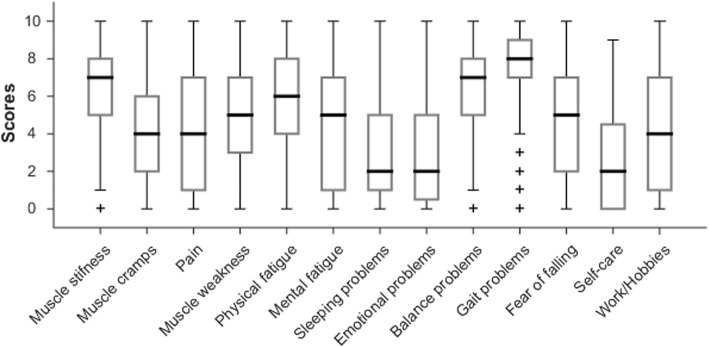
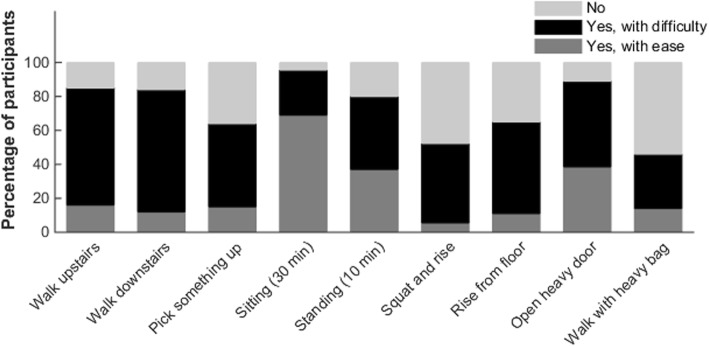
Participants experienced the greatest burden from muscle stiffness and limited standing and walking activities, while 72% reported leg and/or back pain. Thirty-five and 46% reported to use walking aids (e.g. crutches) indoors and outdoors, respectively; 57% reported a fall incidence of at least twice a year ('fallers'); in 51% a fall had led to an injury at least once; and 73% reported fear of falling. Duration of spasticity and incapacity to rise from the floor were positively associated with being a 'faller', whereas non-neurological comorbidity and wheelchair use were negatively associated. Higher age, experienced gait problems, not being able to stand for 10 min, and incapacity to open a heavy door showed a negative association with being a 'walker without aids' (> 500 m).
Our results emphasize the large impact of spastic paraparesis on the lives of people with pure HSP and contribute to a better understanding of possible targets for rehabilitation.
遗传性痉挛性截瘫(HSP)是一组以进行性下肢痉挛性弛缓为特征的遗传性疾病。治疗通常侧重于降低痉挛及其身体后果。为了更好地满足个体患者的需求,我们研究了纯 HSP 患者广泛的体验性投诉、活动受限和运动能力丧失。此外,我们旨在确定与增加跌倒风险和/或降低行走能力相关的患者特征。
我们在荷兰开发并分发了一份专门针对 HSP 的在线问卷。共有 166 名纯 HSP 参与者中,有 109 名返回了问卷。
参与者体验到最大的负担来自肌肉僵硬和站立及行走活动受限,而 72%的人报告腿部和/或背部疼痛。35%和 46%的人分别报告在室内和室外使用助行器(如拐杖);57%的人报告每年至少跌倒两次(“跌倒者”);51%的人至少因跌倒而受伤一次;73%的人报告害怕跌倒。痉挛持续时间和无法从地板上站起来与成为“跌倒者”呈正相关,而无神经学合并症和使用轮椅与成为“跌倒者”呈负相关。较高的年龄、经历步态问题、无法站立 10 分钟、无法打开重门与不能作为“无辅助行走者”(>500 米)呈负相关。
我们的结果强调了痉挛性截瘫对纯 HSP 患者生活的巨大影响,并有助于更好地理解康复的可能目标。