Matić Zoran, Platiša Mirjana M, Kalauzi Aleksandar, Bojić Tijana
Biomedical Engineering and Technology, University of Belgrade, Belgrade, Serbia.
Faculty of Medicine, Institute of Biophysics, University of Belgrade, Belgrade, Serbia.
Front Physiol. 2020 Feb 14;11:24. doi: 10.3389/fphys.2020.00024. eCollection 2020.
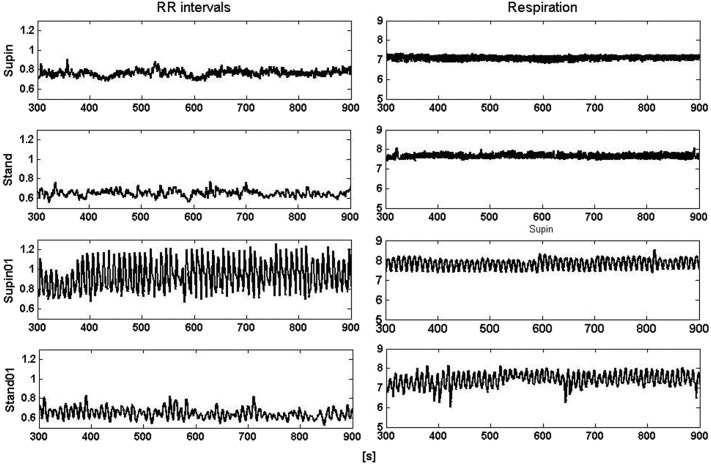
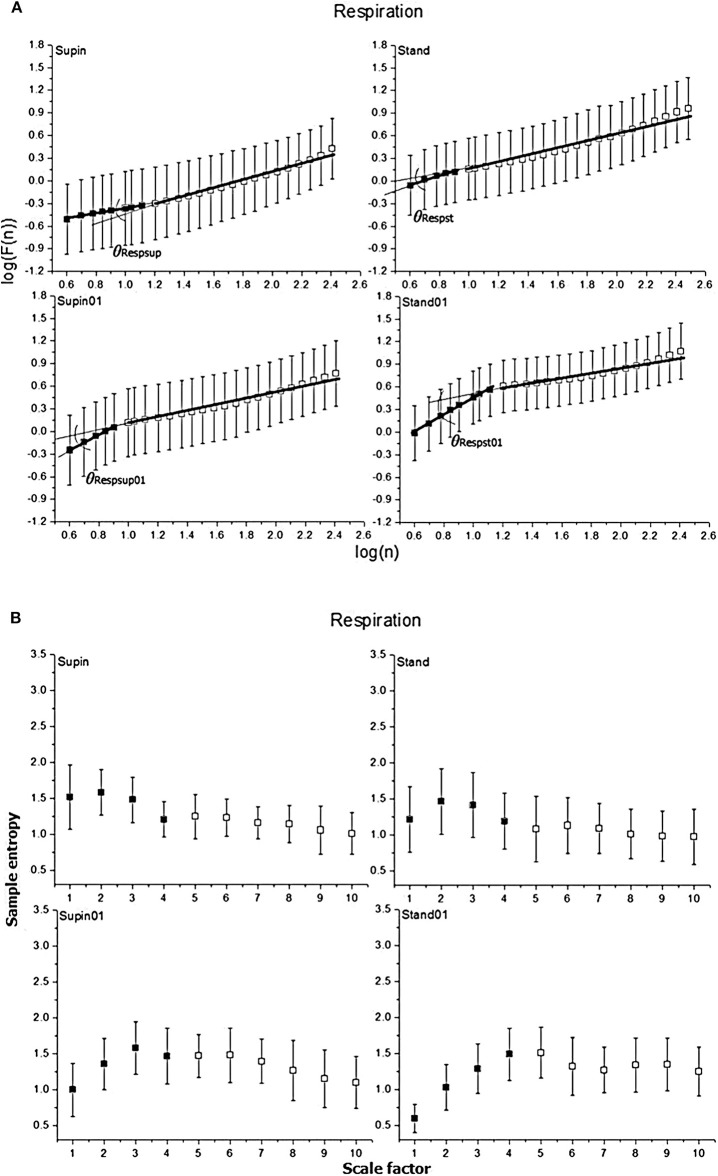
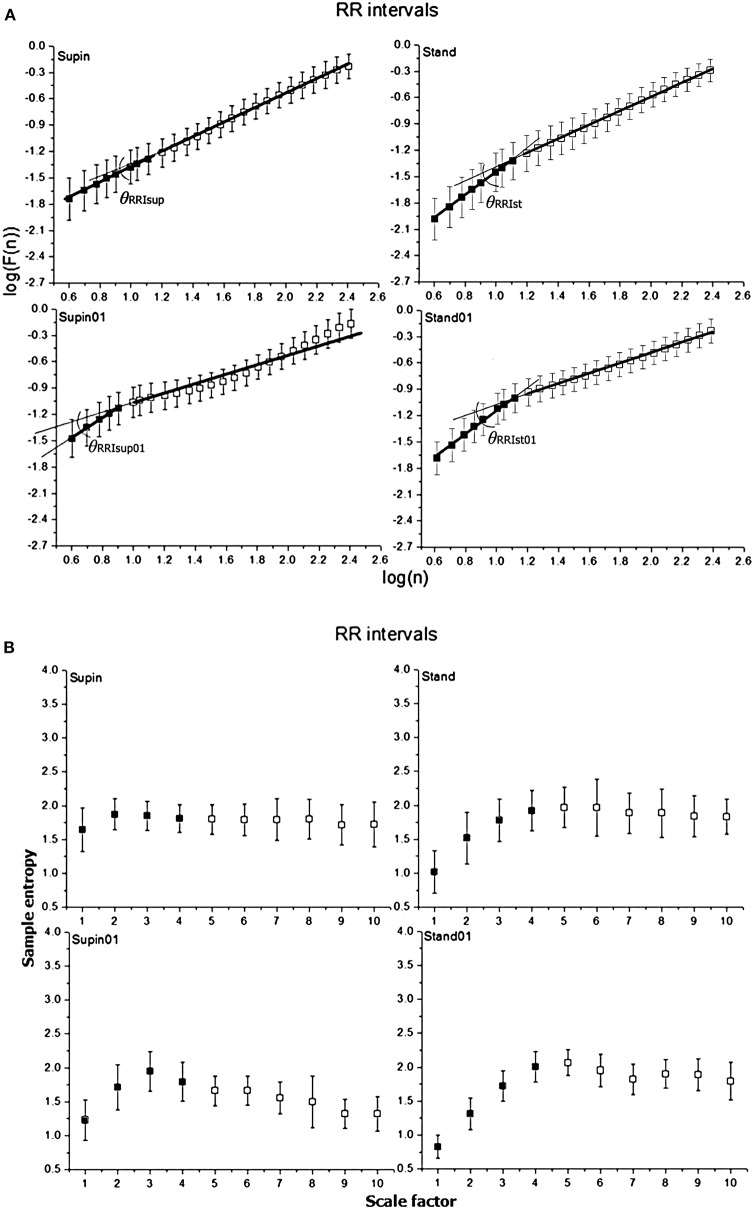
We explored the physiological background of the non-linear operating mode of cardiorespiratory oscillators as the fundamental question of cardiorespiratory homeodynamics and as a prerequisite for the understanding of neurocardiovascular diseases. We investigated 20 healthy human subjects for changes using electrocardiac RR interval (RRI) and respiratory signal (Resp) Detrended Fluctuation Analysis (DFA, α, α, α, α), Multiple Scaling Entropy (MSE, MSE, MSE, MSE), spectral coherence (Coh), cross DFA (ρ and ρ) and cross MSE (X and X) indices in four physiological conditions: supine with spontaneous breathing, standing with spontaneous breathing, supine with 0.1 Hz breathing and standing with 0.1 Hz breathing. Standing is primarily characterized by the change of RRI parameters, insensitivity to change with respiratory parameters, decrease of Coh and insensitivity to change of in ρ, ρ, X, and X. Slow breathing in supine position was characterized by the change of the linear and non-linear parameters of both signals, reflecting the dominant vagal RRI modulation and the impact of slow 0.1 Hz breathing on Resp parameters. Coh did not change with respect to supine position, while ρ increased. Slow breathing in standing reflected the qualitatively specific state of autonomic regulation with striking impact on both cardiac and respiratory parameters, with specific patterns of cardiorespiratory coupling. Our results show that cardiac and respiratory short term and long term complexity parameters have different, state dependent patterns. Sympathovagal non-linear interactions are dependent on the pattern of their activation, having different scaling properties when individually activated with respect to the state of their joint activation. All investigated states induced a change of α vs. α relationship, which can be accurately expressed by the proposed measure-inter-fractal angle θ. Short scale (α vs. MSE) and long scale (α vs. MSE) complexity measures had reciprocal interrelation in standing with 0.1 Hz breathing, with specific cardiorespiratory coupling pattern (ρ vs. X). These results support the hypothesis of hierarchical organization of cardiorespiratory complexity mechanisms and their recruitment in ascendant manner with respect to the increase of behavioral challenge complexity. Specific and comprehensive cardiorespiratory regulation in standing with 0.1 Hz breathing suggests this state as the potentially most beneficial maneuver for cardiorespiratory conditioning.
我们探讨了心肺振荡器非线性运行模式的生理背景,将其作为心肺自稳态动力学的基本问题以及理解神经心血管疾病的先决条件。我们使用心电RR间期(RRI)和呼吸信号(Resp)的去趋势波动分析(DFA,α,α,α,α)、多重标度熵(MSE,MSE,MSE,MSE)、谱相干(Coh)、交叉DFA(ρ和ρ)以及交叉MSE(X和X)指数,在四种生理状态下对20名健康人类受试者进行了变化研究:仰卧位自主呼吸、站立位自主呼吸、仰卧位0.1Hz呼吸以及站立位0.1Hz呼吸。站立位的主要特征是RRI参数变化、对呼吸参数变化不敏感、Coh降低以及对ρ、ρ、X和X的变化不敏感。仰卧位慢呼吸的特征是两个信号的线性和非线性参数均发生变化,反映了迷走神经对RRI的主导调节以及0.1Hz慢呼吸对Resp参数的影响。Coh相对于仰卧位没有变化,而ρ增加。站立位慢呼吸反映了自主调节的定性特定状态,对心脏和呼吸参数均有显著影响,具有特定的心肺耦合模式。我们的结果表明,心脏和呼吸的短期和长期复杂性参数具有不同的、依赖状态的模式。交感迷走神经非线性相互作用取决于其激活模式,相对于其联合激活状态单独激活时具有不同的标度特性。所有研究状态均引起α与α关系的变化,这可以通过所提出的测量指标——分形间角度θ准确表达。在站立位0.1Hz呼吸时,短尺度(α与MSE)和长尺度(α与MSE)复杂性测量指标具有相互关系,具有特定的心肺耦合模式(ρ与X)。这些结果支持了心肺复杂性机制分层组织的假说,以及它们随着行为挑战复杂性增加而以上升方式被招募的观点。站立位0.1Hz呼吸时特定且全面的心肺调节表明这种状态可能是心肺调节最有益的方式。