Klein Dylan J, McKeever Kenneth H, Mirek Emily T, Anthony Tracy G
Department of Health and Exercise Science, Rowan University, Glassboro, NJ, United States.
Rutgers Equine Science Center, Department of Animal Sciences, Rutgers, The State University of New Jersey, New Brunswick, NJ, United States.
Front Physiol. 2020 Feb 18;11:110. doi: 10.3389/fphys.2020.00110. eCollection 2020.
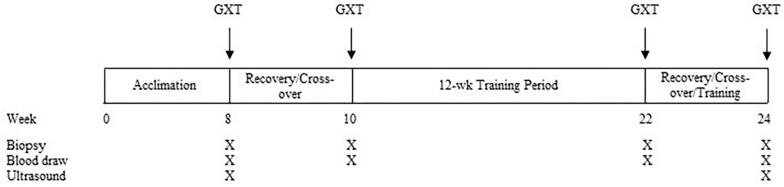
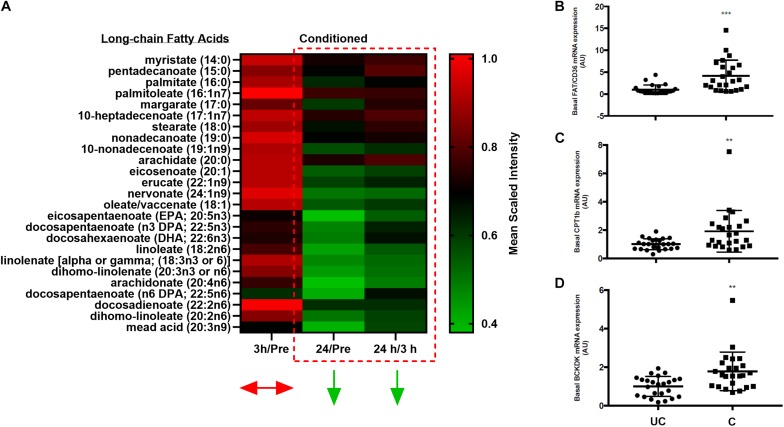
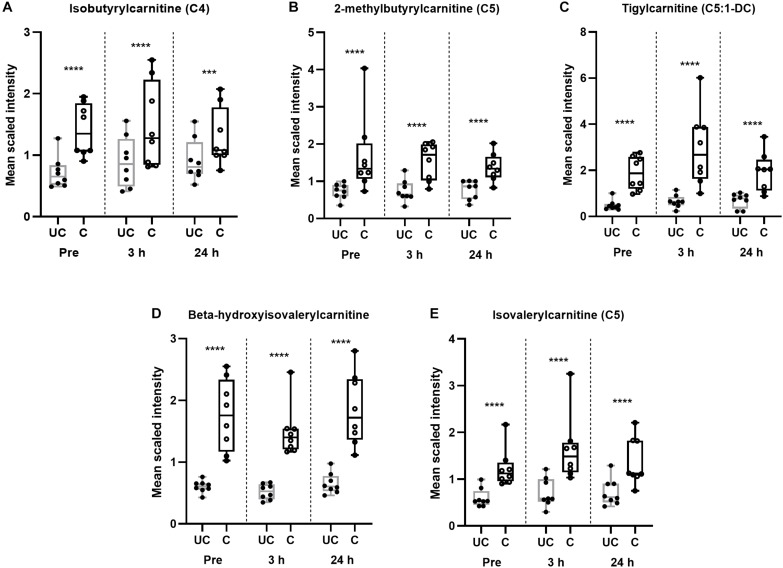
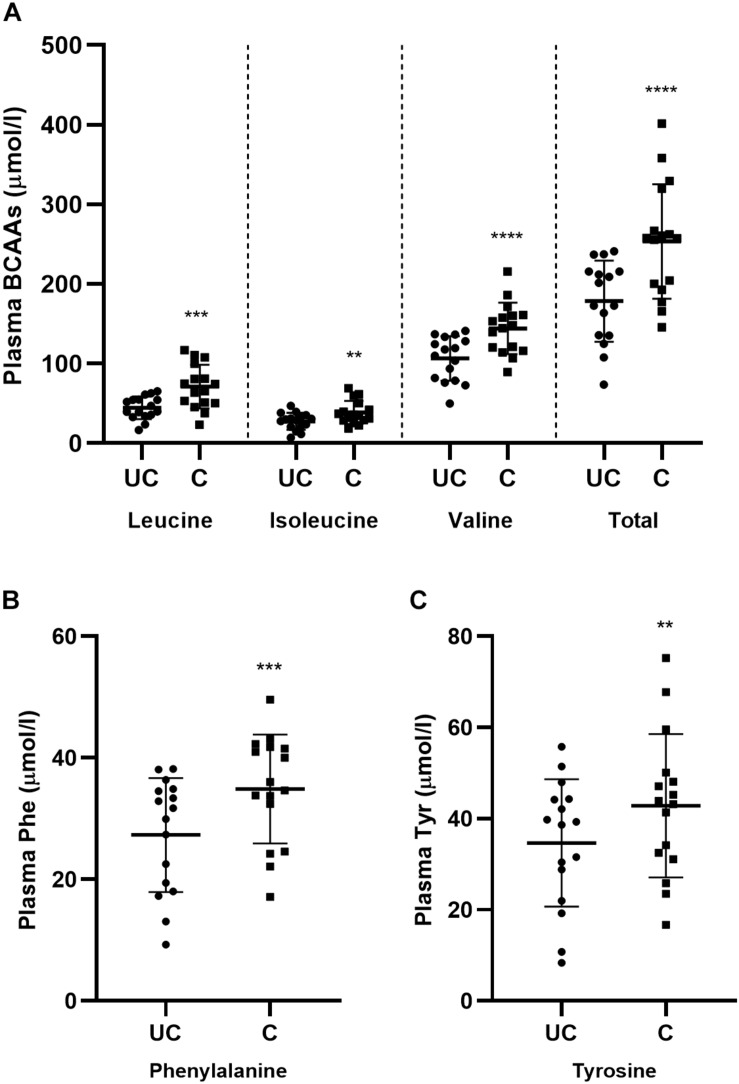
The athletic horse, despite being over 50% muscle mass, remains understudied with regard to the effects of exercise and training on skeletal muscle metabolism. To begin to address this knowledge gap, we employed an untargeted metabolomics approach to characterize the exercise-induced and fitness-related changes in the skeletal muscle of eight unconditioned Standardbred horses (four male, four female) before and after a 12-week training period. Before training, unconditioned horses showed a high degree of individual variation in the skeletal muscle metabolome, resulting in very few differences basally and at 3 and 24 h after acute fatiguing exercise. Training did not alter body composition but did improve maximal aerobic and running capacities ( < 0.05), and significantly altered the skeletal muscle metabolome ( < 0.05, < 0.1). While sex independently influenced body composition and distance run following training ( < 0.05), sex did not affect the skeletal muscle metabolome. Exercise-induced metabolomic alterations ( < 0.05, < 0.1) largely centered on the branched-chain amino acids (BCAA), xenobiotics, and a variety of lipid and nucleotide-related metabolites, particularly in the conditioned state. Further, training increased ( < 0.05, < 0.1) the relative abundance of almost every identified lipid species, and this was accompanied by increased plasma BCAAs ( < 0.0005), phenylalanine ( = 0.01), and tyrosine ( < 0.02). Acute exercise in the conditioned state decreased ( < 0.05, < 0.1) the relative abundance of almost all lipid-related species in skeletal muscle by 24 h post-exercise, whereas plasma amino acids remained unaltered. These changes occurred alongside increased muscle gene expression ( < 0.05) related to lipid uptake () and lipid () and BCAA () utilization. This work suggests that metabolites related to amino acid, lipid, nucleotide and xenobiotic metabolism play pivotal roles in the response of equine skeletal muscle to vigorous exercise and training. Use of these and future data sets could be used to track the impact of training and fitness on equine health and may lead to novel predictors and/or diagnostic biomarkers.
竞技用马尽管肌肉质量超过50%,但在运动和训练对骨骼肌代谢的影响方面,仍未得到充分研究。为了开始填补这一知识空白,我们采用了非靶向代谢组学方法,来表征8匹未经训练的标准赛马(4匹雄性,4匹雌性)在12周训练期前后骨骼肌中运动诱导的和与体能相关的变化。训练前,未经训练的马匹骨骼肌代谢组存在高度个体差异,导致在基础状态以及急性疲劳运动后3小时和24小时几乎没有差异。训练并未改变身体组成,但确实提高了最大有氧能力和跑步能力(P<0.05),并显著改变了骨骼肌代谢组(P<0.05,P<0.1)。虽然性别独立影响训练后的身体组成和跑步距离(P<0.05),但性别并未影响骨骼肌代谢组。运动诱导的代谢组学改变(P<0.05,P<0.1)主要集中在支链氨基酸(BCAA)、外源性物质以及多种与脂质和核苷酸相关的代谢物上,特别是在训练后的状态下。此外,训练增加了(P<0.05,P<0.1)几乎每种已鉴定脂质种类的相对丰度,同时血浆BCAA增加(P<0.0005)、苯丙氨酸(P = 0.01)和酪氨酸增加(P<0.02)。在训练后的状态下进行急性运动,会使运动后24小时骨骼肌中几乎所有与脂质相关种类的相对丰度降低(P<0.05,P<0.1),而血浆氨基酸保持不变。这些变化伴随着与脂质摄取(P<0.05)、脂质(P<0.05)和BCAA(P<0.05)利用相关的肌肉基因表达增加。这项工作表明,与氨基酸、脂质、核苷酸和外源性物质代谢相关的代谢物在马骨骼肌对剧烈运动和训练的反应中起关键作用。利用这些以及未来的数据集可用于追踪训练和体能对马健康的影响,并可能产生新的预测指标和/或诊断生物标志物。