Henriques Bianca Santos, Garcia Eloi Souza, Azambuja Patricia, Genta Fernando Ariel
Laboratory of Insect Physiology and Biochemistry, Oswaldo Cruz Institute - Oswaldo Cruz Foundation (IOC-FIOCRUZ), Rio de Janeiro, Brazil.
National Institute of Science and Technology for Molecular Entomology (INCT-EM), Cidade Universitária, Rio de Janeiro, Brazil.
Front Physiol. 2020 Feb 18;11:117. doi: 10.3389/fphys.2020.00117. eCollection 2020.
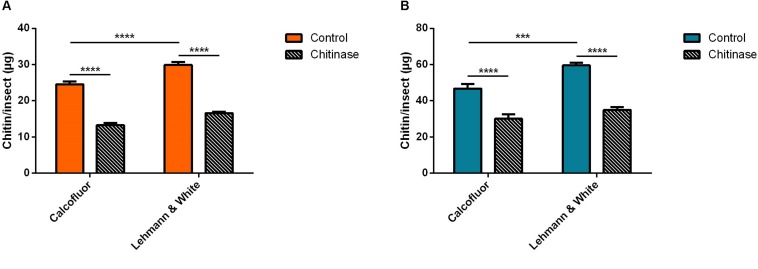
Chitin is an aminopolysaccharide present in yeast cells and arthropod cuticle and is one of the most abundant biopolymers. The conventional methods for the quantitation of chitin content in biological samples are based on its hydrolysis (acid or enzymatic), and the assessment of the byproduct, glucosamine. However, previously described methodologies are time-consuming, laborious, low throughput, and not applicable to insect samples in many cases. Here we describe a new approach to chitin content quantitation based on calcofluor fluorescent brightener staining of samples, followed by microplate fluorescence readings. Calcofluor is a specific chitin stain commonly used for topological localization of the polymer. The protocol was tested in three important disease vector species, namely , , and , and then compared to a classic colorimetric chitin assessment method. Results show that chitin content in the tested insects can vary largely in a range of 8-4600 micrograms of chitin per insect, depending on species, sex, and instar. Comparisons between measurements from the previous protocol and calcofluor method showed statistically significant differences in some samples. However, the difference might be due to interference in the classic method from non-chitin sources of glucosamine and reducing agents. Furthermore, chitinase hydrolysis reduces the total chitin mass estimated between 36 and 74%, consolidating the fluorescent measurements as actual stained chitin in the same extent that was observed with the standard protocol. Therefore, the calcofluor staining method revealed to be a fast and reliable technique for chitin quantitation in homogenized insect samples.
几丁质是一种存在于酵母细胞和节肢动物表皮中的氨基多糖,是最丰富的生物聚合物之一。生物样品中几丁质含量的传统定量方法基于其水解(酸解或酶解)以及对副产物氨基葡萄糖的评估。然而,先前描述的方法耗时、费力、通量低,并且在许多情况下不适用于昆虫样品。在此,我们描述了一种基于样品的钙黄绿素荧光增白剂染色,随后进行微孔板荧光读数的几丁质含量定量新方法。钙黄绿素是一种常用于该聚合物拓扑定位的特异性几丁质染色剂。该方案在三种重要的病媒物种,即[此处原文缺失物种名称]、[此处原文缺失物种名称]和[此处原文缺失物种名称]中进行了测试,然后与经典的比色法几丁质评估方法进行了比较。结果表明,根据物种、性别和龄期,测试昆虫中的几丁质含量在每只昆虫8 - 4600微克的范围内差异很大。先前方案的测量结果与钙黄绿素方法之间的比较表明,在一些样品中存在统计学上的显著差异。然而,这种差异可能是由于经典方法中来自非几丁质来源的氨基葡萄糖和还原剂的干扰。此外,几丁质酶水解使估计的总几丁质质量减少了36%至74%,这巩固了荧光测量作为实际染色几丁质的结果,其程度与标准方案中观察到的相同。因此,钙黄绿素染色方法被证明是一种用于匀浆昆虫样品中几丁质定量的快速且可靠的技术。