Research Department Virus Immunology, Heinrich Pette Institute, Leibniz Institute for Experimental Virology, Hamburg, Germany.
Institute for Immunology, Universitätsklinikum Hamburg Eppendorf, Hamburg, Germany.
Front Cell Infect Microbiol. 2020 Feb 18;10:55. doi: 10.3389/fcimb.2020.00055. eCollection 2020.
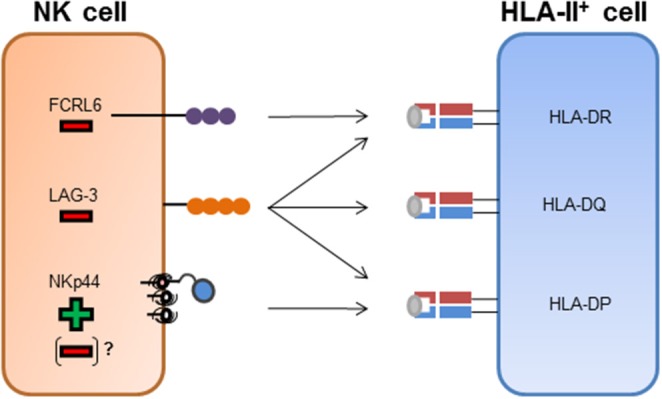
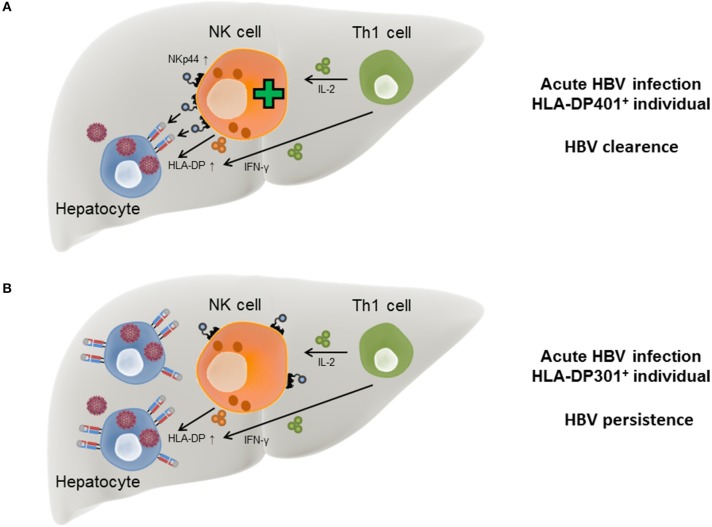
Natural Killer (NK) cells were initially described as part of the innate immune system and characterized by their ability to lyse malignant and virus-infected cells. The cytolytic function of NK cells is tightly controlled by activating and inhibitory receptors expressed on the cell surface. Ligands that interact with a variety of NK-cell receptors include the human leukocyte antigen (HLA) molecules, and the regulation of NK-cell function by HLA class I molecules is well-established. Earlier studies also suggested a role of HLA class II molecules in regulating NK cell activity; yet, interactions between HLA class II molecules and NK cell receptors have not been well-characterized. We recently identified a subset of HLA-DP molecules that can serve as ligands for the natural cytotoxicity receptor NKp44 and activate NK cells. This novel receptor-ligand interaction provides a potential mechanism to explain the strong associations of HLA-DP molecules with HBV infection outcomes, graft-vs.-host disease and inflammatory bowel disease. Furthermore, it adds a new mechanism for NK-cell crosstalk with immune cells expressing HLA class II molecules. In this perspective article, we discuss the potential implications of NK cell receptor interactions with HLA class II molecules for the regulation of immune responses.
自然杀伤 (NK) 细胞最初被描述为先天免疫系统的一部分,其特征是能够裂解恶性和病毒感染的细胞。NK 细胞的细胞溶解功能受到细胞表面表达的激活和抑制受体的紧密控制。与各种 NK 细胞受体相互作用的配体包括人类白细胞抗原 (HLA) 分子,HLA 类 I 分子对 NK 细胞功能的调节已得到充分证实。早期研究还表明 HLA 类 II 分子在调节 NK 细胞活性方面起作用;然而,HLA 类 II 分子与 NK 细胞受体之间的相互作用尚未得到很好的描述。我们最近鉴定了一组 HLA-DP 分子,它们可以作为自然细胞毒性受体 NKp44 的配体并激活 NK 细胞。这种新的受体-配体相互作用提供了一种潜在的机制,可以解释 HLA-DP 分子与乙型肝炎病毒感染结局、移植物抗宿主病和炎症性肠病的强烈关联。此外,它为表达 HLA 类 II 分子的免疫细胞与 NK 细胞的串扰增加了一种新的机制。在这篇观点文章中,我们讨论了 NK 细胞受体与 HLA 类 II 分子相互作用对免疫反应调节的潜在影响。