Götschi Tobias, Rosenberg George, Li Xiang, Zhang Chen, Bachmann Elias, Snedeker Jess G, Fucentese Sandro F
Institute for Biomechanics, ETH Zurich, Zurich, Switzerland.
Department of Orthopedics, Balgrist University Hospital, Zurich, Switzerland.
Orthop J Sports Med. 2020 Feb 25;8(2):2325967120904322. doi: 10.1177/2325967120904322. eCollection 2020 Feb.
Implant fixation by means of a cortical fixation device (CFD) has become a routine procedure in anterior cruciate ligament reconstruction. There is no clear consensus whether adjustable-length CFDs are more susceptible to loop lengthening when compared with pretied fixed-length CFDs.
To assess biomechanical performance measures of 3 types of CFDs when subjected to various loading protocols.
Controlled laboratory study.
Three types of CFDs underwent biomechanical testing: 1 fixed length and 2 adjustable length. One of the adjustable-length devices is based on the so-called finger trap mechanism, and the other is based on a modified sling lock mechanism. A device-only test of 5000 cycles (n = 8 per group) and a tendon-device test of 1000 cycles (n = 8 per group) with lower and upper force limits of 50 and 250 N, respectively, were applied, followed by ramp-to-failure testing. Adjustable-length devices then underwent further cyclic testing with complete loop unloading (n = 5 per group) at each cycle, as well as fatigue testing (n = 3 per group) over a total of 1 million cycles. Derived mechanical parameters were compared among the devices for statistical significance using Kruskal-Wallis analysis of variance followed by post hoc Mann-Whitney testing with Bonferroni correction.
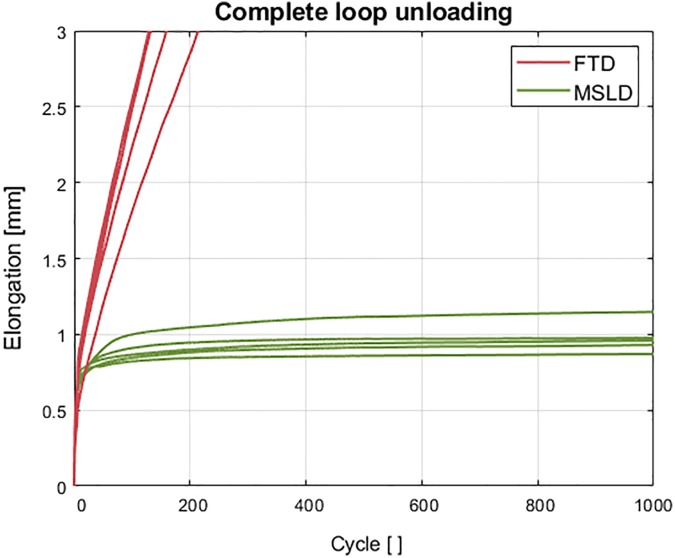
All CFDs showed elongation <2 mm after 5000 cycles when tested in an isolated manner and withstood ultimate tensile forces in excess of estimated peak in vivo forces. In both device-only and tendon-device tests, differences in cyclic performance were found among the devices, favoring adjustable-length fixation devices over the fixed-length device. Completely unloading the suspension loops, however, led to excessive loop lengthening of the finger trap device, whereas the modified sling lock device remained stable throughout the test. The fixed-length device displayed superior ultimate strength over both adjustable-length devices. Both adjustable-length devices showed adequate fatigue behavior during high-cyclic testing.
All tested devices successfully prevented critical construct elongation when tested with constant tension and withstood ultimate loads in excess of estimated in vivo forces during the rehabilitation phase. The finger trap device gradually lengthened excessively when completely unloaded during cyclic testing.
Critical loop lengthening may occur if adjustable-length devices based on the finger trap mechanism are repeatedly unloaded in situ.
借助皮质固定装置(CFD)进行植入物固定已成为前交叉韧带重建中的常规手术。与预系固定长度的CFD相比,可调节长度的CFD是否更容易出现环圈延长,目前尚无明确共识。
评估3种类型的CFD在不同加载方案下的生物力学性能指标。
对照实验室研究。
对3种类型的CFD进行生物力学测试:1种固定长度和2种可调节长度。其中一种可调节长度的装置基于所谓的指套机制,另一种基于改良的吊带锁机制。进行了5000次循环的仅装置测试(每组n = 8)和1000次循环的肌腱-装置测试(每组n = 8),上下力限分别为50和250 N,随后进行斜坡至破坏测试。然后,可调节长度的装置在每个循环进行完全环圈卸载的进一步循环测试(每组n = 5),以及总共100万次循环的疲劳测试(每组n = 3)。使用Kruskal-Wallis方差分析,然后进行事后Mann-Whitney检验并进行Bonferroni校正,比较各装置之间导出的力学参数的统计学显著性。
所有CFD在单独测试5000次循环后伸长均<2 mm,并能承受超过估计体内峰值力的极限拉伸力。在仅装置测试和肌腱-装置测试中,各装置之间均发现循环性能存在差异,可调节长度的固定装置优于固定长度的装置。然而,完全卸载悬吊环会导致指套装置的环圈过度延长,而改良的吊带锁装置在整个测试过程中保持稳定。固定长度的装置在极限强度方面优于两种可调节长度的装置。两种可调节长度的装置在高循环测试中均表现出足够的疲劳性能。
所有测试装置在恒张力测试时均成功防止了关键结构伸长,并在康复阶段承受了超过估计体内力的极限载荷。指套装置在循环测试中完全卸载时会逐渐过度延长。
如果基于指套机制的可调节长度装置在原位反复卸载,可能会发生关键环圈延长。