Department of Industrial Engineering Jerusalem College of Technology (JCT), Jerusalem, Israel.
GENIE GastroENterological IntervEntion Group, Department for Targeted Intervention, University College London (UCL), London, United Kingdom.
Lancet Digit Health. 2020 Jan 1;2(1):E37-E48. doi: 10.1016/S2589-7500(19)30216-X. Epub 2019 Dec 5.
Screening for Barrett's Oesophagus (BE) relies on endoscopy which is invasive and has a low yield. This study aimed to develop and externally validate a simple symptom and risk-factor questionnaire to screen for patients with BE.
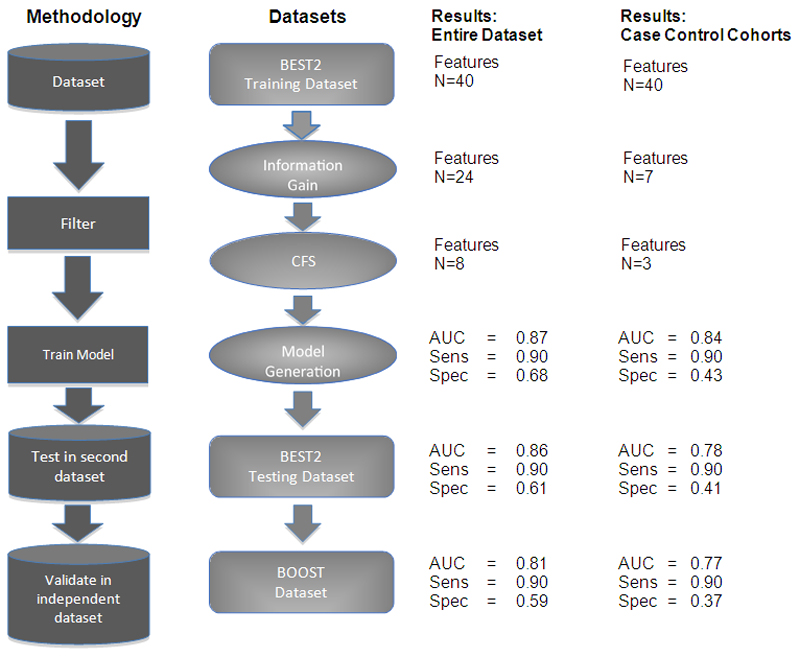
Questionnaires from 1299 patients in the BEST2 case-controlled study were analysed: 880 had BE including 40 with invasive oesophageal adenocarcinoma (OAC) and 419 were controls. This was randomly split into a training cohort of 776 patients and an internal validation cohort of 523 patients. External validation included 398 patients from the BOOST case-controlled study: 198 with BE (23 with OAC) and 200 controls. Identification of independently important diagnostic features was undertaken using machine learning techniques information gain (IG) and correlation based feature selection (CFS). Multiple classification tools were assessed to create a multi-variable risk prediction model. Internal validation was followed by external validation in the independent dataset.
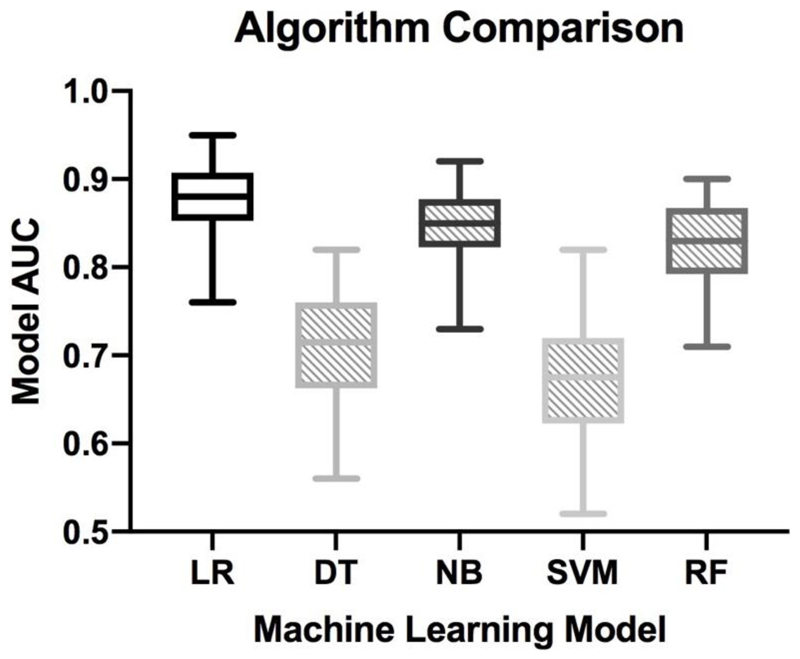
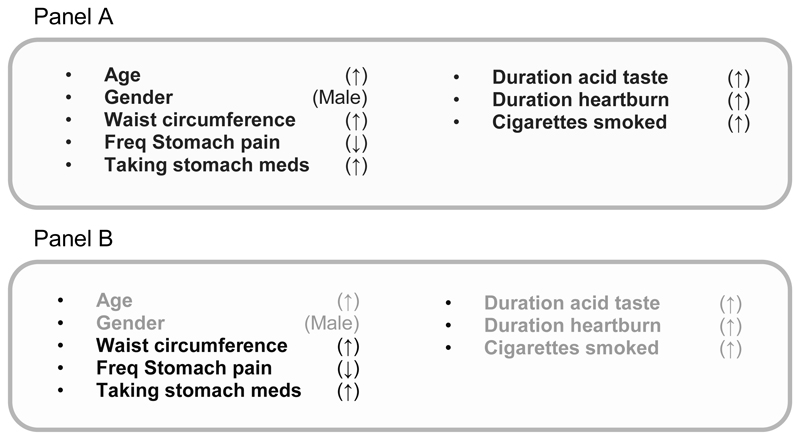
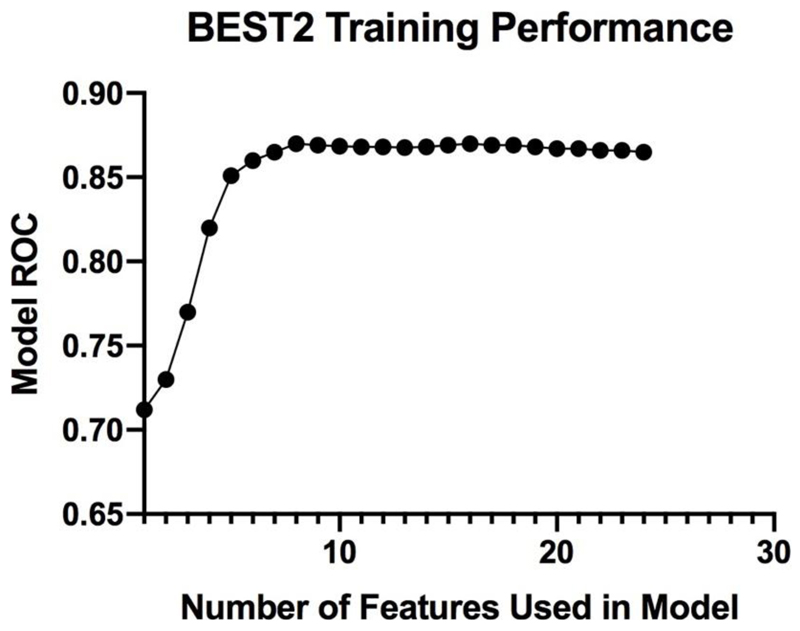
The BEST2 study included 40 features. Of these, 24 added IG but following CFS, only 8 demonstrated independent diagnostic value including age, gender, smoking, waist circumference, frequency of stomach pain, duration of heartburn and acid taste and taking of acid suppression medicines. Logistic regression offered the highest prediction quality with AUC (area under the receiver operator curve) of 0.87. In the internal validation set, AUC was 0.86. In the BOOST external validation set, AUC was 0.81.
The diagnostic model offers valid predictions of diagnosis of BE in patients with symptomatic gastroesophageal reflux, assisting in identifying who should go forward to invasive testing. Overweight men who have been taking stomach medicines for a long time may merit particular consideration for further testing. The risk prediction tool is quick and simple to administer but will need further calibration and validation in a prospective study in primary care.
Charles Wolfson Trust and Guts UK.
巴雷特食管(BE)的筛查依赖于内镜检查,这种方法具有侵袭性且检出率低。本研究旨在开发并外部验证一种简单的症状和危险因素问卷,以筛查 BE 患者。
对 BEST2 病例对照研究中的 1299 名患者的问卷进行分析:880 例患者患有 BE,其中 40 例患有侵袭性食管腺癌(OAC),419 例为对照组。将其随机分为训练队列 776 例和内部验证队列 523 例。外部验证包括 BOOST 病例对照研究中的 398 名患者:198 例 BE(23 例 OAC)和 200 例对照组。使用信息增益(IG)和基于相关的特征选择(CFS)等机器学习技术来识别独立的重要诊断特征。评估了多种分类工具以创建多变量风险预测模型。在独立数据集上进行内部验证后,进行外部验证。
BEST2 研究包括 40 个特征。其中,24 个增加了 IG,但经过 CFS 后,只有 8 个特征具有独立的诊断价值,包括年龄、性别、吸烟、腰围、胃痛频率、烧心和酸味持续时间以及服用酸抑制药物。逻辑回归提供了最高的预测质量,ROC 曲线下面积(AUC)为 0.87。在内部验证集中,AUC 为 0.86。在 BOOST 外部验证集中,AUC 为 0.81。
该诊断模型可对有症状的胃食管反流患者的 BE 诊断做出有效预测,有助于确定哪些患者应进行侵入性检查。长期服用胃药的超重男性可能需要特别考虑进一步检查。该风险预测工具快速简单,适用于管理,但需要在初级保健的前瞻性研究中进一步校准和验证。
查尔斯·沃尔夫森信托基金和 Gut UK。