Mateus André, Kurzawa Nils, Becher Isabelle, Sridharan Sindhuja, Helm Dominic, Stein Frank, Typas Athanasios, Savitski Mikhail M
Genome Biology Unit, European Molecular Biology Laboratory, Heidelberg, Germany.
Faculty of Biosciences, EMBL and Heidelberg University, Heidelberg, Germany.
Mol Syst Biol. 2020 Mar;16(3):e9232. doi: 10.15252/msb.20199232.
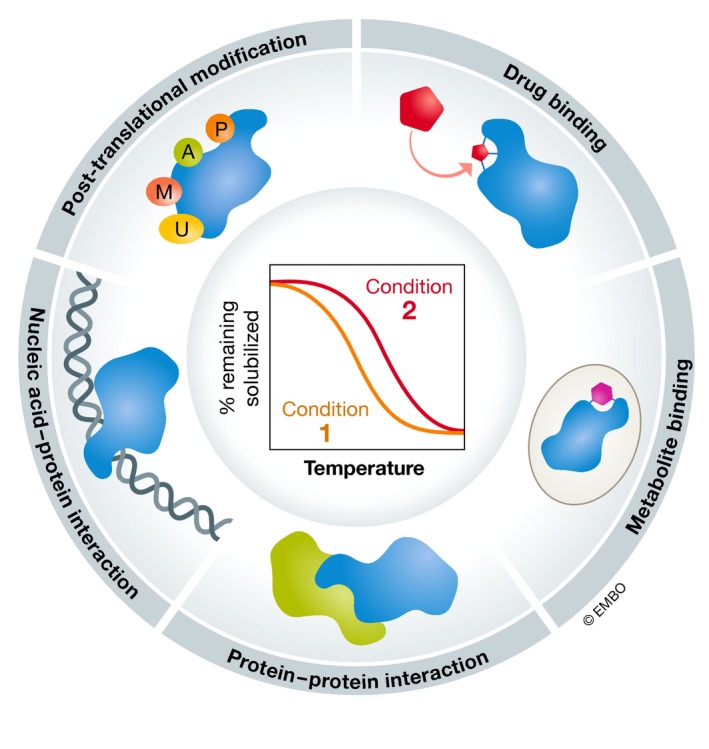
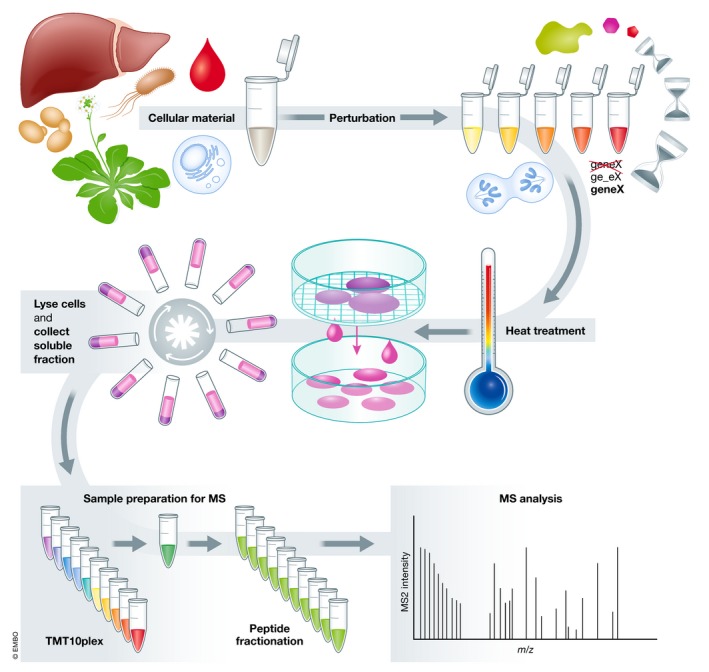
Thermal proteome profiling (TPP) is based on the principle that, when subjected to heat, proteins denature and become insoluble. Proteins can change their thermal stability upon interactions with small molecules (such as drugs or metabolites), nucleic acids or other proteins, or upon post-translational modifications. TPP uses multiplexed quantitative mass spectrometry-based proteomics to monitor the melting profile of thousands of expressed proteins. Importantly, this approach can be performed in vitro, in situ, or in vivo. It has been successfully applied to identify targets and off-targets of drugs, or to study protein-metabolite and protein-protein interactions. Therefore, TPP provides a unique insight into protein state and interactions in their native context and at a proteome-wide level, allowing to study basic biological processes and their underlying mechanisms.
热蛋白质组分析(TPP)基于这样一个原理:蛋白质受热时会变性并变得不溶。蛋白质在与小分子(如药物或代谢物)、核酸或其他蛋白质相互作用时,或在发生翻译后修饰时,其热稳定性会发生变化。TPP使用基于多重定量质谱的蛋白质组学来监测数千种表达蛋白质的熔解曲线。重要的是,这种方法可以在体外、原位或体内进行。它已成功应用于识别药物的靶点和脱靶,或研究蛋白质-代谢物和蛋白质-蛋白质相互作用。因此,TPP在蛋白质组水平上对蛋白质在其天然环境中的状态和相互作用提供了独特的见解,有助于研究基本生物学过程及其潜在机制。