• 文献检索
  • 文档翻译
  • 深度研究
  • 学术资讯
  • Suppr Zotero 插件Zotero 插件
  • 邀请有礼
  • 套餐&价格
  • 历史记录
应用&插件
Suppr Zotero 插件Zotero 插件浏览器插件Mac 客户端Windows 客户端微信小程序
定价
高级版会员购买积分包购买API积分包
服务
文献检索文档翻译深度研究API 文档MCP 服务
关于我们
关于 Suppr公司介绍联系我们用户协议隐私条款
关注我们

Suppr 超能文献

核心技术专利:CN118964589B侵权必究
粤ICP备2023148730 号-1Suppr @ 2026

文献检索

告别复杂PubMed语法,用中文像聊天一样搜索,搜遍4000万医学文献。AI智能推荐,让科研检索更轻松。

立即免费搜索

文件翻译

保留排版,准确专业,支持PDF/Word/PPT等文件格式,支持 12+语言互译。

免费翻译文档

深度研究

AI帮你快速写综述,25分钟生成高质量综述,智能提取关键信息,辅助科研写作。

立即免费体验

印度中央邦基孔肯雅热的实验室监测(2016-2017 年)。

Laboratory surveillance of chikungunya in Madhya Pradesh, India (2016-2017).

机构信息

Division of Virology and Zoonoses, ICMR-National Institute of Research in Tribal Health, Jabalpur, Madhya Pradesh, India.

Maximum Containment Laboratory, ICMR-National Institute of Virology, Pune, Maharashtra, India.

出版信息

Indian J Med Res. 2020 Jan;151(1):87-92. doi: 10.4103/ijmr.IJMR_204_19.

DOI:10.4103/ijmr.IJMR_204_19
PMID:32134019
原文链接:https://pmc.ncbi.nlm.nih.gov/articles/PMC7055169/
Abstract

BACKGROUND & OBJECTIVES: Chikungunya (CHIK) is a neglected, re-emerging arboviral disease. Limited information on CHIK-confirmed cases during interepidemic period is available from India. This surveillance study was conducted in Madhya Pradesh (MP), India, during the years 2016-2017, to provide information about CHIK cases.

METHODS

Blood samples collected from patients suspected having CHIK were tested by immunoglobulin (Ig) IgM ELISA or real time reverse transcription-polymerase chain reaction (rRT-PCR) for the detection of CHIK virus (CHIKV)-specific IgM antibodies or viral RNA, respectively. Partial envelope-1 gene sequencing was done. Clinical and demographic data were collected and analyzed.

RESULTS

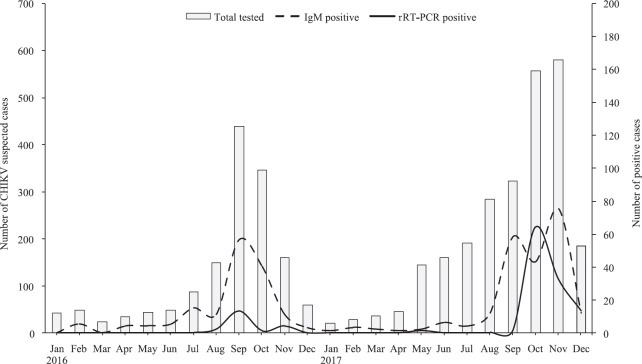
Of the 4019 samples tested, 494 (12.2%) were found positive for CHIKV infection. The positivity was detected in both rural and urban areas. The mean age of CHIK-positive cases was 33.12±18.25 yr. Headache and joint pain were the most prominent symptoms, 34.6 per cent (171/494) of the CHIK cases required hospitalization and six patients with CHIKV infection died. The East/Central/South African genotype of CHIKV was found to be circulating in the study area.

INTERPRETATION & CONCLUSIONS: Our study recorded a higher CHIK positivity during 2016-2017 in comparison to earlier reports from MP, India. A high proportion of CHIK cases required hospitalization and deaths were also reported, which indicated the severity of the disease in the study area. In-depth molecular analysis of the virus and other risk factors is essential to understand the trends in disease severity.

摘要

背景与目的

基孔肯雅热(CHIK)是一种被忽视的、重新出现的虫媒病毒病。印度在流行间歇期有关于确诊 CHIK 病例的信息有限。本监测研究于 2016-2017 年在印度中央邦(MP)进行,旨在提供有关 CHIK 病例的信息。

方法

采集疑似患有 CHIK 的患者的血液样本,通过免疫球蛋白(Ig)IgM ELISA 或实时逆转录-聚合酶链反应(rRT-PCR)检测 CHIK 病毒(CHIKV)特异性 IgM 抗体或病毒 RNA。进行部分包膜-1 基因测序。收集并分析临床和人口统计学数据。

结果

在检测的 4019 个样本中,有 494 个(12.2%)被检测出 CHIKV 感染呈阳性。在农村和城市地区都检测到了阳性。CHIK 阳性病例的平均年龄为 33.12±18.25 岁。头痛和关节痛是最突出的症状,494 例 CHIK 病例中有 34.6%(171/494)需要住院治疗,有 6 例 CHIKV 感染患者死亡。研究区域内循环的 CHIKV 为东/中非基因型。

解释与结论

与印度 MP 之前的报告相比,我们的研究在 2016-2017 年记录了更高的 CHIK 阳性率。很大比例的 CHIK 病例需要住院治疗,也有死亡报告,这表明研究区域疾病的严重程度。深入分析病毒和其他风险因素的分子分析对于了解疾病严重程度的趋势至关重要。
https://cdn.ncbi.nlm.nih.gov/pmc/blobs/66e6/7055169/8c152757df58/IJMR-151-87-g002.jpg
https://cdn.ncbi.nlm.nih.gov/pmc/blobs/66e6/7055169/eacd106a450b/IJMR-151-87-g001.jpg
https://cdn.ncbi.nlm.nih.gov/pmc/blobs/66e6/7055169/8c152757df58/IJMR-151-87-g002.jpg
https://cdn.ncbi.nlm.nih.gov/pmc/blobs/66e6/7055169/eacd106a450b/IJMR-151-87-g001.jpg
https://cdn.ncbi.nlm.nih.gov/pmc/blobs/66e6/7055169/8c152757df58/IJMR-151-87-g002.jpg

相似文献

1
Laboratory surveillance of chikungunya in Madhya Pradesh, India (2016-2017).印度中央邦基孔肯雅热的实验室监测(2016-2017 年)。
Indian J Med Res. 2020 Jan;151(1):87-92. doi: 10.4103/ijmr.IJMR_204_19.
2
Evaluation of chikungunya virus infection in children from India during 2009-2010: A cross sectional observational study.评估 2009-2010 年印度儿童的基孔肯雅病毒感染:一项横断面观察性研究。
J Med Virol. 2016 Jun;88(6):923-30. doi: 10.1002/jmv.24433. Epub 2015 Dec 15.
3
Chikungunya outbreak in Garo Hills, Meghalaya: An epidemiological perspective.梅加拉亚邦加罗丘陵地区的基孔肯雅热疫情:流行病学视角
Indian J Med Res. 2015 May;141(5):591-7. doi: 10.4103/0971-5916.159521.
4
Imported cases of Chikungunya virus in Iran.伊朗输入性基孔肯雅热病例。
BMC Infect Dis. 2019 Nov 27;19(1):1004. doi: 10.1186/s12879-019-4637-4.
5
Copy number variation of Chikungunya ECSA virus with disease symptoms among Indian patients.印度患者具有疾病症状的基孔肯雅热 ECSA 病毒的拷贝数变异。
J Med Virol. 2014 Aug;86(8):1386-92. doi: 10.1002/jmv.23794. Epub 2013 Oct 16.
6
Re-emergence of Chikungunya virus infection in Eastern India.印度东部基孔肯雅热病毒感染再现。
Braz J Microbiol. 2020 Mar;51(1):177-182. doi: 10.1007/s42770-019-00212-0. Epub 2020 Jan 2.
7
Molecular and phylogenetic evidence of chikungunya virus circulating in Assam, India.在印度阿萨姆邦传播的基孔肯雅病毒的分子和系统发育证据。
Indian J Med Microbiol. 2017 Jul-Sep;35(3):389-393. doi: 10.4103/ijmm.IJMM_16_127.
8
Large-scale outbreak of Chikungunya virus infection in Thailand, 2018-2019.2018-2019 年泰国大规模基孔肯雅热病毒感染疫情。
PLoS One. 2021 Mar 10;16(3):e0247314. doi: 10.1371/journal.pone.0247314. eCollection 2021.
9
Molecular and serological evidence of chikungunya virus infection with high case fatality among pediatric population with acute encephalitis syndrome: first report from Eastern Uttar Pradesh, India.分子和血清学证据表明,在急性脑炎综合征的儿科人群中,基孔肯雅病毒感染导致高病死率:来自印度北方邦东部的首次报告。
Eur J Clin Microbiol Infect Dis. 2024 Jun;43(6):1205-1212. doi: 10.1007/s10096-024-04817-8. Epub 2024 Apr 1.
10
Study of viremic profile in febrile specimens of chikungunya in Bandung, Indonesia.印度尼西亚万隆基孔肯雅热患者发热样本病毒血症特征研究。
J Clin Virol. 2016 Jan;74:61-5. doi: 10.1016/j.jcv.2015.11.017. Epub 2015 Nov 17.

引用本文的文献

1
Seropositivity of Chikungunya in Hospital Setting, India: A Systematic Review and Meta-Analysis.印度医院环境中基孔肯雅热的血清阳性率:一项系统评价和荟萃分析
Indian J Community Med. 2024 Nov-Dec;49(6):805-811. doi: 10.4103/ijcm.ijcm_63_24. Epub 2024 Oct 17.
2
Epidemiology and Economic Burden of Chikungunya: A Systematic Literature Review.基孔肯雅热的流行病学与经济负担:一项系统文献综述
Trop Med Infect Dis. 2023 May 31;8(6):301. doi: 10.3390/tropicalmed8060301.
3
Highly potent multivalent VHH antibodies against Chikungunya isolated from an alpaca naïve phage display library.

本文引用的文献

1
Epidemiology of chikungunya based on laboratory surveillance data-India, 2016-2018.基于实验室监测数据的基孔肯雅热流行病学-印度,2016-2018 年。
Trans R Soc Trop Med Hyg. 2019 May 1;113(5):259-262. doi: 10.1093/trstmh/try141.
2
Rainfall and Chikungunya incidences in India during 2010-2014.2010 - 2014年印度的降雨量与基孔肯雅热发病率
Virusdisease. 2018 Mar;29(1):46-53. doi: 10.1007/s13337-018-0428-6. Epub 2018 Feb 14.
3
Excess Mortality Related to Chikungunya Epidemics in the Context of Co-circulation of Other Arboviruses in Brazil.
从羊驼天然噬菌体展示文库中分离出的针对基孔肯雅热的高效价多价 VHH 抗体。
J Nanobiotechnology. 2022 May 14;20(1):231. doi: 10.1186/s12951-022-01417-6.
在巴西其他虫媒病毒共同传播背景下,与基孔肯雅热疫情相关的超额死亡率
PLoS Curr. 2017 Nov 13;9:ecurrents.outbreaks.14608e586cd321d8d5088652d7a0d884. doi: 10.1371/currents.outbreaks.14608e586cd321d8d5088652d7a0d884.
4
Alert: Severe cases and deaths associated with Chikungunya in Brazil.警报:巴西出现与基孔肯雅热相关的严重病例和死亡情况。
Rev Soc Bras Med Trop. 2017 Sep-Oct;50(5):585-589. doi: 10.1590/0037-8682-0479-2016.
5
Co-circulation of dengue virus serotypes with chikungunya virus in Madhya Pradesh, central India.印度中部中央邦登革热病毒血清型与基孔肯雅病毒的共同传播。
WHO South East Asia J Public Health. 2014 Jan-Mar;3(1):36-40. doi: 10.4103/2224-3151.206881.
6
Current status of dengue and chikungunya in India.印度登革热和基孔肯雅热的现状
WHO South East Asia J Public Health. 2014 Jan-Mar;3(1):22-26. doi: 10.4103/2224-3151.206879.
7
Arboviruses emerging in Brazil: challenges for clinic and implications for public health.巴西出现的虫媒病毒:临床面临的挑战及对公共卫生的影响。
Rev Saude Publica. 2017 Apr 10;51:30. doi: 10.1590/S1518-8787.2017051006889.
8
Seroprevalence and clinical manifestations of chikungunya virus infection in rural areas of Chandrapur, Maharashtra, India.印度马哈拉施特拉邦钱德拉布尔农村地区基孔肯雅病毒感染的血清流行率及临床表现
J Vector Borne Dis. 2017 Jan-Mar;54(1):35-43.
9
Chikungunya virus infection in West Bengal, India.印度西孟加拉邦的基孔肯雅病毒感染
Indian J Med Microbiol. 2016 Apr-Jun;34(2):213-5. doi: 10.4103/0255-0857.176839.
10
Chikungunya: epidemiology.基孔肯雅热:流行病学
F1000Res. 2016 Jan 19;5. doi: 10.12688/f1000research.7171.1. eCollection 2016.