Center for Disease Control and Prevention of Guangdong Province, Guangzhou, China.
Jockey Club School of Public Health and Primary Care, The Chinese University of Hong Kong, Hong Kong, China.
BMC Infect Dis. 2020 Mar 6;20(1):197. doi: 10.1186/s12879-020-4919-x.
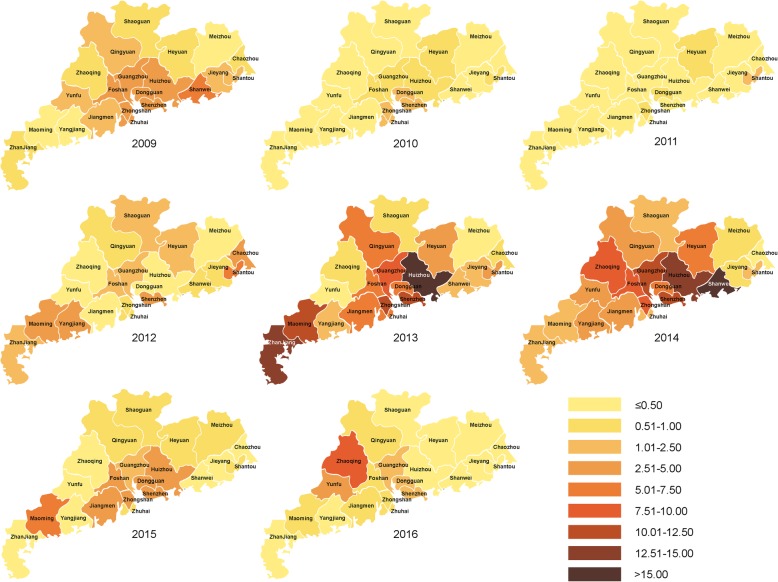
The incidence rate of measles in China reached a nadir in 2012 after 2 supplementary immunization activities (SIAs) were undertaken in 2009 and 2010. However, the disease began re-emerging in 2013, with a high prevalence rate observed in 2013-2014 in the southern province of Guangdong. In this study, we assessed the changes that occurred in measles epidemiology during 2009-2016, particularly between 2009 and 2011 (when the influence of the SIAs were in full effect) and between 2012 and 2016 (when this influence subsided).
Data from 22,362 patients with measles diagnosed between 2009 and 2016, and whose diagnoses were confirmed clinically and/or with laboratory testing, were extracted from the National Infectious Disease Monitoring Information System. Descriptive analyses were performed, and changes in epidemiological characteristics between 2009 and 2011 and 2012-2016 were compared.
There was a substantial surge in 0-8-month-old patients after 2012; the incidence rate increased from 4.0 per 100,000 population in 2011 (10.3% of the total) to 280 per 100,000 population in 2013 (32.8% of the total). Patients aged 0-6 years represented 73.4% of the total increase between 2011 and 2013. Compared with 2009-2011, adults aged ≥25 years accounted for a higher proportion of patients in 2013 and after (p < 0.01), and were highest in 2016 (31% of the patient total).
Despite the remarkable results achieved by SIAs in terms of providing herd immunity, the 2013 resurgence of measles revealed insufficient immunization coverage among children. Therefore routine immunization programs should be strengthened, and supplementary vaccinations targeting adults should also be contemplated.
2009 年和 2010 年开展了 2 次补充免疫活动(SIAs)后,中国麻疹发病率在 2012 年达到最低点。然而,该疾病于 2013 年再次出现,2013-2014 年在南部省份广东流行率较高。在这项研究中,我们评估了 2009-2016 年麻疹流行病学的变化,特别是 2009 年和 2011 年(SIAs 全面生效时)以及 2012 年至 2016 年(影响消退时)之间的变化。
从国家传染病监测信息系统中提取了 2009 年至 2016 年间确诊的 22362 例麻疹患者的数据,这些患者的诊断是临床确诊和/或实验室检测确诊的。进行描述性分析,并比较了 2009 年和 2011 年与 2012-2016 年之间流行病学特征的变化。
2012 年后 0-8 个月大的婴儿麻疹病例大幅增加;发病率从 2011 年的每 10 万人 4.0 例(占总数的 10.3%)增加到 2013 年的每 10 万人 280 例(占总数的 32.8%)。0-6 岁的患者占 2011-2013 年总增长率的 73.4%。与 2009-2011 年相比,2013 年及以后年龄≥25 岁的成年人占患者比例较高(p<0.01),2016 年最高(占患者总数的 31%)。
尽管 SIAs 在提供群体免疫方面取得了显著成果,但 2013 年麻疹的再次爆发表明儿童免疫接种覆盖率不足。因此,应加强常规免疫规划,并考虑针对成年人开展补充疫苗接种。