JC School of Public Health and Primary Care, The Chinese University of Hong Kong, Hong Kong, China.
Clinical Trials and Biostatistics Laboratory, Shenzhen Research Institute, The Chinese University of Hong Kong, Hong Kong, China.
PLoS One. 2018 Oct 8;13(10):e0205339. doi: 10.1371/journal.pone.0205339. eCollection 2018.
Despite several immunization efforts, China saw a resurgence of measles in 2012. Monitoring of transmissions of individuals from different age groups could offer information that would be valuable for planning adequate disease control strategies. We compared the age-specific effective reproductive numbers (R) of measles during 2009-2016 in Guangdong, China.
We estimated the age-specific R values for 7 age groups: 0-8 months, 9-18 months, 19 months to 6 years, 7-15 years, 16-25 years, 26-45 years, and ≥46 years adapting the contact matrix of China. The daily numbers of laboratory and clinically confirmed cases reported to the Center for Disease Control and Prevention of Guangdong were used.
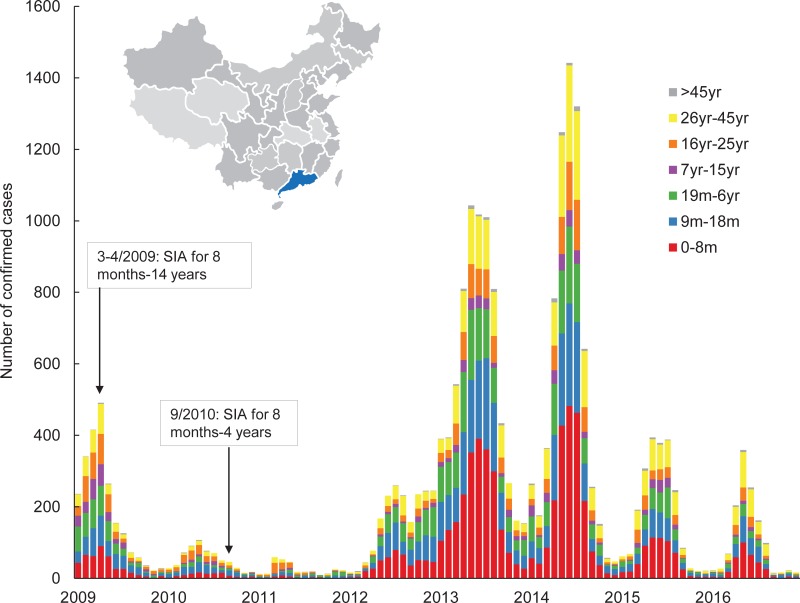
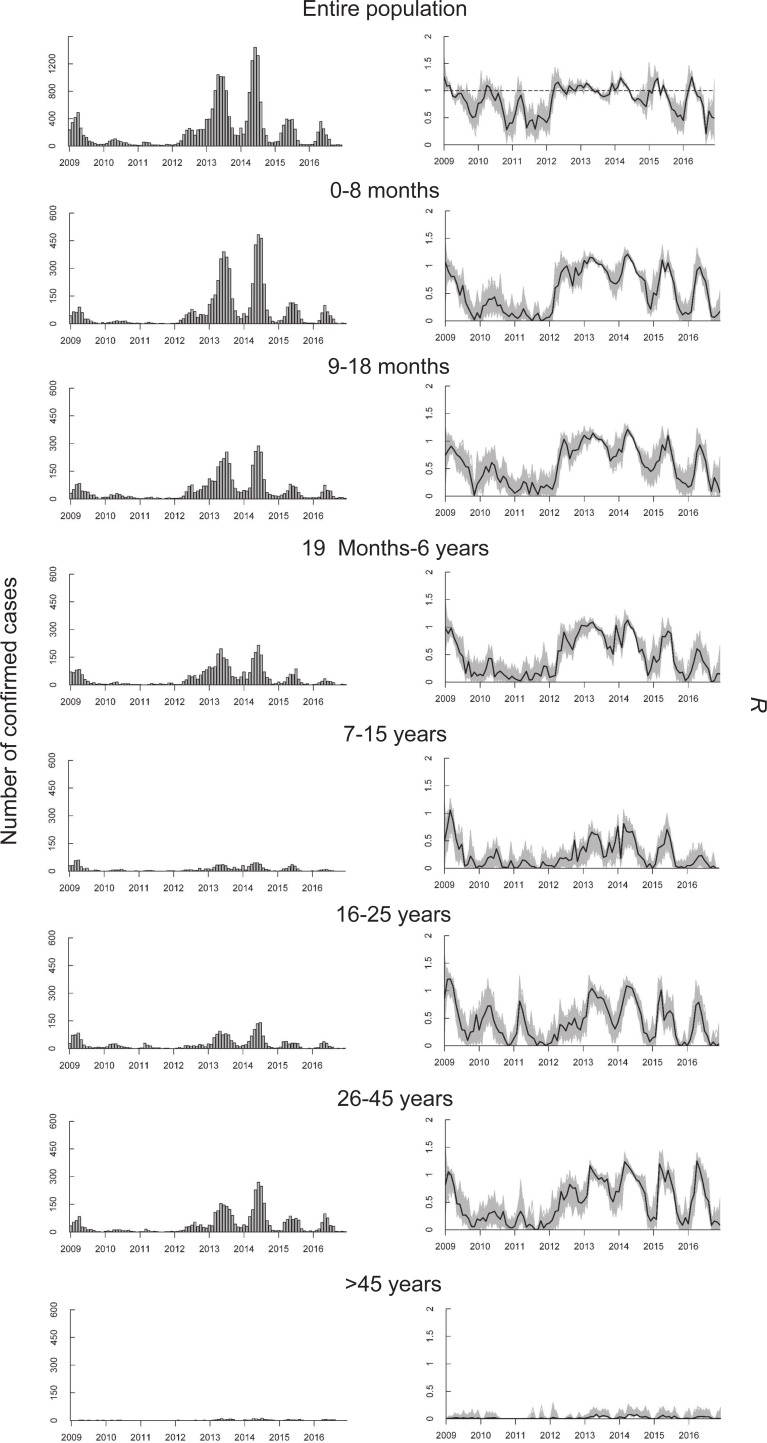
The peak R values of the entire population were above unity from 2012 to 2016, indicating the persistence of measles in the population. In general, children aged 0-6 years and adults aged 26-45 years had larger values of R when comparing with other age groups after 2012. While the peaks of R values for children aged 0-6 years dropped steadily after 2013, the peaks of R values for adults aged 26-45 years kept at a high range every year.
Although the provincial supplementary immunization activities (SIAs) conducted in 2009 and 2010 were able to reduce the transmissions from 2009 to 2011, larger values of R for children aged 0-6 years were observed after 2012, indicating that the benefits of the SIAs were short-lived. In addition, the transmissions from adults aged between 26 and 45 years increased over time. Disease control strategies should target children and adult groups that carry high potential for measles transmission.
尽管采取了多项免疫措施,中国在 2012 年还是出现了麻疹疫情反弹。监测不同年龄组人群的传播情况,可以提供有价值的信息,为制定充分的疾病控制策略提供参考。本研究比较了 2009-2016 年期间广东省麻疹在不同年龄组的特定年龄有效繁殖数(R)。
我们利用中国疾病预防控制中心的接触矩阵,估计了 7 个年龄组(0-8 个月、9-18 个月、19 个月至 6 岁、7-15 岁、16-25 岁、26-45 岁和≥46 岁)的特定年龄 R 值。采用广东省疾病预防控制中心报告的实验室确诊和临床确诊病例的日发病数。
2012-2016 年,全人群的 R 值峰值均高于 1,表明麻疹在人群中持续存在。总体而言,2012 年以后,与其他年龄组相比,0-6 岁儿童和 26-45 岁成人的 R 值较大。2013 年后,0-6 岁儿童的 R 值峰值呈持续下降趋势,而 26-45 岁成人的 R 值峰值每年均保持在较高水平。
虽然 2009 年和 2010 年开展的省级补充免疫活动(SIAs)能够降低 2009-2011 年的传播,但 2012 年后,0-6 岁儿童的 R 值较大,表明 SIAs 的效果持续时间较短。此外,26-45 岁成人的传播也呈上升趋势。疾病控制策略应针对麻疹传播风险较高的儿童和成人。