Division of Surgical Oncology, Department of Surgery, Massachusetts General Hospital, Harvard Medical School, Boston, USA.
Neurosurgery and Brain and Nerve Research Laboratory, The First Affiliated Hospital of Soochow University, Suzhou, Jiangsu, China.
Cell Commun Signal. 2020 Mar 5;18(1):36. doi: 10.1186/s12964-019-0507-3.
The current successful clinical use of agents promoting robust anti-tumor immunity in cancer patients warrants noting that radiation therapy (RT) induces immunogenic cell death (ICD) of tumor cells, which can generate anti-tumor immune responses. However, breast cancer stem cells (BCSCs) are resistant to RT and RT alone usually failed to mount an anti-tumor immune response.
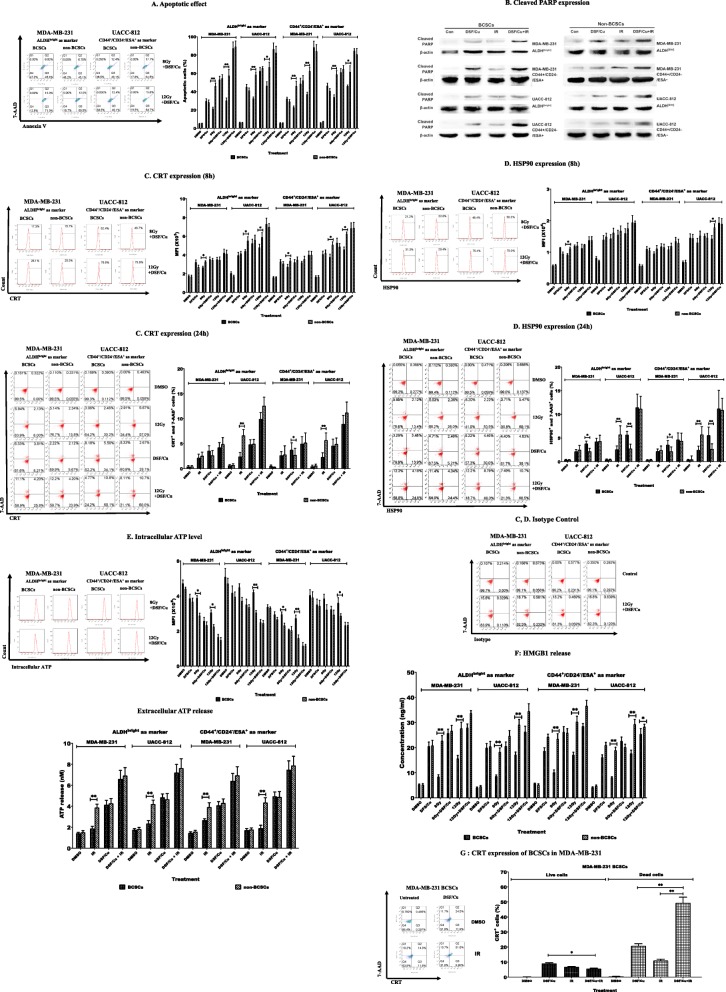
High aldehyde dehydrogenase activity (ALDH) and CD44/CD24/ESA cancer cells, previously shown to have BCSC properties, were isolated from human MDA-MB-231 and UACC-812 breast cancer cell lines by flow cytometer. Flow sorted BCSCs and non-BCSCs were further tested for their characteristic of stemness by mammosphere formation assay. Induction of ICD in BCSCs vs. non-BCSCs in response to different in vitro treatments was determined by assessing cell apoptosis and a panel of damage-associated molecular pattern molecules (DAMPs) by flow and enzyme-linked immunosorbent assay (ELISA).
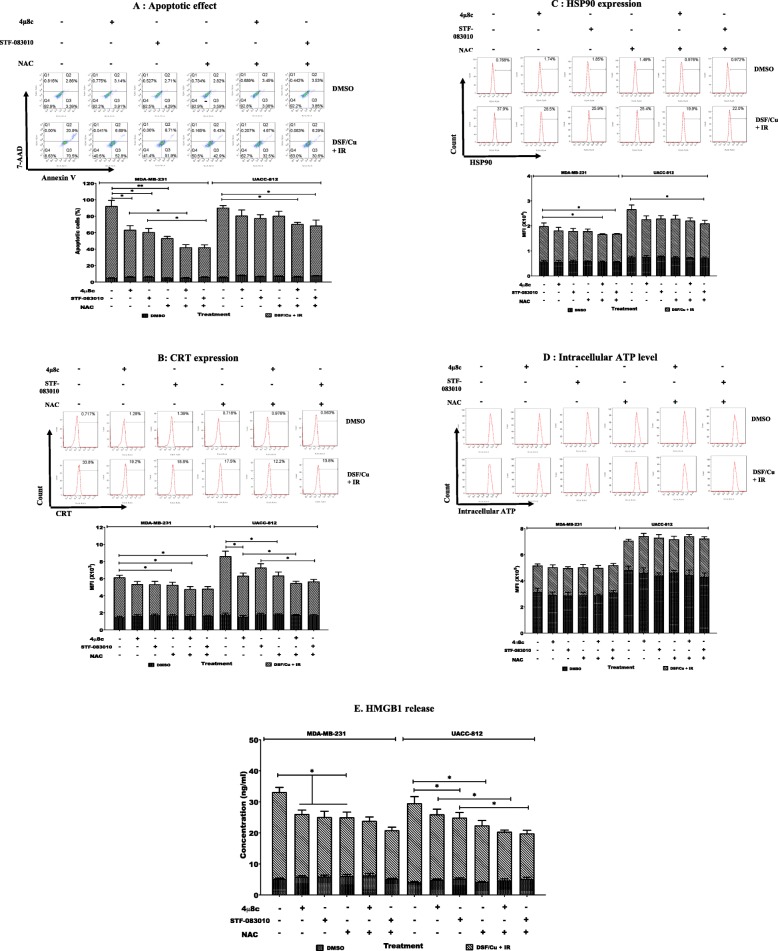
We found that ionizing radiation (IR) triggered a lower level of ICD in BCSCs than non-BCSCs. We then investigated the ability of disulfiram/cooper (DSF/Cu) which is known to preferentially induce cancer stem cells (CSCs) apoptosis to enhance IR-induced ICD of BCSCs. The results indicate that DSF/Cu induced a similar extent of IDC in both BCSCs and non-BCSCs and rendered IR-resistant BCSCs as sensitive as non-BCSCs to IR-induced ICD. IR and DSF/Cu induced ICD of BCSCs could be partly reversed by pre-treatment of BCSCs with a reactive oxygen species (ROS) scavenger and XBP1s inhibitors.
DSF/Cu rendered IR-resistant BCSCs as sensitive as non-BCSCs to IR-induced ICD. Our data demonstrate the potential of IR and DSF/Cu to induce ICD in BCSCs and non-BCSCs leading to robust immune responses against not only differentiated/differentiating breast cancer cells but also BCSCs, the root cause of cancer formation, progression and metastasis.
目前,在癌症患者中成功应用增强抗肿瘤免疫的药物表明,放射治疗(RT)可诱导肿瘤细胞发生免疫原性细胞死亡(ICD),从而产生抗肿瘤免疫反应。然而,乳腺癌干细胞(BCSCs)对 RT 具有抗性,单独使用 RT 通常无法引发抗肿瘤免疫反应。
通过流式细胞仪从人 MDA-MB-231 和 UACC-812 乳腺癌细胞系中分离出具有 BCSC 特性的高醛脱氢酶活性(ALDH)和 CD44/CD24/ESA 阳性细胞。对分选的 BCSC 和非 BCSC 进行乳腺球形成实验,进一步检测其干细胞特性。通过流式细胞术和酶联免疫吸附试验(ELISA)评估细胞凋亡和一组损伤相关分子模式分子(DAMPs)来确定不同体外处理下 BCSC 和非 BCSC 中 ICD 的诱导情况。
我们发现,电离辐射(IR)在 BCSC 中引发的 ICD 水平低于非 BCSC。然后,我们研究了已知优先诱导癌症干细胞(CSC)凋亡的二硫化四乙基秋兰姆/铜(DSF/Cu)增强 BCSC 中 IR 诱导 ICD 的能力。结果表明,DSF/Cu 在 BCSC 和非 BCSC 中诱导的 ICD 程度相似,使 IR 耐药的 BCSC 对 IR 诱导的 ICD 与非 BCSC 一样敏感。IR 和 DSF/Cu 诱导的 BCSC ICD 可部分被 BCSC 用活性氧(ROS)清除剂和 XBP1s 抑制剂预处理逆转。
DSF/Cu 使 IR 耐药的 BCSC 对 IR 诱导的 ICD 与非 BCSC 一样敏感。我们的数据表明,IR 和 DSF/Cu 有可能在 BCSC 和非 BCSC 中诱导 ICD,从而引发针对不仅分化/分化乳腺癌细胞而且还针对癌症形成、进展和转移的根源——BCSCs 的强大免疫反应。