Department of Biomechanics and Center for Research in Human Movement Variability, University of Nebraska at Omaha, Biomechanics Research Building 214, 6160 University Drive South, Omaha, NE, 68182-0860, USA.
Department of Health and Nutritional Sciences, South Dakota State University, Brookings, USA.
J Neuroeng Rehabil. 2020 Mar 5;17(1):41. doi: 10.1186/s12984-020-00671-9.
There is scientific evidence that older adults aged 65 and over walk with increased step width variability which has been associated with risk of falling. However, there are presently no threshold levels that define the optimal reference range of step width variability. Thus, the purpose of our study was to estimate the optimal reference range for identifying older adults with normative and excessive step width variability.
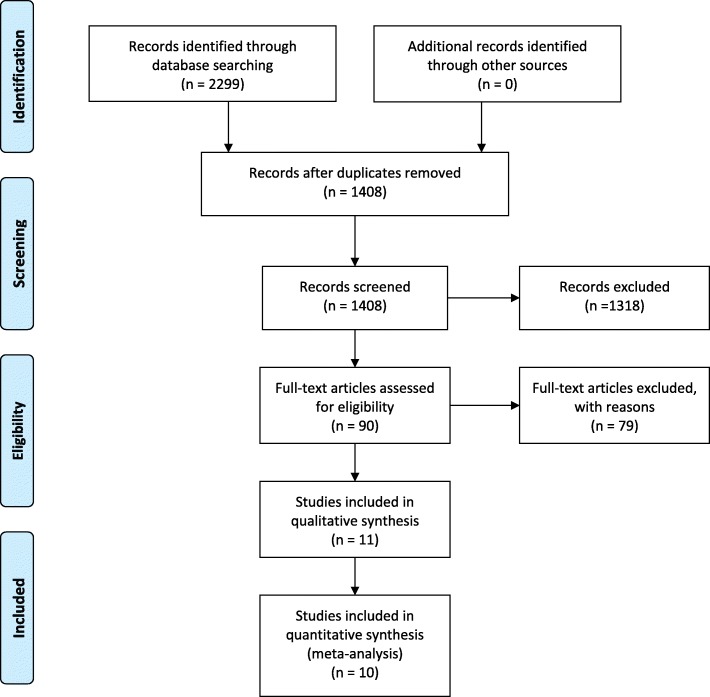
We searched systematically the BMC, Cochrane Library, EBSCO, Frontiers, IEEE, PubMed, Scopus, SpringerLink, Web of Science, Wiley, and PROQUEST databases until September 2018, and included the studies that measured step width variability in both younger and older adults during walking at self-selected speed. Data were pooled in meta-analysis, and standardized mean differences (SMD) with 95% confidence intervals (CI) were calculated. A single-decision threshold method based on the Youden index, and a two-decision threshold method based on the uncertain interval method were used to identify the optimal threshold levels (PROSPERO registration: CRD42018107079).
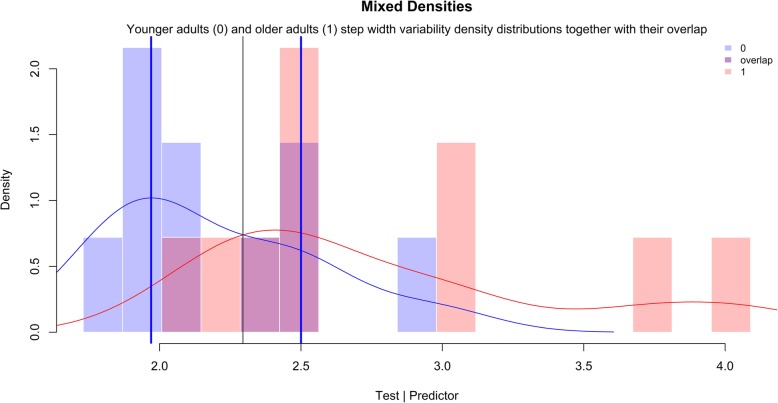
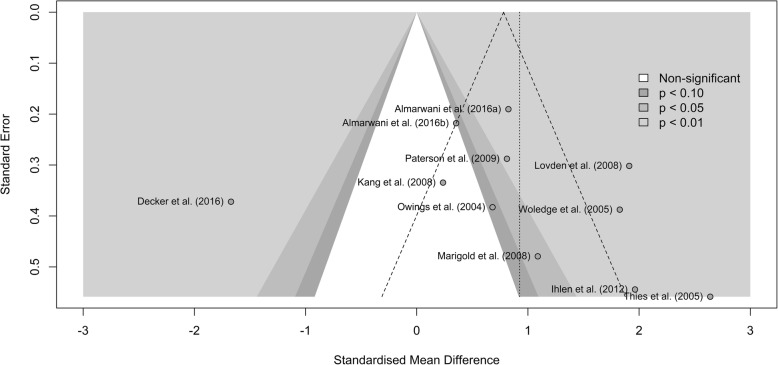
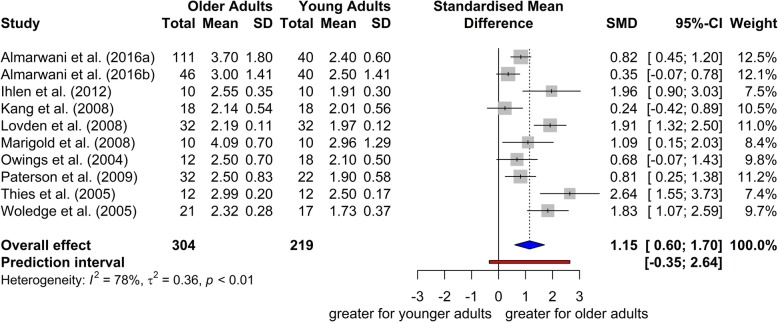
Ten studies were retrieved (older adults = 304; younger adults = 219). Step width variability was higher in older than in younger adults (SMD = 1.15, 95% CI = 0.60; 1.70; t = 4.72, p = 0.001). The single-decision method set the threshold level for excessive step width variability at 2.14 cm. For the two-decision method, step width variability values above the upper threshold level of 2.50 cm were considered excessive, while step width variability values below the lower threshold level of 1.97 cm were considered within the optimal reference range.
Step width variability is higher in older adults than in younger adults, with step width variability values above the upper threshold level of 2.50 cm to be considered as excessive. This information could potentially impact rehabilitation technology design for devices targeting lateral stability during walking.
有科学证据表明,65 岁及以上的老年人在行走时步宽变异性增加,这与跌倒风险有关。然而,目前还没有界定步宽变异性最佳参考范围的阈值水平。因此,我们的研究目的是估计确定步宽变异性正常和过大的老年人的最佳参考范围。
我们系统地检索了 BMC、Cochrane 图书馆、EBSCO、Frontiers、IEEE、PubMed、Scopus、SpringerLink、Web of Science、Wiley 和 PROQUEST 数据库,检索时间截至 2018 年 9 月,纳入了在自我选择的速度下行走时测量年轻人和老年人步宽变异性的研究。数据在荟萃分析中汇总,并计算了标准化均数差(SMD)和 95%置信区间(CI)。采用基于约登指数的单一决策阈值法和基于不确定区间法的双决策阈值法来确定最佳阈值水平(PROSPERO 注册:CRD42018107079)。
检索到 10 项研究(老年人=304 人;年轻人=219 人)。老年人的步宽变异性高于年轻人(SMD=1.15,95%CI=0.60;1.70;t=4.72,p=0.001)。单一决策方法将步宽变异性过大的阈值水平设定为 2.14cm。对于双决策方法,步宽变异性值超过上限阈值 2.50cm 被认为过大,而步宽变异性值低于下限阈值 1.97cm 被认为在最佳参考范围内。
老年人的步宽变异性高于年轻人,步宽变异性值超过上限阈值 2.50cm 被认为过大。这一信息可能会对旨在提高行走时横向稳定性的康复技术设备的设计产生影响。