Department of Radiation Oncology, Ruijin Hospital, Shanghai Jiao Tong University School of Medicine, Shanghai, 200025, China.
Department of Radiation Physics, The University of Texas MD Anderson Cancer Center, Houston, TX, 77030, USA.
Radiat Oncol. 2020 Mar 5;15(1):55. doi: 10.1186/s13014-020-01503-9.
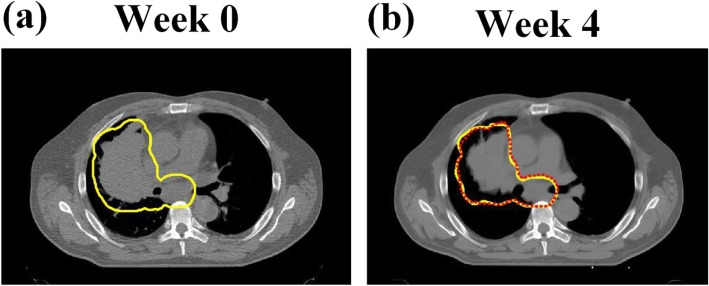
To quantify tumor anatomic change of non-small cell lung cancer (NSCLC) patients given passive-scattering proton therapy (PSPT) and intensity-modulated radiation therapy (IMRT) through 6-7 weeks of treatment, and analyze the correlation between anatomic change and the need to adopt adaptive radiotherapy (ART).
Weekly 4D CT sets of 32 patients (8/8 IMRT with/without ART, 8/8 PSPT with/without ART) acquired during treatment, were registered to the planning CT using an in-house developed deformable registration algorithm. The anatomic change was quantified as the mean variation of the region of interest (ROI) relative to the planning CT by averaging the magnitude of deformation vectors of all voxels within the ROI contour. Mean variations of GTV and CTV were compared between subgroups classified by ART status and treatment modality using the independent t-test. Logistic regression analysis was performed to clarify the effect of anatomic change on the probability of ART adoption.
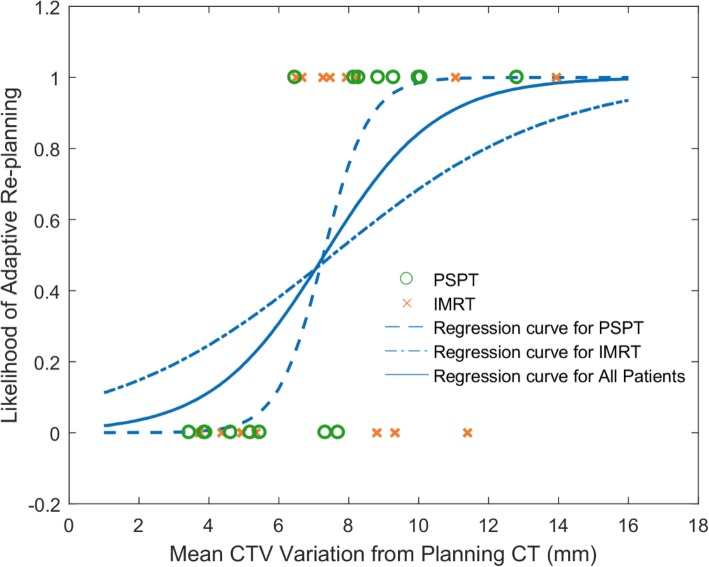
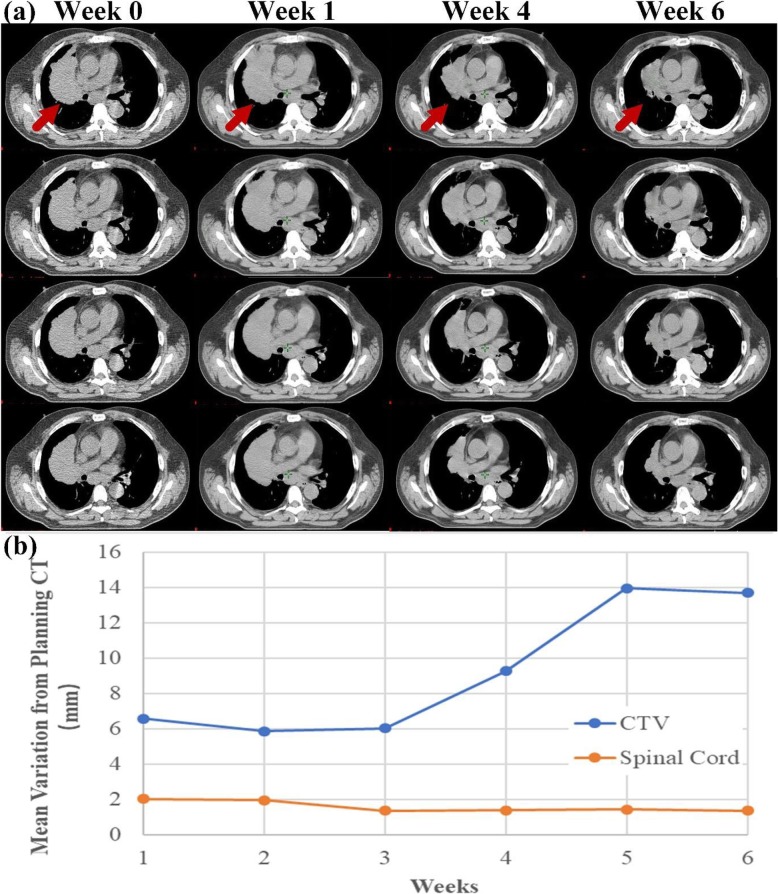
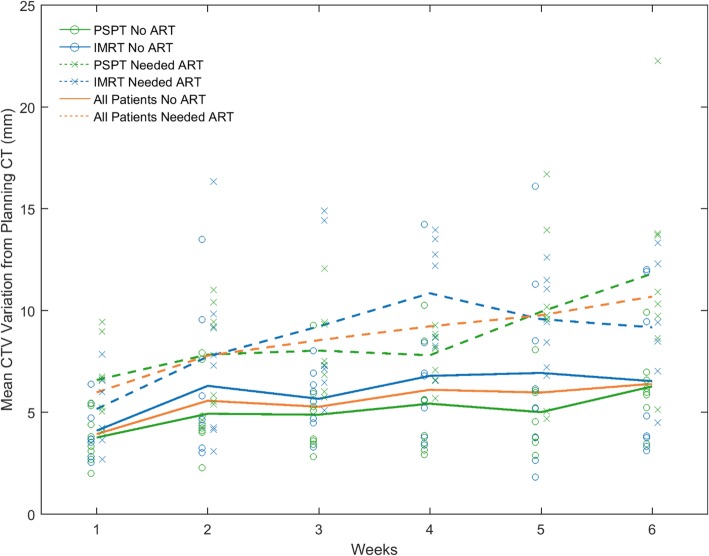
There was no significant difference (p = 0.679) for the time-averaged mean CTV variations from the planning CT between IMRT (7.61 ± 2.80 mm) and PSPT (7.21 ± 2.67 mm) patients. However, a significant difference (p = 0.001) was observed between ART (8.93 ± 2.19 mm) and non-ART (5.90 ± 2.33 mm) patients, when treatment modality was not considered. Mean CTV variation from the planning CT in all patients increases significantly (p < 0.001), with a changing rate of 1.77 mm per week. Findings for the GTV change was similar. The logistic regression model correctly predicted 71.9% of cases in ART adoption. The correlation is stronger in the PSPT group with a pseudo R value of 0.782, compared to that in the IMRT group (pseudo R = 0.182).
The magnitude of target volume variation over time could be greater than the usual treatment margin. Mean target volume variation from the planning position can be used to identify lung cancer patients that may need ART.
通过 6-7 周的治疗,量化接受被动散射质子治疗 (PSPT) 和调强放疗 (IMRT) 的非小细胞肺癌 (NSCLC) 患者的肿瘤解剖变化,并分析解剖变化与采用适应性放疗 (ART) 的相关性。
对治疗过程中采集的 32 名患者(8/8 例 IMRT 有/无 ART,8/8 例 PSPT 有/无 ART)的每周 4DCT 进行分析,使用自主开发的变形配准算法将其与计划 CT 进行配准。通过计算 ROI 内所有体素变形向量的大小平均值,将 ROI 相对于计划 CT 的解剖变化量化为 ROI 的平均变化量。使用独立 t 检验比较 ART 状态和治疗方式分类的亚组之间的 GTV 和 CTV 的平均变化量。采用逻辑回归分析阐明解剖变化对采用 ART 概率的影响。
IMRT 组(7.61 ± 2.80mm)和 PSPT 组(7.21 ± 2.67mm)的 CTV 从计划 CT 的时间平均均值变化无显著差异(p=0.679)。然而,当不考虑治疗方式时,ART 组(8.93 ± 2.19mm)和非 ART 组(5.90 ± 2.33mm)之间存在显著差异(p=0.001)。所有患者的 CTV 从计划 CT 的变化明显增加(p<0.001),每周变化率为 1.77mm。GTV 变化的发现相似。ART 采用的逻辑回归模型正确预测了 71.9%的病例。在 PSPT 组中,伪 R 值为 0.782,相关性强于 IMRT 组(伪 R=0.182)。
靶区随时间的变化幅度可能大于通常的治疗边界。从计划位置的靶区平均变化量可用于识别可能需要 ART 的肺癌患者。