Department of Gastroenterology and Hepatology, Amsterdam UMC, University of Amsterdam, Amsterdam, The Netherlands.
Department of Gastroenterology and Hepatology, Netherlands Cancer Institute, Amsterdam, The Netherlands.
Gut. 2020 Dec;69(12):2150-2158. doi: 10.1136/gutjnl-2019-319804. Epub 2020 Mar 5.
Serrated polyps (SPs) are an important cause of postcolonoscopy colorectal cancers (PCCRCs), which is likely the result of suboptimal SP detection during colonoscopy. We assessed the long-term effect of a simple educational intervention focusing on optimising SP detection.
An educational intervention, consisting of two 45 min training sessions (held 3 years apart) on serrated polyp detection, was given to endoscopists from 9 Dutch hospitals. Hundred randomly selected and untrained endoscopists from other hospitals were selected as control group. Our primary outcome measure was the proximal SP detection rate (PSPDR) in trained versus untrained endoscopists who participated in our faecal immunochemical test (FIT)-based population screening programme.
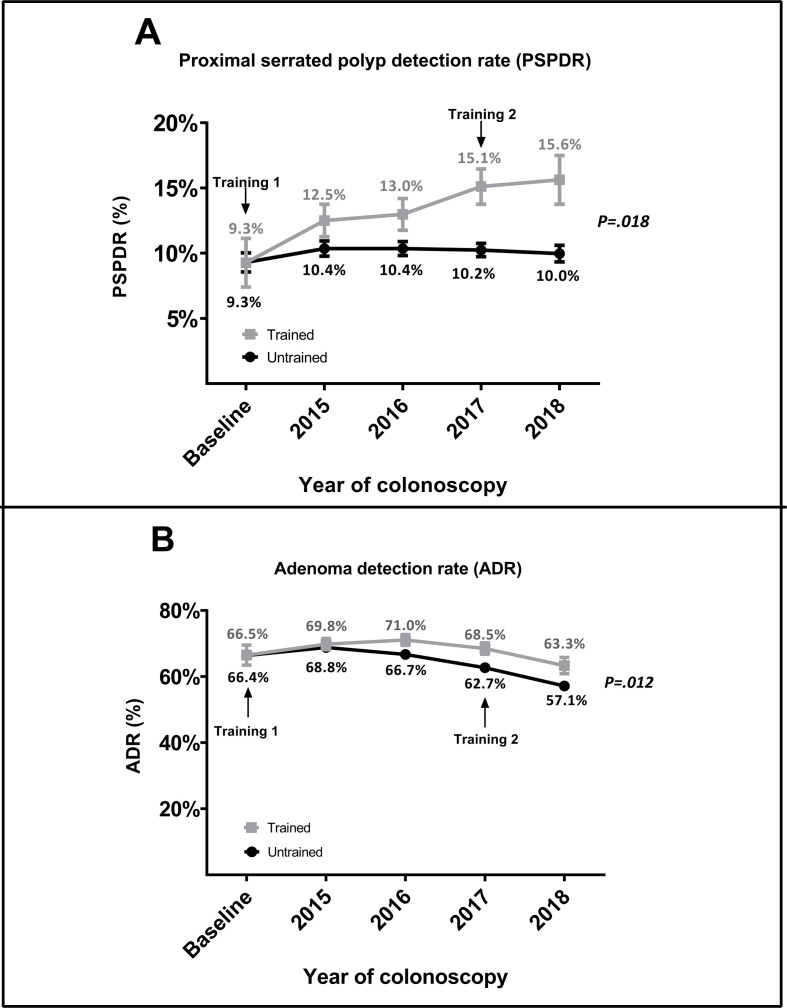
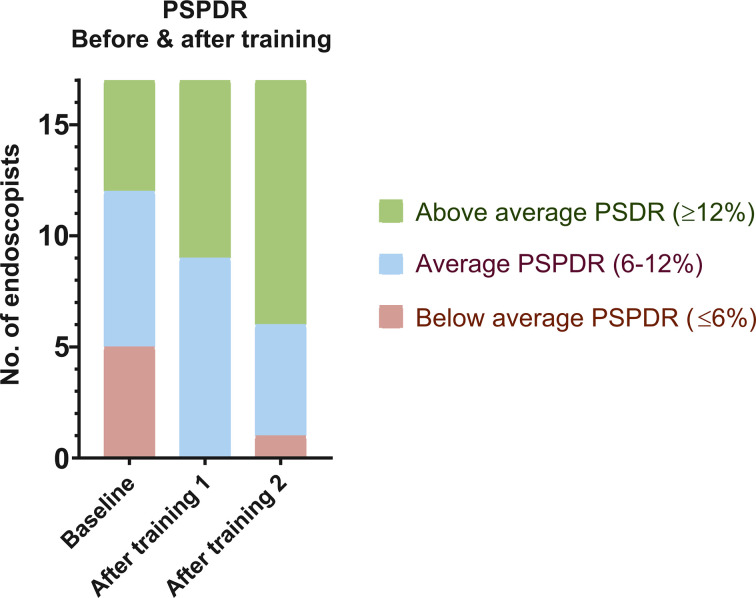
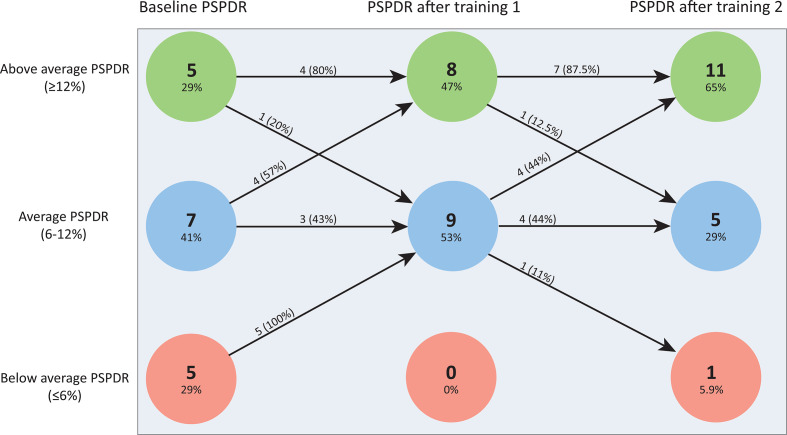
Seventeen trained and 100 untrained endoscopists were included, who performed 11 305 and 51 039 colonoscopies, respectively. At baseline, PSPDR was equal between the groups (9.3% vs 9.3%). After training, the PSPDR of trained endoscopists gradually increased to 15.6% in 2018. This was significantly higher than the PSPDR of untrained endoscopists, which remained stable around 10% (p=0.018). All below-average (ie, PSPDR ≤6%) endoscopists at baseline improved their PSPDR after training session 1, as did 57% of endoscopists with average PSPDR (6%-12%) at baseline. The second training session further improved the PSPDR in 44% of endoscopists with average PSPDR after the first training.
A simple educational intervention was associated with substantial long-term improvement of PSPDR in a prospective controlled trial within FIT-based population screening. Widespread implementation of such interventions might be an easy way to improve SP detection, which may ultimately result in fewer PCCRCs.
NCT03902899.
锯齿状息肉(SPs)是结肠镜检查后结直肠癌(PCCRCs)的一个重要原因,这可能是由于结肠镜检查中 SP 检测效果不佳所致。我们评估了一项专注于优化 SP 检测的简单教育干预的长期效果。
对来自 9 家荷兰医院的内镜医生进行了两次 45 分钟的锯齿状息肉检测培训课程(相隔 3 年进行)的教育干预。从其他医院随机选择 100 名未经培训的内镜医生作为对照组。我们的主要观察指标是参加粪便免疫化学检测(FIT)人群筛查计划的训练有素和未经训练的内镜医生的近端 SP 检测率(PSPDR)。
纳入了 17 名训练有素和 100 名未经训练的内镜医生,他们分别进行了 11305 次和 51039 次结肠镜检查。在基线时,两组的 PSPDR 相等(9.3%比 9.3%)。经过培训后,训练有素的内镜医生的 PSPDR 逐渐增加到 2018 年的 15.6%。这明显高于未经训练的内镜医生的 PSPDR,后者稳定在 10%左右(p=0.018)。所有基线时低于平均水平(即 PSPDR≤6%)的内镜医生在第一次培训后都提高了 PSPDR,基线时平均 PSPDR 为(6%-12%)的内镜医生中有 57%提高了 PSPDR。第二次培训进一步提高了第一次培训后平均 PSPDR 为 44%的内镜医生的 PSPDR。
在基于 FIT 的人群筛查中,一项简单的教育干预与前瞻性对照试验中 SPDR 的长期显著提高相关。广泛实施此类干预措施可能是提高 SP 检测的一种简单方法,这可能最终导致更少的 PCCRCs。
NCT03902899。