Department of Endocrinology and Metabolism, Peking University Third Hospital, Beijing, China.
Clinical Stem Cell Research Center, Peking University Third Hospital, Beijing, China.
BMJ Open Diabetes Res Care. 2020 Mar;8(1). doi: 10.1136/bmjdrc-2019-001025.
Glucagon receptor (GCGR) blockage improves glycemic control and increases circulating glucagon-like peptide-1 (GLP-1) level in diabetic animals and humans. The elevated GLP-1 has been reported to be involved in the hypoglycemic effect of GCGR blockage. However, the source of this elevation remains to be clarified.
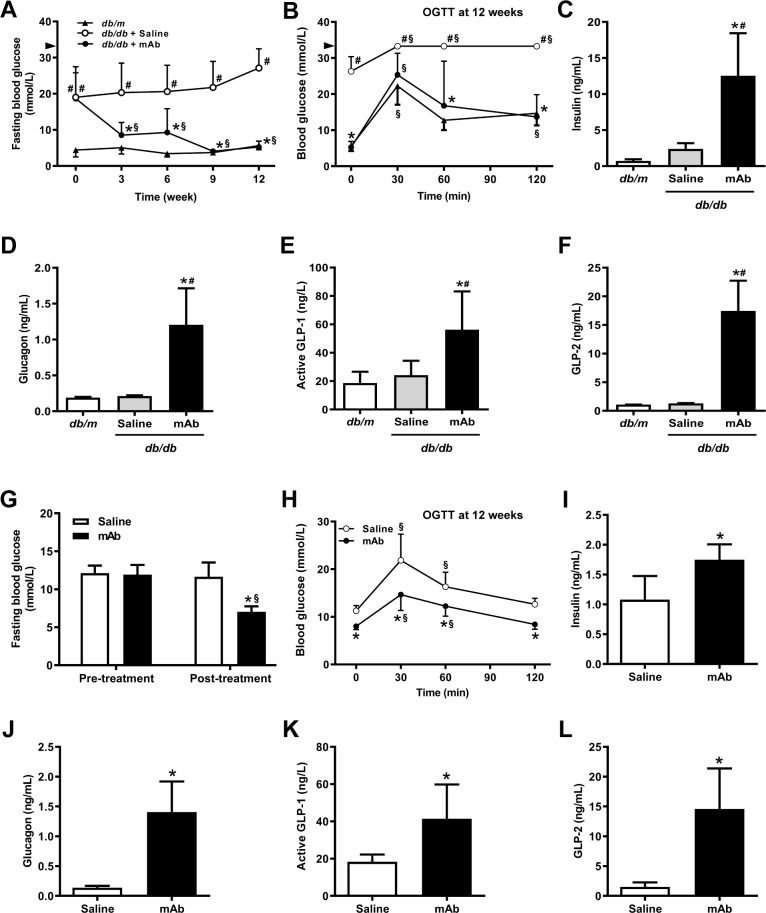
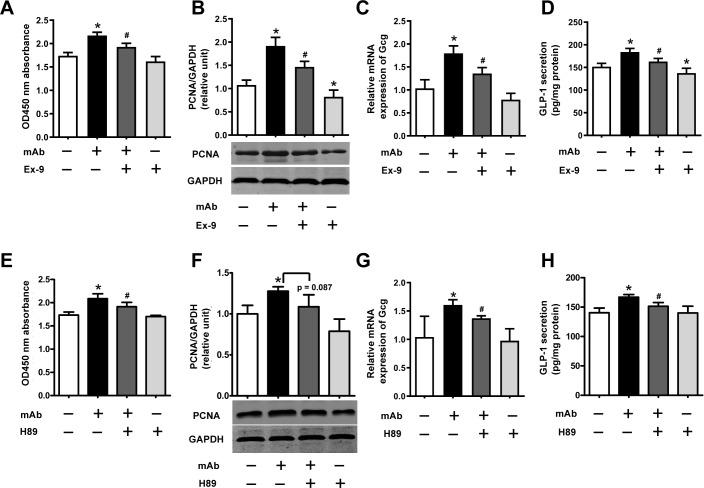
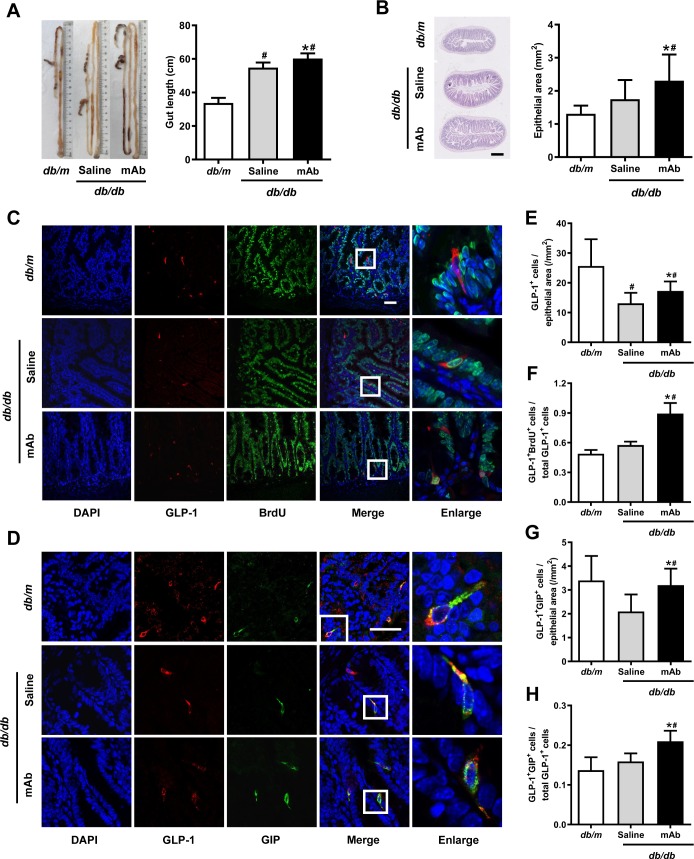
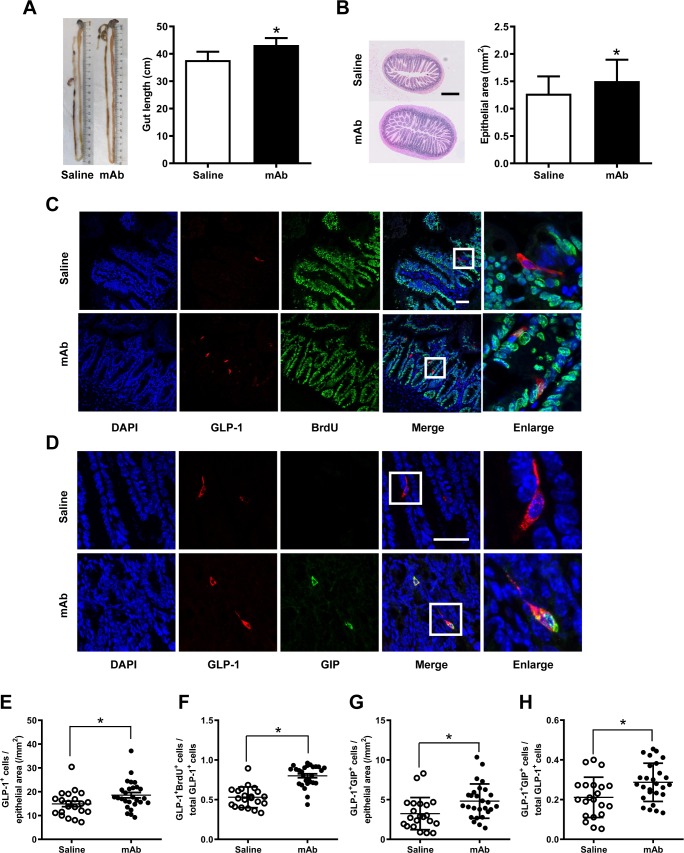
REMD 2.59, a human GCGR monoclonal antibody (mAb), was administrated for 12 weeks in mice and high-fat diet+streptozotocin (HFD/STZ)-induced type 2 diabetic (T2D) mice. Blood glucose, glucose tolerance and plasma GLP-1 were evaluated during the treatment. The gut length, epithelial area, and L-cell number and proliferation were detected after the mice were sacrificed. Cell proliferation and GLP-1 production were measured in mouse L-cell line GLUTag cells, and primary mouse and human enterocytes. Moreover, GLP-1 receptor (GLP-1R) antagonist or protein kinase A (PKA) inhibitor was used in GLUTag cells to determine the involved signaling pathways.
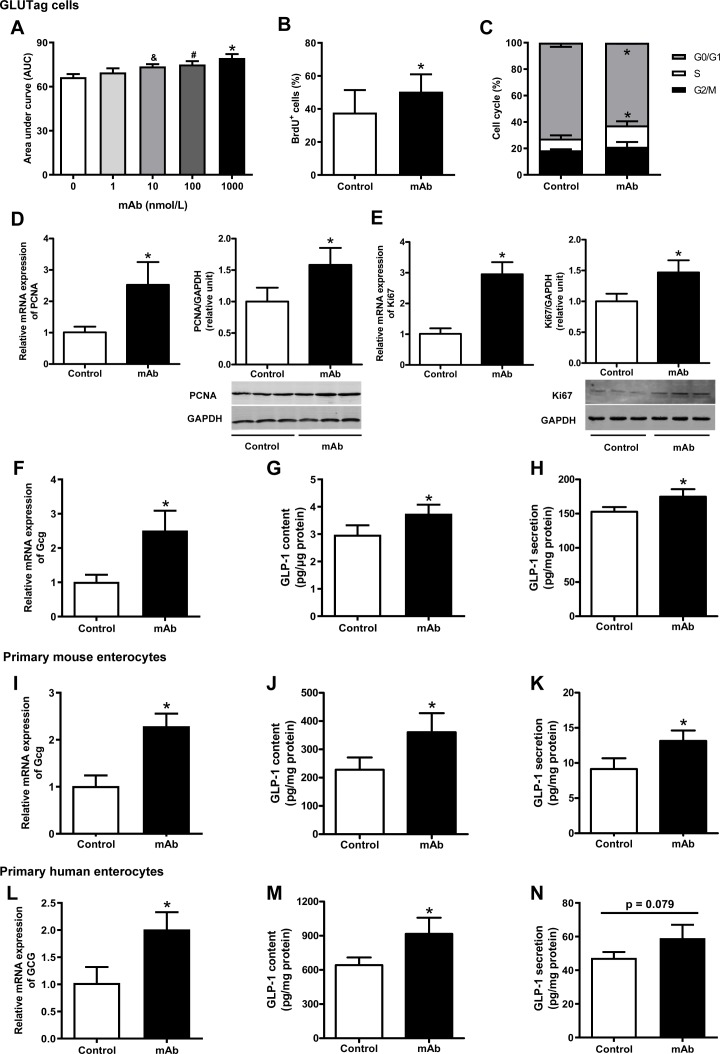
Treatment with the GCGR mAb lowered blood glucose level, improved glucose tolerance and elevated plasma GLP-1 level in both and HFD/STZ-induced T2D mice. Besides, the treatment promoted L-cell proliferation and LK-cell expansion, and increased the gut length, epithelial area and L-cell number in these two T2D mice. Similarly, our in vitro study showed that the GCGR mAb promoted L-cell proliferation and increased GLP-1 production in GLUTag cells, and primary mouse and human enterocytes. Furthermore, either GLP-1R antagonist or PKA inhibitor diminished the effects of GCGR mAb on L-cell proliferation and GLP-1 production.
The elevated circulating GLP-1 level by GCGR mAb is mainly due to intestinal L-cell proliferation and GLP-1 production, which may be mediated via GLP-1R/PKA signaling pathways. Therefore, GCGR mAb represents a promising strategy to improve glycemic control and restore the impaired GLP-1 production in T2D.
胰高血糖素受体(GCGR)阻断可改善糖尿病动物和人类的血糖控制并增加循环胰高血糖素样肽-1(GLP-1)水平。据报道,升高的 GLP-1 参与了 GCGR 阻断的降血糖作用。然而,这种升高的来源仍有待阐明。
在小鼠和高脂肪饮食+链脲佐菌素(HFD/STZ)诱导的 2 型糖尿病(T2D)小鼠中,给予人 GCGR 单克隆抗体(mAb)REMD 2.59 治疗 12 周。在治疗期间评估血糖、葡萄糖耐量和血浆 GLP-1。处死小鼠后检测肠道长度、上皮面积、L 细胞数量和增殖。在小鼠 L 细胞系 GLUTag 细胞以及原代小鼠和人肠上皮细胞中测量细胞增殖和 GLP-1 产生。此外,在 GLUTag 细胞中使用 GLP-1 受体(GLP-1R)拮抗剂或蛋白激酶 A(PKA)抑制剂来确定涉及的信号通路。
GCGR mAb 治疗可降低 和 HFD/STZ 诱导的 T2D 小鼠的血糖水平,改善葡萄糖耐量并升高血浆 GLP-1 水平。此外,该治疗促进了 L 细胞增殖和 LK 细胞扩张,并增加了这两种 T2D 小鼠的肠道长度、上皮面积和 L 细胞数量。同样,我们的体外研究表明,GCGR mAb 可促进 GLUTag 细胞、原代小鼠和人肠上皮细胞中的 L 细胞增殖和 GLP-1 产生。此外,GLP-1R 拮抗剂或 PKA 抑制剂可减弱 GCGR mAb 对 L 细胞增殖和 GLP-1 产生的作用。
GCGR mAb 引起的循环 GLP-1 水平升高主要归因于肠道 L 细胞增殖和 GLP-1 产生,这可能是通过 GLP-1R/PKA 信号通路介导的。因此,GCGR mAb 代表了一种改善血糖控制和恢复 T2D 中受损 GLP-1 产生的有前途的策略。