Department of Endocrinology and Metabolism, Peking University Third Hospital, Beijing, China.
Clinical Stem Research Cell Center, Peking University Third Hospital, Beijing, China.
Diabetologia. 2023 Mar;66(3):535-550. doi: 10.1007/s00125-022-05822-2. Epub 2022 Nov 4.
AIMS/HYPOTHESIS: Glucagon receptor (GCGR) antagonism ameliorates hyperglycaemia and promotes beta cell regeneration in mouse models of type 2 diabetes. However, the underlying mechanisms remain unclear. The present study aimed to investigate the mechanism of beta cell regeneration induced by GCGR antagonism in mice.
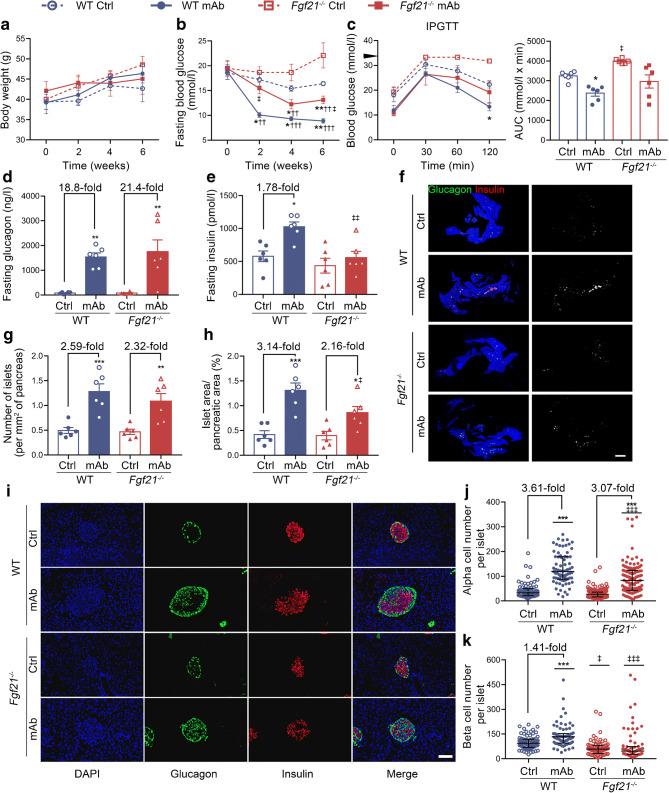
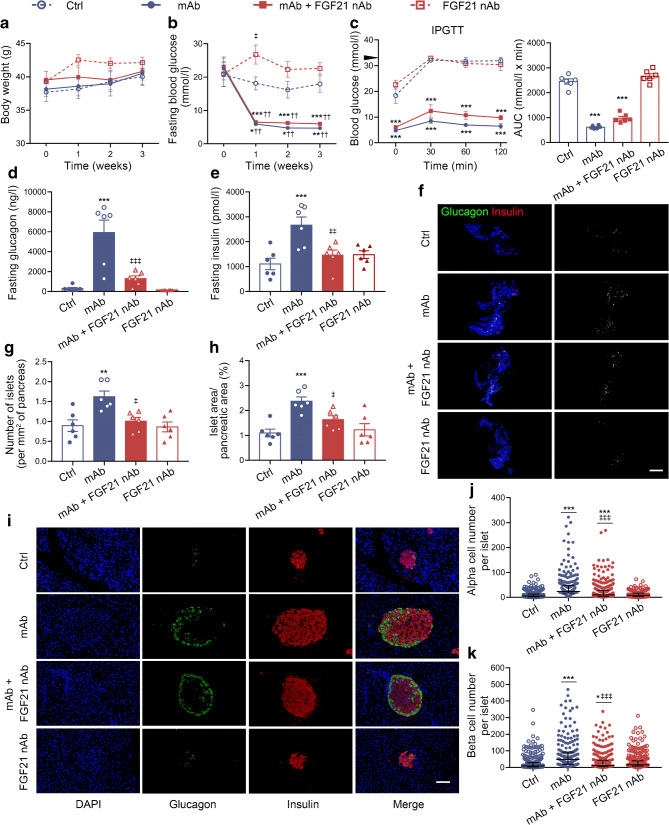
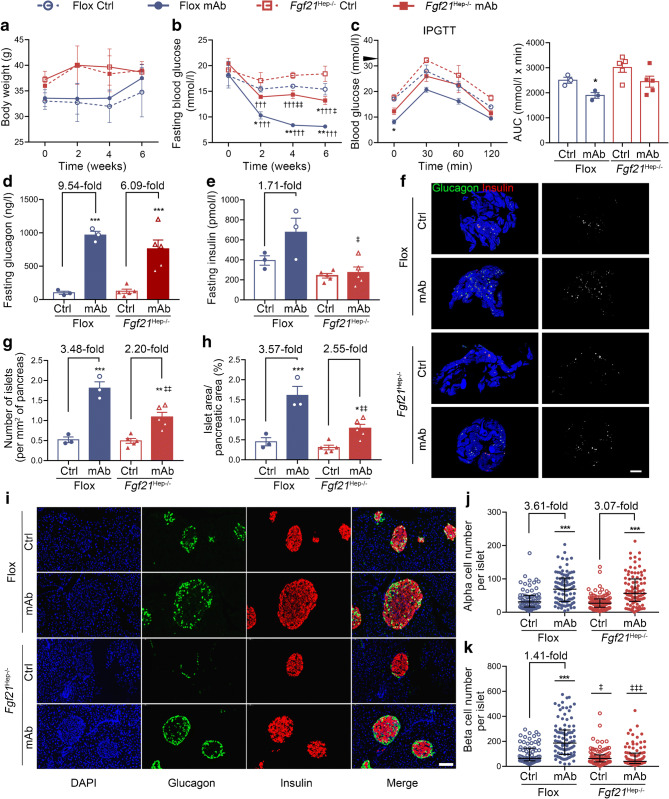
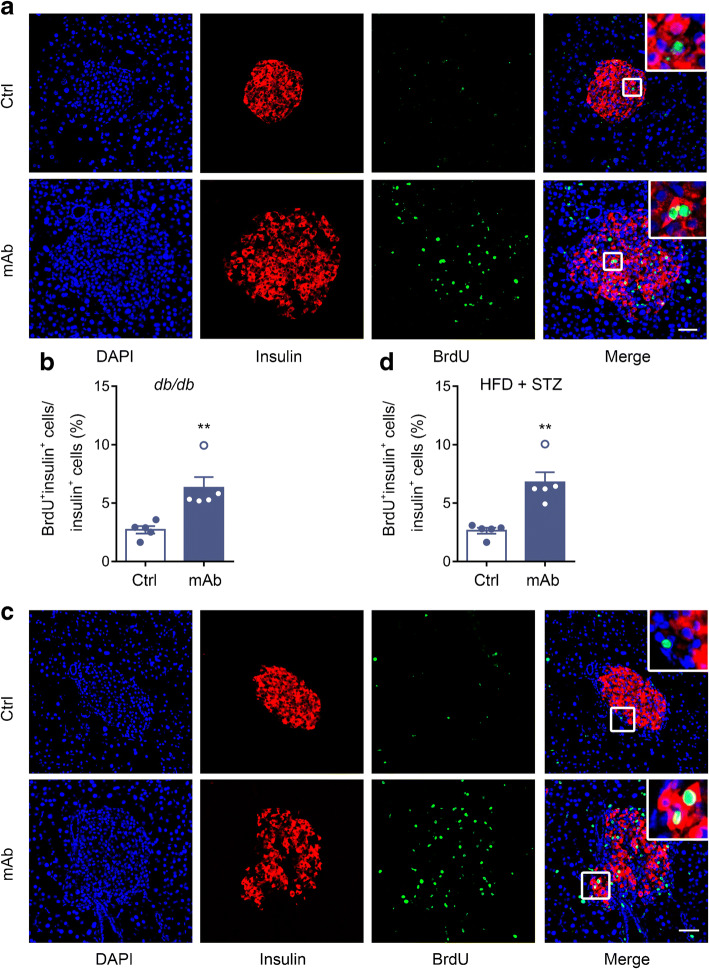
The db/db mice and high-fat diet (HFD)+streptozotocin (STZ)-induced mice with type 2 diabetes were treated with antagonistic GCGR monoclonal antibody (mAb), and the metabolic variables and islet cell quantification were evaluated. Plasma cytokine array and liver RNA sequencing data were used to screen possible mediators, including fibroblast growth factor 21 (FGF21). ELISA, quantitative RT-PCR and western blot were applied to verify FGF21 change. Blockage of FGF21 signalling by FGF21-neutralising antibody (nAb) was used to clarify whether FGF21 was involved in the effects of GCGR mAb on the expression of beta cell identity-related genes under plasma-conditional culture and hepatocyte co-culture conditions. FGF21 nAb-treated db/db mice, systemic Fgf21-knockout (Fgf21) diabetic mice and hepatocyte-specific Fgf21-knockout (Fgf21) diabetic mice were used to reveal the involvement of FGF21 in beta cell regeneration. A BrdU tracing study was used to analyse beta cell proliferation in diabetic mice treated with GCGR mAb.
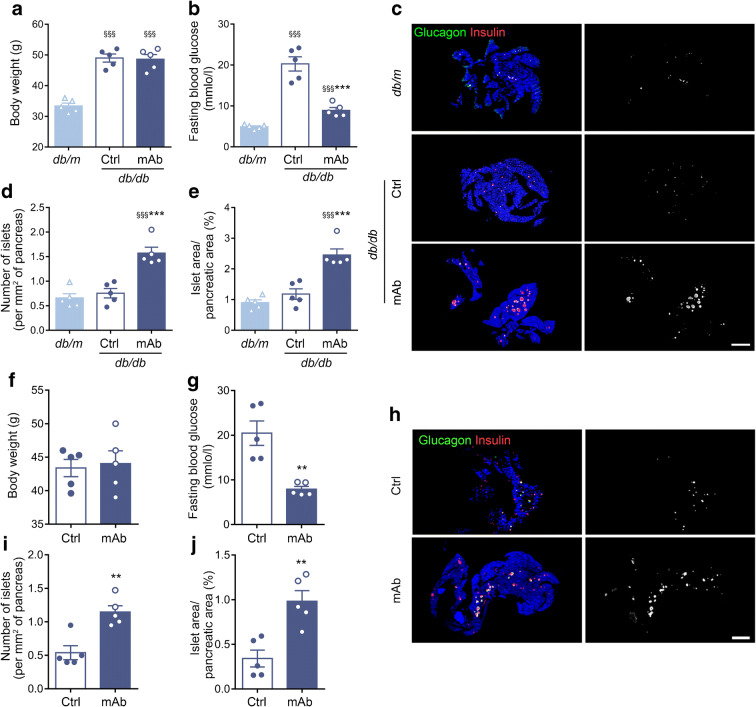
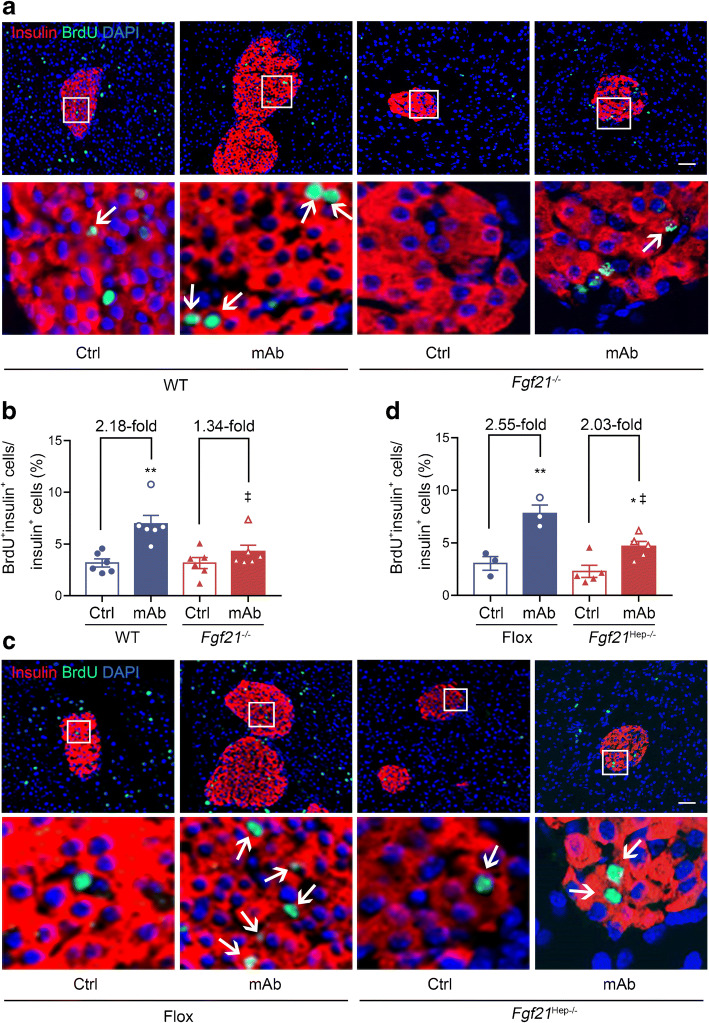
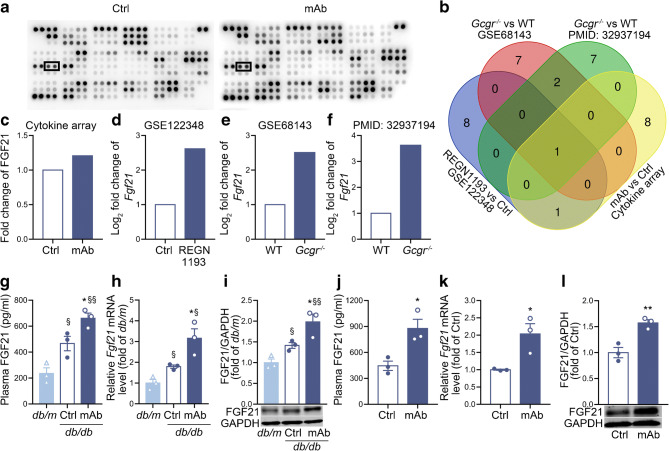
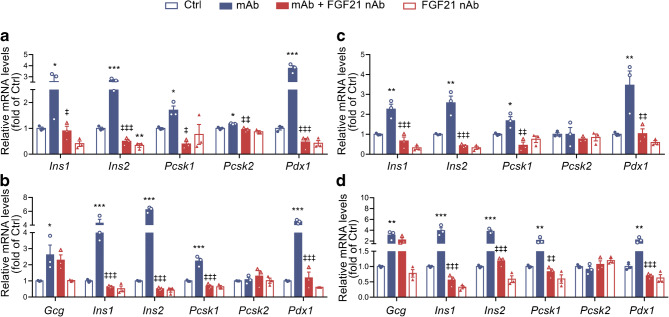
GCGR mAb treatment improved blood glucose control, and increased islet number (db/db 1.6±0.1 vs 0.8±0.1 per mm, p<0.001; HFD+STZ 1.2±0.1 vs 0.5±0.1 per mm, p<0.01) and area (db/db 2.5±0.2 vs 1.2±0.2%, p<0.001; HFD+STZ 1.0±0.1 vs 0.3±0.1%, p<0.01) in diabetic mice. The plasma cytokine array and liver RNA sequencing data showed that FGF21 levels in plasma and liver were upregulated by GCGR antagonism. The GCGR mAb induced upregulation of plasma FGF21 levels (db/db 661.5±40.0 vs 466.2±55.7 pg/ml, p<0.05; HFD+STZ 877.0±106.8 vs 445.5±54.0 pg/ml, p<0.05) and the liver levels of Fgf21 mRNA (db/db 3.2±0.5 vs 1.8±0.1, p<0.05; HFD+STZ 2.0±0.3 vs 1.0±0.2, p<0.05) and protein (db/db 2.0±0.2 vs 1.4±0.1, p<0.05; HFD+STZ 1.6±0.1 vs 1.0±0.1, p<0.01). Exposure to plasma or hepatocytes from the GCGR mAb-treated mice upregulated the mRNA levels of characteristic genes associated with beta cell identity in cultured mouse islets and a beta cell line, and blockage of FGF21 activity by an FGF21 nAb diminished this upregulation. Notably, the effects of increased beta cell number induced by GCGR mAb were attenuated in FGF21 nAb-treated db/db mice, Fgf21 diabetic mice and Fgf21 diabetic mice. Moreover, GCGR mAb treatment enhanced beta cell proliferation in the two groups of diabetic mice, and this effect was weakened in Fgf21 and Fgf21 mice.
CONCLUSIONS/INTERPRETATION: Our findings demonstrate that liver-derived FGF21 is involved in the GCGR antagonism-induced beta cell regeneration in a mouse model of type 2 diabetes.
目的/假设:胰高血糖素受体(GCGR)拮抗剂可改善 2 型糖尿病小鼠的高血糖并促进β细胞再生。然而,其潜在机制尚不清楚。本研究旨在探讨 GCGR 拮抗剂在小鼠中诱导β细胞再生的机制。
使用拮抗 GCGR 的单克隆抗体(mAb)治疗 db/db 小鼠和高脂肪饮食(HFD)+链脲佐菌素(STZ)诱导的 2 型糖尿病小鼠,并评估代谢变量和胰岛细胞定量。使用血浆细胞因子阵列和肝 RNA 测序数据筛选可能的介质,包括成纤维细胞生长因子 21(FGF21)。应用 ELISA、定量 RT-PCR 和 Western blot 验证 FGF21 的变化。使用 FGF21 中和抗体(nAb)阻断 FGF21 信号通路,以阐明 FGF21 是否参与 GCGR mAb 在血浆条件培养和肝细胞共培养条件下对β细胞特征相关基因表达的影响。使用 FGF21 nAb 处理的 db/db 小鼠、全身 Fgf21 敲除(Fgf21)糖尿病小鼠和肝细胞特异性 Fgf21 敲除(Fgf21)糖尿病小鼠,揭示 FGF21 在β细胞再生中的作用。使用 BrdU 示踪研究分析接受 GCGR mAb 治疗的糖尿病小鼠的β细胞增殖情况。
GCGR mAb 治疗改善了血糖控制,增加了胰岛数量(db/db 小鼠每 mm 为 1.6±0.1 比 0.8±0.1,p<0.001;HFD+STZ 小鼠为 1.2±0.1 比 0.5±0.1,p<0.01)和胰岛面积(db/db 小鼠为 2.5±0.2 比 1.2±0.2,p<0.001;HFD+STZ 小鼠为 1.0±0.1 比 0.3±0.1,p<0.01)。血浆细胞因子阵列和肝 RNA 测序数据显示,GCGR 拮抗作用使血浆和肝中 FGF21 水平上调。GCGR mAb 诱导血浆 FGF21 水平上调(db/db 小鼠为 661.5±40.0 比 466.2±55.7 pg/ml,p<0.05;HFD+STZ 小鼠为 877.0±106.8 比 445.5±54.0 pg/ml,p<0.05)和肝中 Fgf21 mRNA 水平(db/db 小鼠为 3.2±0.5 比 1.8±0.1,p<0.05;HFD+STZ 小鼠为 2.0±0.3 比 1.0±0.2,p<0.05)和蛋白水平(db/db 小鼠为 2.0±0.2 比 1.4±0.1,p<0.05;HFD+STZ 小鼠为 1.6±0.1 比 1.0±0.1,p<0.01)。暴露于 GCGR mAb 处理的小鼠的血浆或肝细胞可上调培养的小鼠胰岛和β细胞系中与β细胞特征相关的基因的 mRNA 水平,并且 FGF21 nAb 阻断 FGF21 活性可减弱这种上调。值得注意的是,GCGR mAb 增加的β细胞数量的作用在 FGF21 nAb 处理的 db/db 小鼠、Fgf21 糖尿病小鼠和 Fgf21 糖尿病小鼠中减弱。此外,GCGR mAb 治疗增强了两组糖尿病小鼠的β细胞增殖,而在 Fgf21 和 Fgf21 小鼠中,这种作用减弱。
我们的研究结果表明,肝源性 FGF21 参与了 2 型糖尿病小鼠中 GCGR 拮抗剂诱导的β细胞再生。