School of Tropical Medicine and Global Health, Nagasaki University, Nagasaki, Japan.
Tropical Epidemiology Group, London School of Hygiene and Tropical Medicine, London, UK.
Sci Rep. 2020 Mar 5;10(1):4100. doi: 10.1038/s41598-020-60942-2.
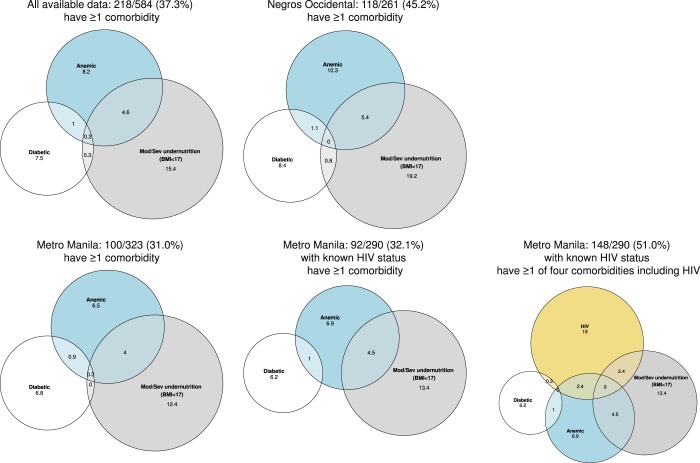
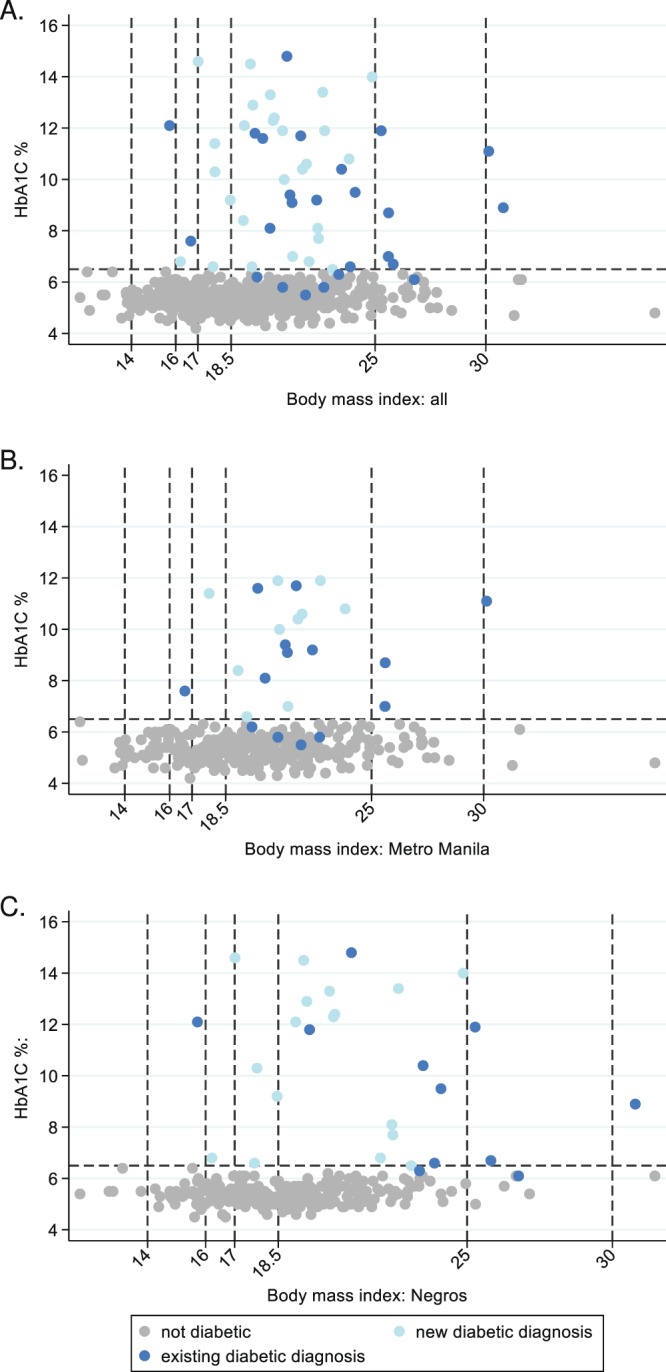
Diabetes and undernutrition are common risk factors for TB, associated with poor treatment outcomes and exacerbated by TB. We aimed to assess non-communicable multimorbidity (co-occurrence of two or more medical conditions) in Filipino TB outpatients, focusing on malnutrition and diabetes. In a cross-sectional study, 637 adults (70% male) from clinics in urban Metro Manila (N = 338) and rural Negros Occidental (N = 299) were enrolled. Diabetes was defined as HbA1c of ≥6.5% and/or current diabetes medication. Study-specific HIV screening was conducted. The prevalence of diabetes was 9.2% (54/589, 95%CI: 7.0-11.8%) with 52% newly diagnosed. Moderate/severe undernutrition (body mass index (BMI) <17 kg/) was 20.5% (130/634, 95%CI: 17.4-23.9%). Forty percent of participants had at least one co-morbidity (diabetes, moderate/severe undernutrition or moderate/severe anaemia (haemoglobin <11 g/dL)). HIV infection (24.4%, 74/303) was not associated with other co-morbidities (but high refusal in rural clinics). Central obesity assessed by waist-to-hip ratio was more strongly associated with diabetes (Adjusted Odds Ratio (AOR) = 6.16, 95%CI: 3.15-12.0) than BMI. Undernutrition was less common in men (AOR = 0.44, 95%CI: 0.28-0.70), and associated with previous history of TB (AOR = 1.97, 95%CI: 1.28-3.04) and recent reduced food intake. The prevalence of multimorbidity was high demonstrating a significant unmet need. HIV was not a risk factor for increased non-communicable multimorbidity.
糖尿病和营养不良是结核病的常见危险因素,与治疗效果不佳有关,并因结核病而加重。我们旨在评估菲律宾结核病门诊患者的非传染性多病共存(两种或多种疾病同时存在),重点关注营养不良和糖尿病。在一项横断面研究中,从马尼拉都会区的诊所(N=338)和内格罗斯西部的农村诊所(N=299)招募了 637 名成年人(70%为男性)。糖尿病的定义为 HbA1c≥6.5%和/或正在服用糖尿病药物。进行了特定于研究的 HIV 筛查。糖尿病的患病率为 9.2%(54/589,95%CI:7.0-11.8%),其中 52%为新诊断病例。中重度营养不良(BMI<17kg/)为 20.5%(130/634,95%CI:17.4-23.9%)。40%的参与者至少有一种合并症(糖尿病、中重度营养不良或中度/重度贫血(血红蛋白<11g/dL))。HIV 感染(24.4%,74/303)与其他合并症无关(但农村诊所的拒绝率较高)。通过腰臀比评估的中心性肥胖与糖尿病的相关性更强(调整后的优势比(AOR)=6.16,95%CI:3.15-12.0),而 BMI 的相关性较弱。男性营养不良的发生率较低(AOR=0.44,95%CI:0.28-0.70),与结核病既往史(AOR=1.97,95%CI:1.28-3.04)和近期食物摄入量减少有关。多病共存的患病率很高,表明存在大量未满足的需求。HIV 不是增加非传染性多病共存的危险因素。