Kim Ji Hyun, Nam Seung-Joo, Park Sung Chul, Lee Sang Hoon, Kim Tae Suk, Lee Minjong, Park Jin Myung, Choi Dae Hee, Kang Chang Don, Lee Sung Joon, Ryu Young Joon, Lee Kyungyul, Park So Young
Department of Internal Medicine, Kangwon National University School of Medicine, Chuncheon 24289, Korea.
Department of Pathology, Kangwon National University School of Medicine, Chuncheon 24289, Korea.
Korean J Physiol Pharmacol. 2020 Mar;24(2):185-191. doi: 10.4196/kjpp.2020.24.2.185. Epub 2020 Feb 20.
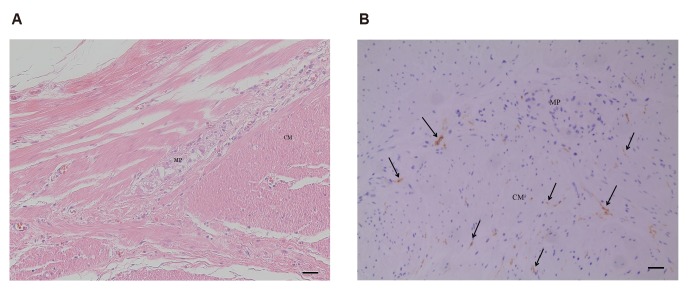
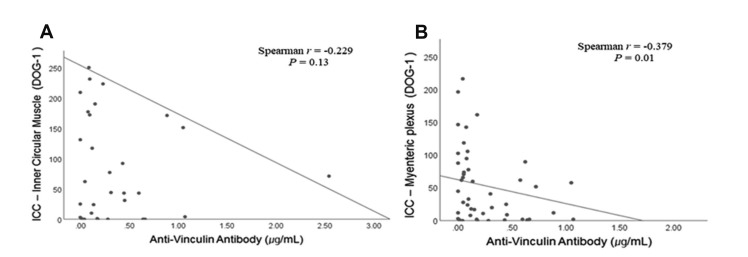
Interstitial cells of Cajal (ICC) are known as the pacemaker cells of gastrointestinal tract, and it has been reported that acute gastroenteritis induces intestinal dysmotility through antibody to vinculin, a cytoskeletal protein in gut, resulting in small intestinal bacterial overgrowth, so that anti-vinculin antibody can be used as a biomarker for irritable bowel syndrome. This study aimed to determine correlation between serum anti-vinculin antibody and ICC density in human stomach. Gastric specimens from 45 patients with gastric cancer who received gastric surgery at Kangwon National University Hospital from 2013 to 2017 were used. ICC in inner circular muscle, and myenteric plexus were counted. Corresponding patient's blood samples were used to determine the amount of anti-vinculin antibody by enzyme-linked immunosorbent assay. Analysis was done to determine correlation between anti-vinculin antibody and ICC numbers. Patients with elevated anti-vinculin antibody titer (above median value) had significantly lower number of ICC in inner circular muscle (71.0 240.5, p = 0.047), and myenteric plexus (12.0 68.5, p < 0.01) compared to patients with lower anti-vinculin antibody titer. Level of serum anti-vinculin antibody correlated significantly with density of ICC in myenteric plexus (r = -0.379, p = 0.01; Spearman correlation). Increased level of circulating anti-vinculin antibody was significantly correlated with decreased density of ICC in myenteric plexus of human stomach.
Cajal间质细胞(ICC)被认为是胃肠道的起搏细胞,据报道,急性肠胃炎通过针对肠道细胞骨架蛋白纽蛋白的抗体诱导肠道运动障碍,导致小肠细菌过度生长,因此抗纽蛋白抗体可作为肠易激综合征的生物标志物。本研究旨在确定人胃中血清抗纽蛋白抗体与ICC密度之间的相关性。使用了2013年至2017年在江原国立大学医院接受胃手术的45例胃癌患者的胃标本。对内环肌和肌间神经丛中的ICC进行计数。使用相应患者的血液样本通过酶联免疫吸附测定法测定抗纽蛋白抗体的量。进行分析以确定抗纽蛋白抗体与ICC数量之间的相关性。与抗纽蛋白抗体滴度较低的患者相比,抗纽蛋白抗体滴度升高(高于中位数)的患者内环肌中的ICC数量明显减少(71.0±240.5,p = 0.047),肌间神经丛中的ICC数量也明显减少(12.0±68.5,p <0.01)。血清抗纽蛋白抗体水平与肌间神经丛中ICC的密度显著相关(r = -0.379,p = 0.01;Spearman相关性)。循环抗纽蛋白抗体水平升高与人类胃肌间神经丛中ICC密度降低显著相关。