Centre de Recherche des Cordeliers, INSERM, Sorbonne Université, USPC, Université Paris Descartes, Université Paris Diderot, Paris, France.
Institute for Diabetes, Obesity and Metabolism, University of Pennsylvania, Philadelphia, PA, United States.
Front Endocrinol (Lausanne). 2020 Feb 19;11:62. doi: 10.3389/fendo.2020.00062. eCollection 2020.
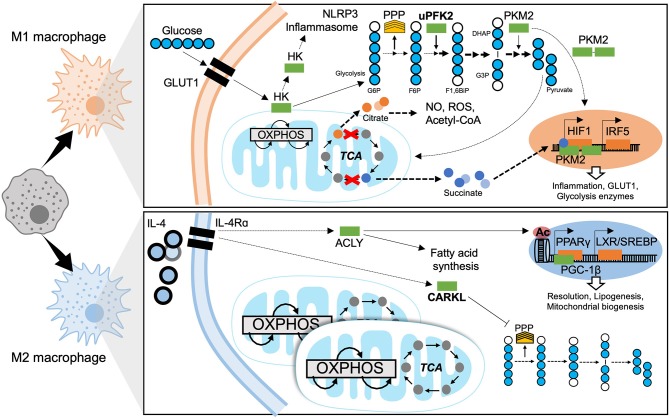
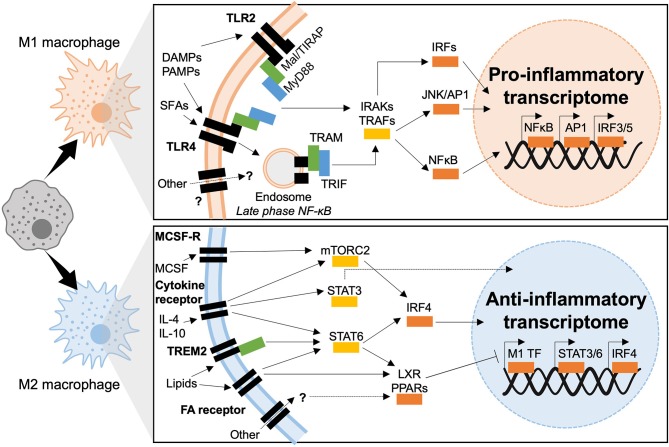
Type-2 diabetes (T2D) is a disease of two etiologies: metabolic and inflammatory. At the cross-section of these etiologies lays the phenomenon of metabolic inflammation. Whilst metabolic inflammation is characterized as systemic, a common starting point is the tissue-resident macrophage, who's successful physiological or aberrant pathological adaptation to its microenvironment determines disease course and severity. This review will highlight the key mechanisms in macrophage polarization, inflammatory and non-inflammatory signaling that dictates the development and progression of insulin resistance and T2D. We first describe the known homeostatic functions of tissue macrophages in insulin secreting and major insulin sensitive tissues. Importantly we highlight the known mechanisms of aberrant macrophage activation in these tissues and the ways in which this leads to impairment of insulin sensitivity/secretion and the development of T2D. We next describe the cellular mechanisms that are known to dictate macrophage polarization. We review recent progress in macrophage bio-energetics, an emerging field of research that places cellular metabolism at the center of immune-effector function. Importantly, following the advent of the metabolically-activated macrophage, we cover the known transcriptional and epigenetic factors that canonically and non-canonically dictate macrophage differentiation and inflammatory polarization. In closing perspectives, we discuss emerging research themes and highlight novel non-inflammatory or non-immune roles that tissue macrophages have in maintaining microenvironmental and systemic homeostasis.
2 型糖尿病(T2D)是由代谢和炎症两种病因引起的疾病。在这些病因的交叉点存在代谢炎症现象。虽然代谢炎症具有系统性特征,但一个常见的起点是组织驻留巨噬细胞,其对微环境的成功生理或异常病理适应决定了疾病的进程和严重程度。本综述将重点介绍决定胰岛素抵抗和 T2D 发生和发展的巨噬细胞极化、炎症和非炎症信号的关键机制。我们首先描述了组织巨噬细胞在胰岛素分泌和主要胰岛素敏感组织中的已知稳态功能。重要的是,我们强调了这些组织中异常巨噬细胞激活的已知机制,以及这如何导致胰岛素敏感性/分泌受损和 T2D 的发展。接下来,我们描述了已知决定巨噬细胞极化的细胞机制。我们回顾了巨噬细胞生物能量学的最新进展,这是一个新兴的研究领域,将细胞代谢置于免疫效应功能的中心。重要的是,在代谢激活的巨噬细胞出现之后,我们介绍了经典和非经典地决定巨噬细胞分化和炎症极化的已知转录和表观遗传因素。在展望部分,我们讨论了新兴的研究主题,并强调了组织巨噬细胞在维持微环境和全身稳态方面的新的非炎症或非免疫作用。