Wu Xingbo, Alexander Lisa W
Oak Ridge Institute of Science and Technology, Otis L. Floyd Nursery Research Center, 472 Cadillac Lane, McMinnville, TN USA.
U.S. Department of Agriculture, Agricultural Research Service, U.S. National Arboretum, Floral and Nursery Plants Research Unit, Otis L. Floyd Nursery Research Center, 472 Cadillac Lane, McMinnville, TN USA.
Hortic Res. 2020 Mar 1;7:27. doi: 10.1038/s41438-020-0255-y. eCollection 2020.
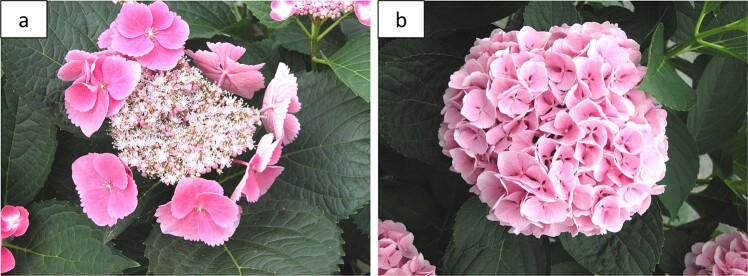
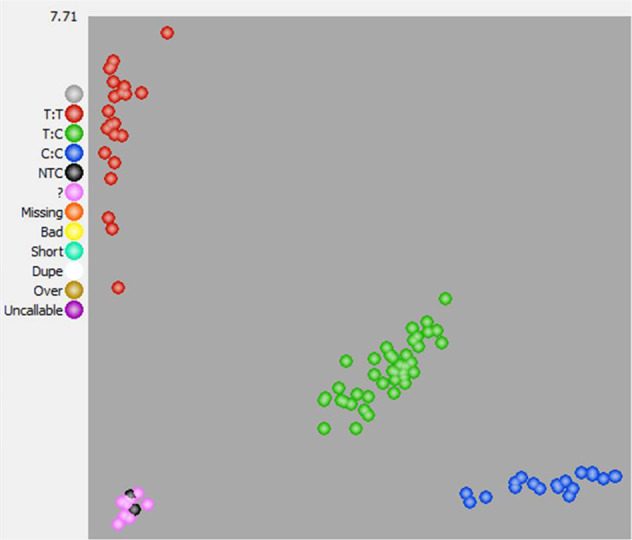
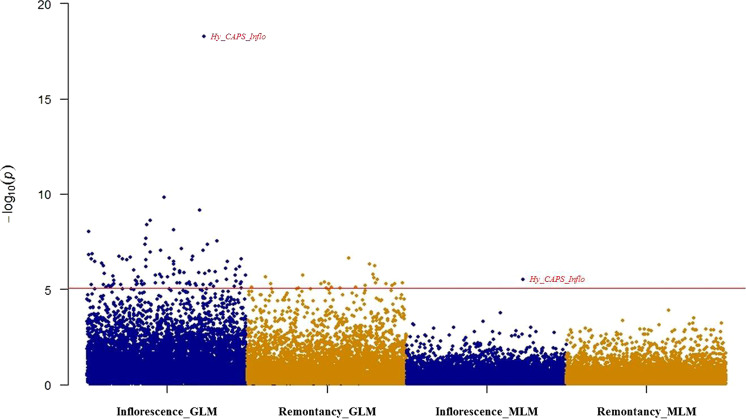
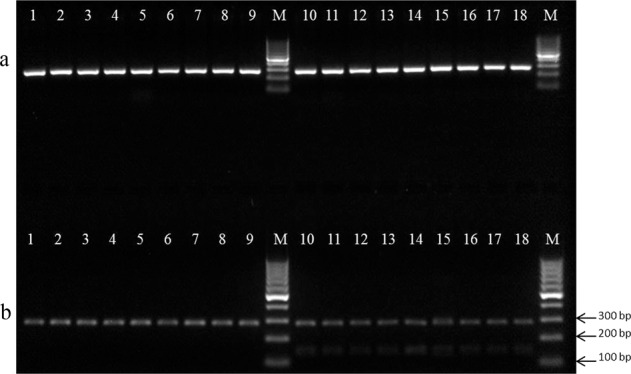
Inflorescence type and remontancy are two valuable traits in bigleaf hydrangea ( L.) and both are recessively inherited. Molecular marker-assisted selection (MAS) can greatly reduce the time necessary to breed cultivars with desired traits. In this study, a genome-wide association study (GWAS) using 5803 single-nucleotide polymorphisms (SNPs) was performed using a panel of 82 bigleaf hydrangea cultivars. One SNP locus () associated with inflorescence type was identified with general linear model (GLM) and mixed linear model (MLM) methods that explained 65.5% and 36.1% of the phenotypic variations, respectively. Twenty-three SNPs associated with remontancy were detected in GLM whereas no SNP was detected in MLM. The SNP locus () was converted to a cleaved amplified polymorphic sequence (CAPS) marker that showed absolute identification accuracy (100%) of inflorescence type in a validation panel consisting of eighteen cultivars. The SNP was investigated in 341 F progenies using genotyping by sequencing (GBS) and co-segregated with inflorescence type ( = 0.12; = 0.73). The SNP was subsequently used for breeding selection using kompetitive allele specific PCR (KASP) technology. Future directions for the use of genomics and MAS in hydrangea breeding improvement are discussed. The results presented in this study provide insights for further research on understanding genetic mechanisms behind inflorescence type and remontancy in . The CAPS and KASP markers developed here will be immediately useful for applying MAS to accelerate breeding improvement in hydrangea.
花序类型和连续开花性是大花绣球(Hydrangea macrophylla (Thunb.) Ser.)的两个重要性状,且均为隐性遗传。分子标记辅助选择(MAS)可大幅缩短培育具有理想性状品种所需的时间。在本研究中,利用82个大花绣球品种组成的群体,基于5803个单核苷酸多态性(SNP)进行了全基因组关联研究(GWAS)。通过一般线性模型(GLM)和混合线性模型(MLM)方法鉴定出一个与花序类型相关的SNP位点(),分别解释了65.5%和36.1%的表型变异。在GLM中检测到23个与连续开花性相关的SNP,而在MLM中未检测到SNP。该SNP位点()被转化为酶切扩增多态性序列(CAPS)标记,在由18个品种组成的验证群体中对花序类型的鉴定准确率达100%。通过简化基因组测序(GBS)在341个F子代中对该SNP进行研究,发现其与花序类型共分离(P = 0.12;LOD = 0.73)。随后利用竞争性等位基因特异性PCR(KASP)技术将该SNP用于育种选择。文中讨论了绣球属植物育种改良中基因组学和MAS的未来应用方向。本研究结果为进一步了解大花绣球花序类型和连续开花性背后的遗传机制提供了思路。本文开发的CAPS和KASP标记将立即用于应用MAS加速绣球属植物的育种改良。