Institute for Diabetes and Obesity, Helmholtz Diabetes Center at Helmholtz Zentrum München, Ingolstädter Landstraße 1, 85764, Neuherberg, Germany.
German Center for Diabetes Research (DZD), München-Neuherberg, Germany.
Diabetologia. 2020 Jun;63(6):1236-1247. doi: 10.1007/s00125-020-05117-4. Epub 2020 Mar 6.
AIMS/HYPOTHESIS: Treatment with the α3β4 nicotinic acetylcholine receptor (nAChR) agonist, 1,1-dimethyl-4-phenylpiperazinium iodide (DMPP), improves glucose tolerance in diet-induced obese (DIO) mice, but the physiological and molecular mechanisms are unknown.
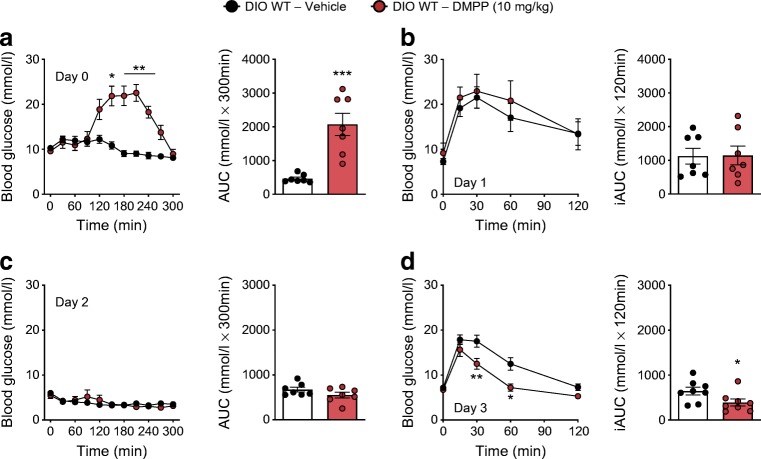
DMPP (10 mg/kg body weight, s.c.) was administered either in a single injection (acute) or daily for up to 14 days (chronic) in DIO wild-type (WT) and Chrnb4 knockout (KO) mice and glucose tolerance, tissue-specific tracer-based glucose metabolism, and insulin signalling were assessed.
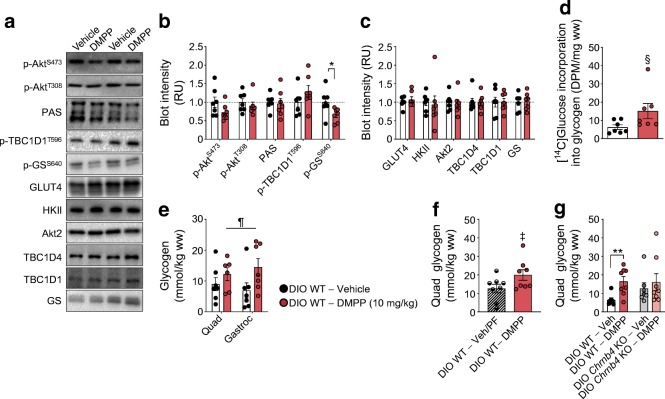
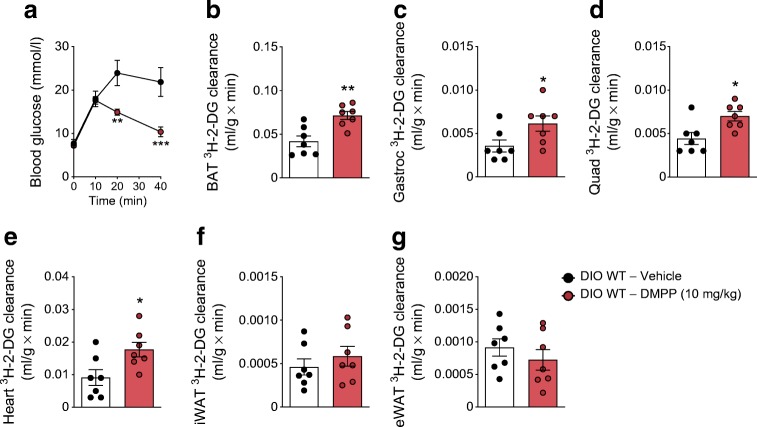
In WT mice, but not in Chrnb4 KO mice, single acute treatment with DMPP induced transient hyperglycaemia, which was accompanied by high plasma adrenaline (epinephrine) levels, upregulated hepatic gluconeogenic genes, and decreased hepatic glycogen content. In contrast to these acute effects, chronic DMPP treatment in WT mice elicited improvements in glucose tolerance already evident after three consecutive days of DMPP treatment. After seven days of DMPP treatment, glucose tolerance was markedly improved, also in comparison with mice that were pair-fed to DMPP-treated mice. The glycaemic benefit of chronic DMPP was absent in Chrnb4 KO mice. Chronic DMPP increased insulin-stimulated glucose clearance into brown adipose tissue (+69%), heart (+93%), gastrocnemius muscle (+74%) and quadriceps muscle (+59%), with no effect in white adipose tissues. After chronic DMPP treatment, plasma adrenaline levels did not increase following an injection with DMPP. In glucose-stimulated skeletal muscle, we detected a decreased phosphorylation of the inhibitory Ser640 phosphorylation site on glycogen synthase and a congruent increase in glycogen accumulation following chronic DMPP treatment.
CONCLUSIONS/INTERPRETATION: Our data suggest that DMPP acutely induces adrenaline release and hepatic glycogenolysis, while chronic DMPP-mediated activation of β4-containing nAChRs improves peripheral insulin sensitivity independently of changes in body weight via mechanisms that could involve increased non-oxidative glucose disposal into skeletal muscle.
目的/假设:α3β4 烟碱型乙酰胆碱受体(nAChR)激动剂 1,1-二甲基-4-苯基哌啶鎓碘化物(DMPP)可改善饮食诱导肥胖(DIO)小鼠的葡萄糖耐量,但生理和分子机制尚不清楚。
在 DIO 野生型(WT)和 ChRnb4 敲除(KO)小鼠中,DMPP(10mg/kg 体重,皮下注射)单次注射(急性)或连续 14 天注射(慢性),评估葡萄糖耐量、组织特异性示踪剂葡萄糖代谢和胰岛素信号。
在 WT 小鼠中,但在 ChRnb4 KO 小鼠中,单次急性 DMPP 处理诱导短暂高血糖,伴有高血浆肾上腺素(去甲肾上腺素)水平,肝糖异生基因上调,肝糖原含量减少。与这些急性作用相反,WT 小鼠连续慢性 DMPP 处理在连续 DMPP 处理 3 天后即引起葡萄糖耐量改善。连续 DMPP 处理 7 天后,葡萄糖耐量明显改善,与 DMPP 处理小鼠的配对喂养小鼠相比也是如此。ChRnb4 KO 小鼠中缺乏慢性 DMPP 的降糖作用。慢性 DMPP 增加了棕色脂肪组织(+69%)、心脏(+93%)、比目鱼肌(+74%)和股四头肌(+59%)的胰岛素刺激葡萄糖清除,而对白色脂肪组织无影响。慢性 DMPP 处理后,DMPP 注射后血浆肾上腺素水平没有升高。在葡萄糖刺激的骨骼肌中,我们发现慢性 DMPP 处理后糖原合酶的抑制性 Ser640 磷酸化位点磷酸化减少,糖原积累增加。
结论/解释:我们的数据表明,DMPP 急性诱导肾上腺素释放和肝糖原分解,而慢性 DMPP 介导的β4 包含 nAChR 激活通过可能涉及增加骨骼肌非氧化葡萄糖处置的机制,独立于体重变化改善外周胰岛素敏感性。