Department of Internal Medicine and Clinical Nutrition, Centre for Bone and Arthritis Research, Institute of Medicine, Sahlgrenska Academy, University of Gothenburg, 413 45, Gothenburg, Sweden.
Klin Farm Lab, Department of Internal Medicine and Clinical Nutrition, Centre for Bone and Arthritis Research, Sahlgrenska University Hospital, Vita Stråket 11, 41345, Gothenburg, Sweden.
Calcif Tissue Int. 2020 Jul;107(1):31-40. doi: 10.1007/s00223-020-00682-7. Epub 2020 Mar 5.
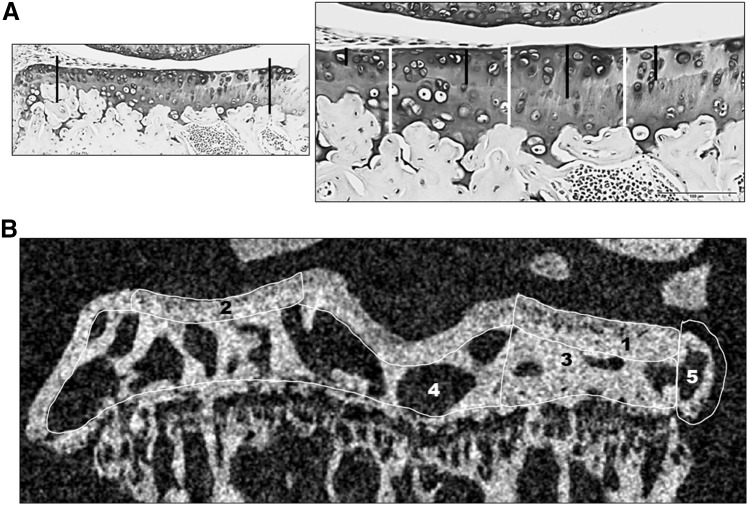
Epidemiological studies have shown that high bone mineral density (BMD) is associated with an increased risk of osteoarthritis (OA), but the causality of this relationship remains unclear. Both bone mass and OA have been associated with the WNT signaling pathway in genetic studies, there is thus an interest in studying molecular partners of the WNT signaling pathway and OA. Female mice overexpressing WNT16 in osteoblasts (Obl-Wnt16 mice) have an increased bone mass. We aimed to evaluate if the high bone mass in Obl-Wnt16 mice leads to a more severe experimental OA development than in WT control mice. We induced experimental OA in female Obl-Wnt16 and WT control mice by destabilizing the medial meniscus (DMM). The Obl-Wnt16 mice displayed thicker medial and lateral subchondral bone plates as well as increased subchondral trabecular bone volume/tissue volume (BV/TV) but un-altered thickness of articular cartilage compared to WT mice. After DMM surgery, there was no difference in OA severity in the articular cartilage in the knee joint between the Obl-Wnt16 and WT mice. Both the Obl-Wnt16 and WT mice developed osteophytes in the DMM-operated tibia to a similar extent. We conclude that although the Obl-Wnt16 female mice have a high subchondral bone mass due to increased WNT signaling, they do not exhibit a more severe OA phenotype than their WT controls. This demonstrates that high bone mass does not result in an increased risk of OA per se.
流行病学研究表明,高骨密度(BMD)与骨关节炎(OA)风险增加有关,但这种关系的因果关系尚不清楚。在遗传研究中,骨量和 OA 都与 WNT 信号通路有关,因此人们有兴趣研究 WNT 信号通路和 OA 的分子伴侣。成骨细胞中过表达 WNT16 的雌性小鼠(Obl-Wnt16 小鼠)骨量增加。我们旨在评估 Obl-Wnt16 小鼠的高骨量是否会导致比 WT 对照小鼠更严重的实验性 OA 发展。我们通过破坏内侧半月板(DMM)在雌性 Obl-Wnt16 和 WT 对照小鼠中诱导实验性 OA。与 WT 小鼠相比,Obl-Wnt16 小鼠的内侧和外侧软骨下骨板更厚,软骨下骨小梁体积/组织体积(BV/TV)增加,但关节软骨的厚度没有改变。DMM 手术后,Obl-Wnt16 和 WT 小鼠膝关节关节软骨的 OA 严重程度没有差异。Obl-Wnt16 和 WT 小鼠在 DMM 操作的胫骨中都形成了类似程度的骨赘。我们的结论是,尽管 Obl-Wnt16 雌性小鼠由于 WNT 信号增加而具有高软骨下骨量,但它们并没有表现出比 WT 对照更严重的 OA 表型。这表明高骨量本身并不会增加 OA 的风险。