Department of Hematology, West German Cancer Center, University Hospital Essen, University of Duisburg-Essen, Hufelandstraße 55, 45147, Essen, Germany.
Institute for Medical Informatics, Biometry and Epidemiology, University Hospital Essen, University of Duisburg-Essen, Essen, Germany.
Int J Clin Oncol. 2020 Jun;25(6):1187-1194. doi: 10.1007/s10147-020-01639-4. Epub 2020 Mar 5.
Treatment of hematological malignancies carries the risk of lasting sterility. We aimed to identify fertility-related unmet needs.
The 'Aftercare in Blood Cancer Survivors' study is a cohort study of hematological patients who were in treatment-free remission for ≥ 3 years or stable under continuous oral medication. Female patients age 18-45 years and male patients age 18-65 years without a history of pre-treatment infertility were asked to answer a structured questionnaire including questions addressing fertility issues. Multivariable analyses were performed to detect risk factors.
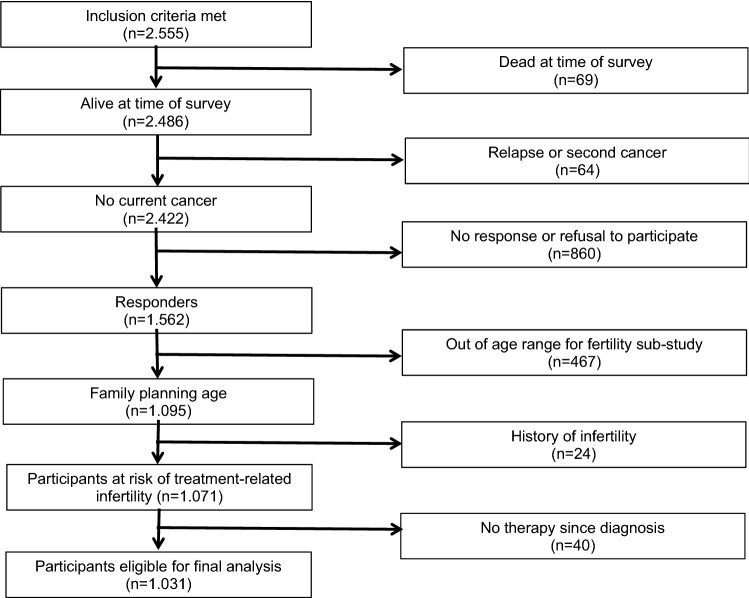
Of 1562 study participants, 1031 met the inclusion criteria for the fertility sub-study. A high proportion of patients (72.4%) received information about the risk of losing fertility, but only a minority (15%) took steps to preserve it. Female and older patients were less likely to be informed. A post-treatment wish for parenthood was expressed by 19.3% of patients. It was strongly associated with childlessness at time of diagnosis and could be fulfilled by 29.4%. Fulfillment of desired parenthood increased with increasing time from diagnosis and was low after allogeneic transplantation.
Female and older hematological patients are less likely to be informed about fertility-related issues than other patients. With societal changes towards first parenthood at higher age, the proportion of patients desiring a child after treatment is likely to increase. Fulfillment of desired parenthood remains challenging, especially after allogeneic transplantation.
In patients likely to express a wish for post-treatment parenthood, fertility-related issues should routinely be addressed before gonadotoxic treatment is started.
治疗血液系统恶性肿瘤存在导致永久性不育的风险。本研究旨在明确与生育相关的未满足需求。
“血液系统恶性肿瘤幸存者随访”是一项队列研究,纳入的研究对象为已无治疗且缓解时间≥3 年或持续口服药物治疗病情稳定的血液系统恶性肿瘤患者。年龄 18-45 岁的女性患者和年龄 18-65 岁的男性患者且无治疗前不孕病史的患者需要回答一个包括生育问题的结构化问卷。采用多变量分析检测风险因素。
在 1562 名研究参与者中,有 1031 名符合生育亚研究的纳入标准。很大一部分患者(72.4%)获得了关于丧失生育力风险的信息,但只有少数(15%)采取了措施来保护生育力。女性和老年患者获得信息的可能性较小。19.3%的患者表示在治疗后希望生育。该需求与诊断时的无子状态密切相关,其中 29.4%的患者可以实现该需求。随着诊断后时间的延长,期望生育的比例增加,且在异基因移植后较低。
与其他患者相比,女性和老年血液系统恶性肿瘤患者获得生育相关问题信息的可能性较小。随着社会向更高龄初育的转变,治疗后有生育需求的患者比例可能会增加。实现期望的生育仍然具有挑战性,特别是在异基因移植后。
对于那些可能在治疗后表达生育意愿的患者,在开始性腺毒性治疗之前,应常规解决与生育相关的问题。