Graduate Institute of Medical Sciences, College of Medicine, Taipei Medical University, 110 Taipei, Taiwan.
Cell Physiology and Molecular Image Research Center, Wan Fang Hospital, Taipei Medical University, 110 Taipei, Taiwan.
Cells. 2020 Mar 4;9(3):623. doi: 10.3390/cells9030623.
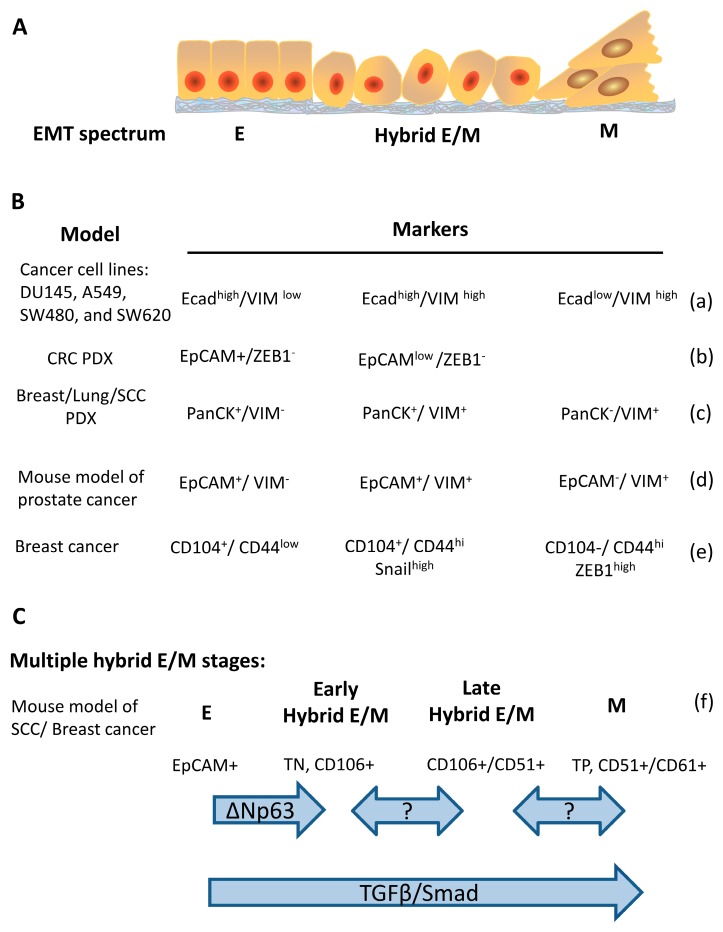
Epithelial-mesenchymal transition (EMT) has been well recognized for its essential role in cancer progression as well as normal tissue development. In cancer cells, activation of EMT permits the cells to acquire migratory and invasive abilities and stem-like properties. However, simple categorization of cancer cells into epithelial and mesenchymal phenotypes misleads the understanding of the complicated metastatic process, and contradictory results from different studies also indicate the limitation of application of EMT theory in cancer metastasis. Nowadays, growing evidence suggests the existence of an intermediate status between epithelial and mesenchymal phenotypes, i.e., the "hybrid epithelial-mesenchymal (hybrid E/M)" state, provides a possible explanation for those conflicting results. Appearance of hybrid E/M phenotype offers a more plastic status for cancer cells to adapt the stressful environment for proceeding metastasis. In this article, we review the biological importance of the dynamic changes between the epithelial and the mesenchymal states. The regulatory mechanisms encompassing the translational, post-translational, and epigenetic control for this complex and plastic status are also discussed.
上皮-间充质转化(EMT)在癌症进展以及正常组织发育中具有重要作用,这一点已得到广泛认可。在癌细胞中,EMT 的激活使细胞获得迁移和侵袭能力以及干细胞样特性。然而,将癌细胞简单地归类为上皮和间充质表型会误导对复杂转移过程的理解,而且来自不同研究的矛盾结果也表明 EMT 理论在癌症转移中的应用存在局限性。如今,越来越多的证据表明,上皮和间充质表型之间存在中间状态,即“混合上皮-间充质(混合 E/M)”状态,为这些相互矛盾的结果提供了可能的解释。混合 E/M 表型的出现为癌细胞提供了一种更具可塑性的状态,使其能够适应压力环境以进行转移。本文综述了上皮和间充质状态之间动态变化的生物学重要性。还讨论了涵盖翻译、翻译后和表观遗传控制的调节机制,这些机制对于这种复杂和可塑的状态非常重要。